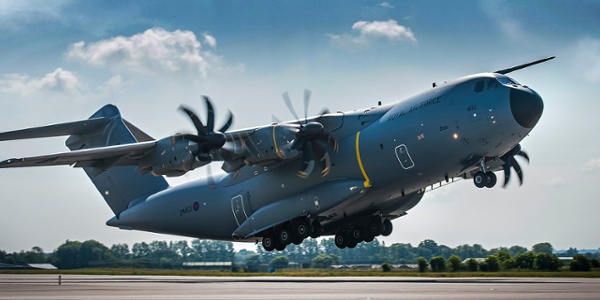
The UK Ministry of Defence (MoD) has extended its maintenance, repair, and support contract with Airbus Defence and Space for the Royal Air Force’s (RAF) A400M Atlas fleet in a £190 million deal announced October 1, 2026. The agreement targets an increase in fully mission-capable aircraft available each day from 10 to 13 by the end of 2027, a 30% gain in daily availability for the RAF’s tactical and strategic airlift fleet.
The extension comes three months after the Defence Investment Plan, published June 30, 2026, left out the additional A400M purchases recommended by the 2025 Strategic Defence Review. The RAF fleet has stood at 22 aircraft since the final delivery in 2023, the same year the C-130J Hercules left service and Atlas became the RAF’s sole tactical airlifter. In November 2022, the National Audit Office reported that buying more A400Ms had been judged unaffordable and that Air Command was instead pursuing improved availability. The new deal follows that logic: more output from existing airframes rather than more airframes.
Inside the A400M Support Contract: Scope, Workforce, and Timeline
The deal is a 31-month extension of the Medium-Term Contract, which moves the end of support services to April 2029. Airbus will continue to deliver maintenance, repair, and support from its UK Support Centre at RAF Brize Norton in Oxfordshire, the main operating base for the RAF’s A400M, C-17, and Voyager fleets. According to the MoD, the contract sustains more than 350 UK jobs, comprising over 240 Airbus staff and 110 primary sub-contract staff. Under the 2017 model, RAF personnel and Airbus engineers worked as a single engineering organization at the base.
The original Medium-Term Contract, worth £410 million, was announced on January 5, 2017, and covered the 22-aircraft fleet through 2026. It was awarded single-source, and the MoD’s procurement organization said at the time that it intended to consider a competition once the aircraft design and fleet had matured. The extension pushes that decision to 2029. The 2017 arrangement paid Airbus to provide the number of aircraft required for tasking and incentivized sortie achievement. The MoD has not disclosed whether the extension retains that availability-based structure, nor has it quantified the financial savings that Kata Escott, Managing Director of Airbus Defence and Space UK, cited alongside the capability gain.
Minister for Defence Readiness and Industry Luke Pollard described the extension as “a vote of confidence in British engineering” and linked the availability gain to the RAF’s ability to conduct global operations and meet NATO commitments. Air Commodore Si Young, Head Air Mobility in National Armaments Materiel, said the contract builds on availability growth achieved over recent years.
Atlas C1 Capabilities and the 13-Aircraft Daily Readiness Target
The Atlas C1 is powered by four Europrop International TP400-D6 turboprops, each rated at 11,000 shaft horsepower and produced by a consortium of Rolls-Royce, Safran, MTU Aero Engines, and ITP Aero. Publicly available specifications indicate a maximum payload of 37 tonnes, a maximum takeoff weight of 141 tonnes, and a cargo hold 17.71 meters long excluding the ramp, 4 meters wide, and 3.85 meters high. That volume accommodates a CH-47 Chinook, two heavy armored vehicles, or up to 116 paratroopers. The MoD has stated the aircraft can carry 17 tonnes over 3,000 miles. The retired C-130J could not carry a Chinook, so every Atlas in maintenance removes outsize tactical lift that only the larger C-17 fleet can partially offset.
In the RAF’s force structure, the A400M sits between the eight C-17A Globemaster III strategic airlifters, rated at roughly 72 tonnes, and the 22-tonne class of the retired C-130J. It also absorbs the full tactical workload: airdrop, austere-strip operations, a 24/7 national standby commitment, and a single aircraft based in the Falkland Islands. Each of those tasks draws on the same pool of available airframes.
The 10-to-13 target is the central metric. On a 22-aircraft fleet, it raises daily mission-capable availability from roughly 45% to roughly 59%. Three additional aircraft represent, on paper, more than 110 tonnes of extra maximum payload capacity available to planners each day, without the acquisition cost of new airframes. The MoD has not specified whether the gain will come from shorter depot maintenance cycles, improved spares supply, or a larger engineering workforce.
Analysis: The contract confirms that London is buying readiness rather than mass. Three extra aircraft a day is a meaningful gain for peacetime tasking and NATO reinforcement, delivered for a fraction of the £750 million the National Audit Office once attached to an additional A400M purchase. Availability, however, is not surge capacity. Raising output from a fixed fleet of 22 leaves no attrition reserve, and the single-source extension deepens dependence on Airbus as sole support provider until at least 2029. If a high-intensity contingency on NATO’s eastern flank demands simultaneous strategic deployment and tactical resupply, the RAF will plan around 13 aircraft, not 22.
Near-term execution coincides with disruption at the main base: the Atlas fleet has operated primarily from MoD Boscombe Down since late July 2026 during Brize Norton runway resurfacing, scheduled to end in late November. The 13-aircraft target falls due at the end of 2027, and the contract expires in April 2029, when the MoD must choose between another extension, a competition, or a new long-term arrangement. Whether a future revision of the Defence Investment Plan, which commits £298 billion to UK defence over four years, reopens the case for additional A400Ms remains unresolved.