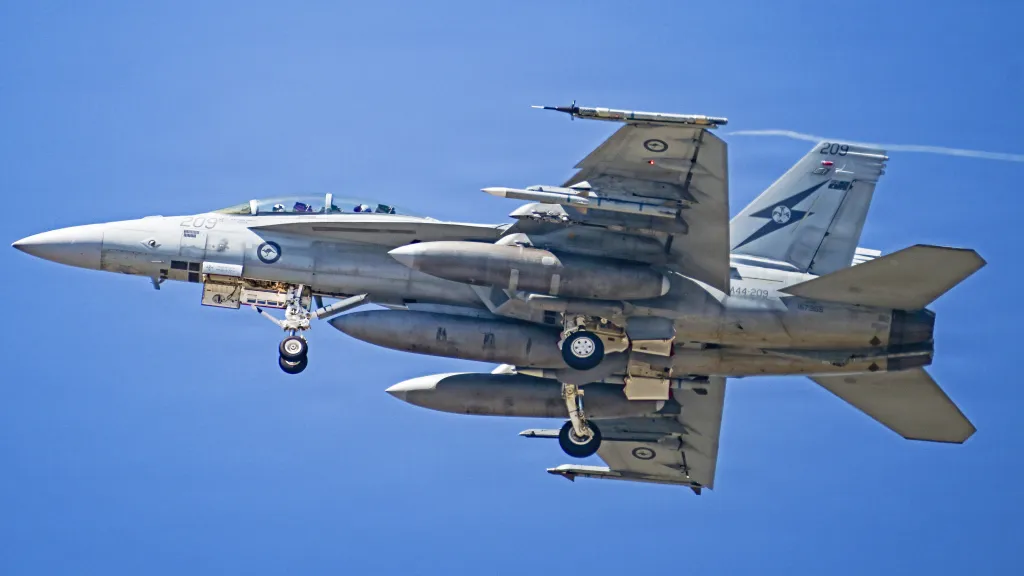
A Royal Australian Air Force (RAAF) F/A-18F Super Hornet has been photographed carrying an inert AIM-260 Joint Advanced Tactical Missile (JATM) during Gray Flag 2026, the US Navy’s large-force test event at Naval Base Ventura County Point Mugu, California. The Navy image, taken on September 11, 2026, shows a No. 1 Squadron jet taking off with the missile on its right fuselage station, the first public image of the weapon on an Australian aircraft.
The flight came five weeks after Deputy Prime Minister and Defence Minister Richard Marles announced at Exercise Pitch Black in Darwin, on August 6, 2026, that Canberra would invest almost A$736 million (approximately $480 million) to acquire the AIM-260 through the US Foreign Military Sales (FMS) program. The purchase makes Australia the first country outside the United States to operate the Lockheed Martin missile. Integration will begin on the F/A-18F, followed by the F-35A Lightning II and the EA-18G Growler. Canberra has disclosed neither missile quantities nor a delivery schedule.
AIM-260 JATM on Station 7: What the Gray Flag Loadout Shows
The missile sits on station 7, the right-hand fuselage “cheek” position where a US Navy Super Hornet from Air Test and Evaluation Squadron 31 (VX-31) carried the first publicly seen JATM in May 2026. The rest of the loadout reflects instrumented testing rather than a combat configuration: a CATM-9X captive training round of the AIM-9X Sidewinder, a CATM-120 training round of the AIM-120 Advanced Medium-Range Air-to-Air Missile (AMRAAM), three external fuel tanks, an AN/ASQ-228 Advanced Targeting Forward-Looking Infrared (ATFLIR) pod, and a Tactical Combat Training System (TCTS) pod for range instrumentation.
Blue bands on the missile body identify a training round with an inert rocket motor, warhead, or both. The image does not establish whether the missile is Australian-owned, a US test asset, or a round assigned to a specific integration objective. It does confirm that RAAF Super Hornet integration has advanced to the point of carrying JATM on sorties within a major US test event.
Gray Flag is the naval aviation test community’s flagship large-force test event, flown over the Point Mugu Sea Range, roughly 36,000 square miles of instrumented sea and airspace. According to the Navy, the 2026 edition was the largest to date, with more than 3,000 personnel from over 150 organizations flying more than 750 sorties and logging over 2,000 flight hours across hundreds of multi-domain test objectives. Previous editions have included live engagements of developmental weapons against representative targets. For a missile designed to engage targets beyond the launch aircraft’s own sensor coverage, a networked range of this scale is where tactics, techniques, and procedures (TTPs) and third-party targeting chains are developed.
Range and Form Factor: How JATM Compares to AMRAAM and PL-15
The AIM-260’s performance data remain classified. Developed jointly by the US Air Force and US Navy, the program was disclosed in 2019 with a fielding goal of 2022 that has since slipped. Its core requirement is an AMRAAM-class form factor, which publicly available specifications put at about 3.65 meters long and 178 millimeters in diameter, allowing internal carriage in the F-22 Raptor and F-35 while delivering substantially greater range. Reported figures point to an intended range of at least 120 miles (about 190 kilometers). Open-source assessments suggest a highly loaded, likely dual-pulse rocket motor and an active electronically scanned array (AESA) seeker; none of these features has been officially confirmed.
US Air Force officials have publicly cited China’s PL-15 as a key driver of the program. Open-source estimates place the PL-15’s range at 200 kilometers or more, beyond that of the AIM-120C/D, while the larger PL-17 is assessed as optimized for engaging tankers and airborne early warning aircraft at extreme distances. For the Super Hornet, a non-stealthy fighter carrying all weapons externally, JATM addresses that range deficit in beyond-visual-range (BVR) engagements. On the F-35A, the same form factor preserves internal loadouts and low observability.
Production planning is also moving. On September 17, 2026, the Pentagon and Lockheed Martin signed a framework agreement laying the groundwork for a JATM multiyear procurement (MYP) contract, pending congressional approval, that includes planned FMS deliveries. Quantities, costs, and schedules were not disclosed. The head of the Air Force Test Center confirmed the same week that the missile is undergoing both ground and airborne testing.
Analysis: The F/A-18F-first sequence is the key detail. US Navy Super Hornets and US Air Force F-22s are expected to be the first US types armed operationally with JATM, and VX-31 has already flown the missile on the same station. By leading with a platform the US Navy is integrating, Canberra builds on a shared integration baseline rather than funding a separate effort, which explains how an RAAF jet carried a JATM round before any delivery schedule was published. Super Hornet commonality should also ease Growler integration. The constraint is supply: Australian deliveries will draw on one Lockheed Martin production line whose rate, and US allocation priorities, depend on a multiyear deal Congress has yet to approve.
Missile quantities, delivery dates, and an Australian initial operational capability date remain undisclosed. The next markers are award of the JATM multiyear contract and any US declaration of operational fielding. Timelines for F-35A and EA-18G integration have not been published, and the MQ-28 Ghost Bat, which has already fired an AIM-120 and whose Block 3 variant is designed for internal weapons carriage, remains a possible future JATM launch platform.