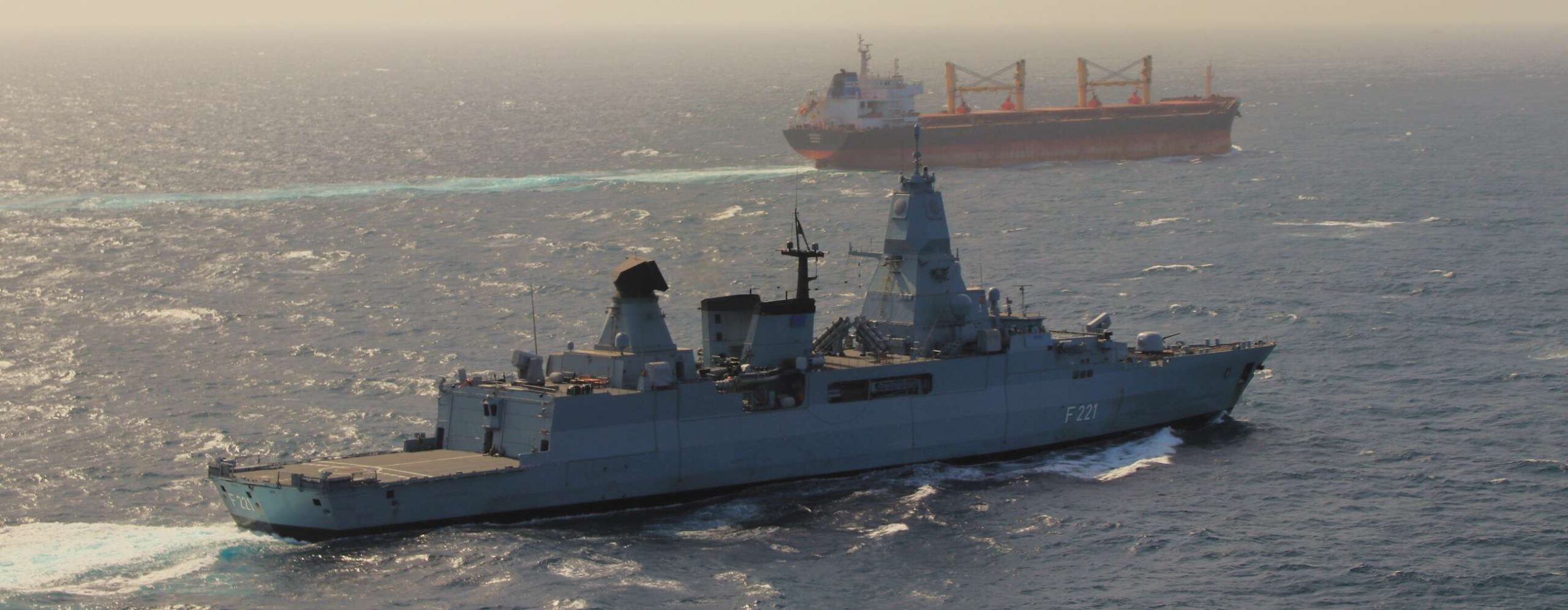
Germany’s Bundestag opened deliberations on October 8, 2026, on a government motion to keep German forces in the European Union’s EUNAVFOR Aspides maritime security operation until October 31, 2027. The cabinet-approved motion, announced October 1, holds the personnel ceiling at 350 soldiers and leaves Germany’s contribution unchanged, even as Houthi attacks on shipping continue and the US-Israeli war with Iran keeps Strait of Hormuz traffic severely disrupted.
State Secretary Sebastian Hartmann told lawmakers during the first reading that Germany was taking responsibility and demonstrating its readiness to act. The current mandate expires on October 31, 2026. Germany has taken part since February 23, 2024. In October 2025, lawmakers halved the ceiling from 700 to 350 as Berlin stopped fielding a standing frigate. The EU Council has already extended Aspides to February 28, 2027, with nearly €15 million for common costs.
What the Aspides Red Sea Mandate Authorizes Through 2027
Germany’s contribution now rests on command, staff and airborne surveillance rather than surface combatants. Personnel serve at the Operation Headquarters in Larissa, Greece, and aboard the operation’s flagship. Regular flights by a Multi-Sensor Platform (MSP), a contractor-operated aircraft carrying Bundeswehr personnel, have provided airborne maritime surveillance from Djibouti since October 2024. In September 2025, Defense Minister Boris Pistorius told the Bundestag that German crews were the only Aspides contributors flying that mission. Its airframe and sensor fit remain undisclosed.
The ceiling also preserves the option to commit a warship on an event-driven basis. Germany last did so in 2024 with the frigates Hessen and Hamburg. Publicly available specifications put the Type 124 Sachsen-class Hessen at 143 meters and roughly 5,800 tonnes full load, with about 240 crew and two Super Lynx Mk 88A helicopters. Its SMART-L long-range radar and APAR fire control radar, paired with SM-2 Block IIIA and Evolved Sea Sparrow Missile (ESSM) interceptors in a 32-cell Mk 41 vertical launch system, gave Aspides area air defense against Houthi drones and missiles; Hessen downed drones on several occasions during what Berlin called the Navy’s first combat deployment of its kind. Pistorius conceded in 2025 that the frigate gap since then also reflects two decades of neglected naval modernization.
The mandate carries executive powers, including the use of weapons, across international waters of the Red Sea, Gulf of Aden, Arabian Sea, Gulf of Oman and Persian Gulf. A separately designated zone around the Strait of Hormuz falls under special rules, and Aspides currently holds no authority there for mine clearance or ship protection. Tasks also include sharing information on the shadow fleet and suspicious activity near critical undersea infrastructure. The government estimates additional deployment costs for the new period at about €18.9 million; the expiring mandate was budgeted at about €23.9 million.
Houthi Escalation and Hormuz Demands Strain a Three-Ship Operation
The threat picture has shifted since the last vote. The Houthis, who began attacking shipping in November 2023, stayed largely on the sidelines in the first months of the war that began with US and Israeli strikes on Iran on February 28, 2026, then escalated in July. With Gulf exports constrained at Hormuz, the Red Sea became the main outlet for crude moved by pipeline to Saudi Arabia’s west coast. The Houthis announced an embargo on Saudi exports through the Bab al-Mandab on July 22 and in early August claimed a strike on the Saudi-flagged tanker NCC WAFA off Yanbu, pushing the campaign into the northern Red Sea. The ministry says attacks continue undiminished, and Cape of Good Hope diversions still add weeks to voyages.
Aspides is thin for that environment. In May 2026, EU foreign policy chief Kaja Kallas said the operation comprised three vessels and needed more ships, and EU officials have discussed merging it with a planned Franco-British Hormuz escort force. Berlin has sent mixed signals. Foreign Minister Johann Wadephul questioned the mission’s effectiveness in March and opposed stretching it to Hormuz. Pistorius later called an expanded Aspides legal framework an appropriate option and pre-positioned the minehunter Fulda in the Mediterranean; the boat sailed from Kiel on May 4 to operate with Standing NATO Mine Countermeasures Group 2. Publicly available specifications describe the Type 332 Frankenthal class as 54-meter, roughly 650-tonne hunters with non-magnetic steel hulls that employ Seefuchs expendable mine disposal vehicles. Chancellor Friedrich Merz has tied any Hormuz role to a durable end to hostilities, an international law basis and a Bundestag mandate.
Analysis: The vote is less about whether Germany stays than about what Aspides is for. A contribution built on staff officers and one contractor-flown aircraft keeps Berlin inside the EU’s only naval response to the Houthis at low cost and risk, but leaves no German air defense hull where attacks now reach waters off Saudi export terminals. Hormuz is the larger test. If Brussels folds post-war mine countermeasures or escort duties into Aspides, Germany would need a new or amended mandate, and the availability of its Sachsen-class frigates and 1990s-vintage minehunters, not the troop ceiling, would define what it can offer.
The motion now goes to committee, led by Foreign Affairs, before second and third readings and a plenary vote ahead of the October 31 expiry. Earlier extensions passed comfortably, including by 594 votes to 37 in January 2025. Still open: whether Berlin commits a frigate in the new period, and how the EU’s next strategic review handles Hormuz before the EU mandate lapses on February 28, 2027.