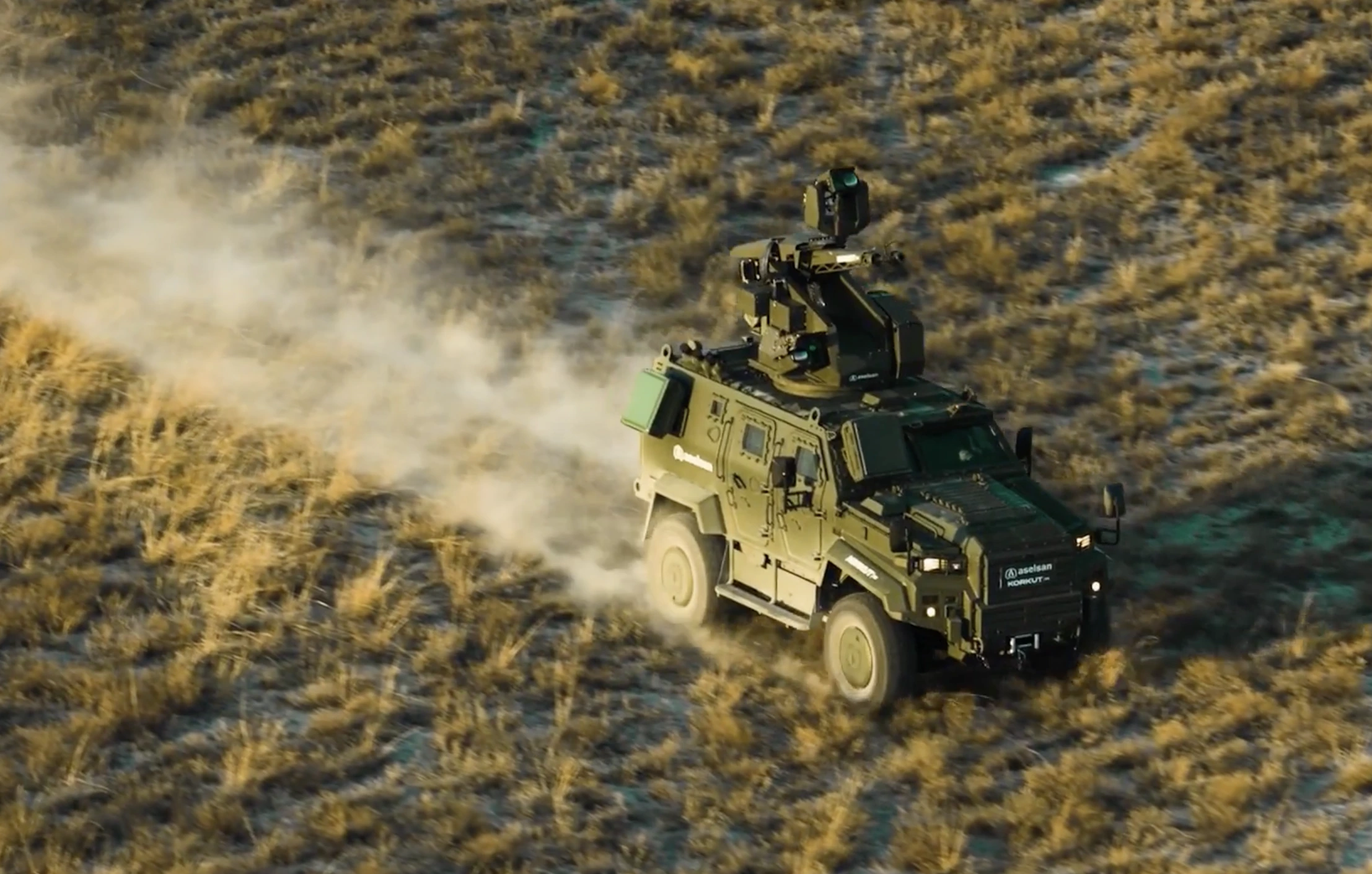
ASELSAN has released new promotional footage of its KORKUT 25 counter-unmanned aerial vehicle (C-UAV) system, pitching the vehicle-mounted 25mm turret as a single answer to drones of different sizes and mission profiles. The Turkish company’s campaign rests on two features: artificial intelligence (AI)-assisted detection and identification, and the ATOM 25 programmable airburst round, which ASELSAN credits with an enhanced fragmentation effect.
The push comes as ASELSAN extends the KORKUT family beyond its original 35mm twin-gun air defense system, which entered service with the Turkish Land Forces and is a component of Türkiye’s Steel Dome (Çelik Kubbe) layered air defense architecture. KORKUT 25 addresses a narrower gap: protecting maneuver units and fixed sites against the small, inexpensive UAVs that have reshaped combat in Ukraine and the Middle East, where firing a surface-to-air missile at every drone is economically unsustainable.
KORKUT 25 Turret, Sensors, and ATOM 25 Airburst Ammunition
ASELSAN unveiled KORKUT 25 at the SAHA Expo in Istanbul in October 2024 as a remote-controlled weapon station and unmanned turret. The company first developed the 25mm weapon to engage armored ground targets, then adapted it to the C-UAV role around its new airburst round. The gyro-stabilized turret carries high-resolution day and thermal cameras, a laser rangefinder, automatic target detection and tracking, and an automatic ballistic computer. Cueing comes from external sensors; in recent demonstrations, ASELSAN’s AURA active electronically scanned array (AESA) radar handled acquisition and tracking. The C-UAV configuration adds a coaxial 7.62mm machine gun.
Weight drives the concept. According to company figures, the turret weighs 1 to 1.2 tonnes with its gun and without ammunition, light enough for 4×4 tactical vehicles. ASELSAN has displayed it on Nurol Makina’s Ejder Yalçın, a 4×4 with a gross vehicle weight of 12 to 14 tonnes. The turret holds 200 rounds, which ASELSAN equates to 20 engagements before reloading, an implied budget of about 10 rounds per target.
The ATOM 25 round, in the NATO-standard 25x137mm caliber, is the core of the kill chain. The 35mm ATOM disperses tungsten sub-projectiles, but the smaller shell could not accommodate that payload, so ASELSAN opted for a pre-fragmented high-explosive design. The electronic time fuze calculates the burst point during firing using measured muzzle velocity, and a dual-mode setting allows point detonation against ground targets. Company figures shown at IDEF 2025 list a muzzle velocity of 1,100 meters per second, an effective range of 1,200 meters against air targets and 1,500 meters against ground targets, a round weight of about 500 grams, and a 10-year shelf life.
Konya Live-Fire Trials and the Counter-UAV Export Campaign
A dedicated variant, KORKUT 100/25 SB, appeared at IDEF 2025 in Istanbul and made its international debut at DSEI in London in September 2025. ASELSAN Chief Executive Ahmet Akyol presented it as a cheaper and more agile complement to the 35mm KORKUT, able to defeat first-person-view (FPV) and fiber-optic-guided drones with smart ammunition.
This spring, ASELSAN staged a live-fire demonstration in Konya for more than 100 senior delegates from 15 countries. The AURA radar acquired target drones before KORKUT 25 destroyed them in flight with ATOM 25 rounds, while soft-kill scenarios used KANGAL-FPV jammers against other targets. ASELSAN did not announce export orders or letters of intent from the event.
The wider KORKUT line is gaining export traction. Pakistan revealed KORKUT air defense systems in September 2026, although the exact variant has not been officially confirmed. In February 2026, ASELSAN also agreed with Czech firm Excalibur International, part of CSG, to integrate KORKUT on the Tatra Force 6×6, with production planned in the Czech Republic and Slovakia. No KORKUT 25 customer has been made public.
Analysis: KORKUT 25 trades reach for mobility and cost. Its 1,200-meter air engagement envelope is a fraction of the 4-kilometer maximum range of the 35mm KORKUT, so it defends a convoy or a site rather than an area. In return, a turret of about 1.2 tonnes can ride a 4×4, and ASELSAN claims a cost-per-engagement advantage over both 35mm guns and interceptor missiles, although it has not published unit prices. The fiber-optic point Akyol raised matters most: cable-guided FPV drones are immune to radio-frequency jamming, so forces relying on electronic warfare alone need an inexpensive kinetic layer for the last few hundred meters. The 200-round load remains the limiting factor against saturation attacks.
Akyol said in February 2026 that ASELSAN was taking KORKUT 25 into the field this year, but neither the company nor the Presidency of Defense Industries (SSB) has published a Turkish order quantity or delivery schedule. Key unknowns include the identity and rate of fire of the 25mm cannon, unit cost, and whether KORKUT 25 will be fielded within Steel Dome. The next signals to watch are a Turkish Land Forces induction announcement and any export contract emerging from the Konya delegations.