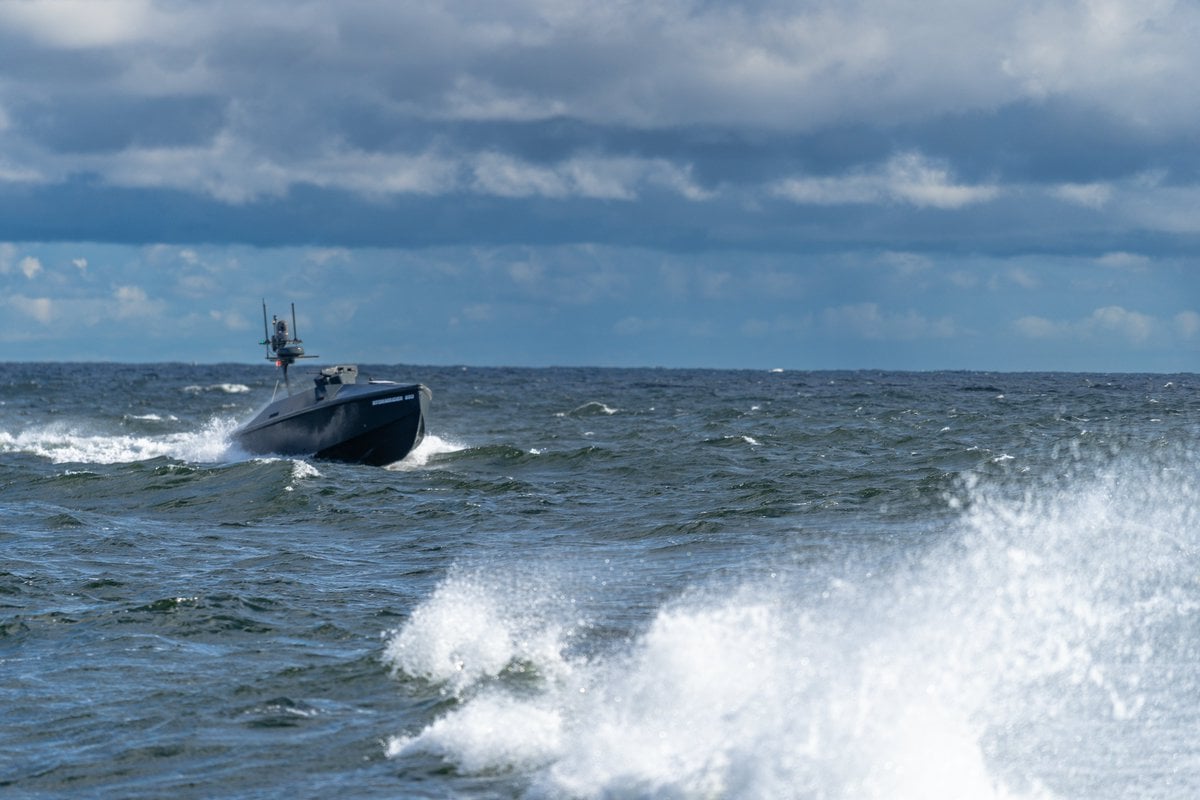
Polish defense group WB Group and Norway’s Kongsberg Defence & Aerospace will jointly develop armed unmanned surface vessels (USVs) for the Baltic Sea, with the Polish Ministry of National Defence confirming on October 7, 2026, that the work covers integration of both air defense systems and strike weapons. WB Group’s StormRider 850 and 550 drone boats were displayed at the Gdynia presentation.
The event, held at WB Group subsidiary Radmor and attended by Deputy Prime Minister and Defence Minister Władysław Kosiniak-Kamysz, built on a cooperation agreement signed on September 8, 2026, at the MSPO defense exhibition in Kielce. That agreement spans manned and unmanned maritime and aerial systems, air defense, weapons, communications, command and control (C2) and advanced electronics. It arrives as Baltic navies work to protect undersea cables, pipelines and ports after repeated anchor-dragging incidents, and as Ukraine’s drone-boat campaign against the Black Sea Fleet resets the value of small, expendable surface combatants.
StormRider 850: WB Group’s Existing Armed USV Platform and Sensors
Radmor designed the StormRider in about nine months, drawing on hull solutions from Poland’s yacht-building sector. The StormRider 850 is 8.5 m long and 3 m wide, displaces more than three tonnes and is optionally manned. WB Group representatives have cited a maximum operating range of about 500 km, and the prototype completed propulsion and navigation trials up to Sea State 4 in July 2025. It operates remotely or semi-autonomously over WB Group-built control and datalink equipment.
Sensors include a navigation radar, sonar, echo sounder and a stabilized electro-optical/infrared (EO/IR) head with day camera, thermal imager and laser rangefinder. One hull can therefore detect surface contacts, hold a surveillance picture and hand targets to other assets, a practical answer for a navy that cannot keep crewed ships over every cable route.
Primary armament is the ZMU-05N, the naval variant of the ZMU-05 remote weapon station (RWS) built by WB Group company Arex. It typically mounts a 12.7 mm M2 heavy machine gun aimed through a stabilized head with a wide-angle 4K day camera, HD thermal camera and laser rangefinder, and is hardened against salt spray, corrosion and icing. The ZMU-05 family also accepts 7.62 mm machine guns, 20 mm or 30 mm cannon and a 40 mm automatic grenade launcher. The smaller StormRider 550, a 5.5 m modular hull unveiled in September 2026, was shown unarmed.
In July 2026, a StormRider operated alongside the Oliver Hazard Perry-class frigate ORP Gen. T. Kościuszko during a NATO Task Force X demonstration, relaying live sensor imagery to the alliance summit in Ankara.
Electronic Reconnaissance, Warmate TL and Undisclosed Air Defense Effectors
Neither company has named the missiles, launchers or interceptors to be integrated. The disclosed core is the sensor architecture: multi-sensor payloads fusing imagery with electronic reconnaissance, letting a USV detect radar and communications emissions from contacts beyond optical range. That passive layer turns a small hull from a camera boat into a cueing node.
For strike, WB Group already offers Warmate TL launchers on the StormRider 850. The Warmate TL is a folding-wing, tube-launched loitering munition; publicly available specifications indicate a 1.7 m wingspan, 1.1 m length and 4.5 kg maximum takeoff weight, including a 1.4 kg high-explosive anti-tank or thermobaric warhead, with EO/IR guidance and about 30 minutes of endurance. That extends the boat’s reach well past the roughly 2,000 m effective range quoted for the ZMU-05’s 12.7 mm gun.
Kongsberg brings heavier options: the Naval Strike Missile already fielded by Poland’s coastal Naval Missile Unit, the Protector RWS family and the National Advanced Surface-to-Air Missile System (NASAMS). It is also partnered with Polska Grupa Zbrojeniowa (PGZ) and Gdynia-based Advanced Protection Systems on Poland’s SAN counter-drone program. Whether any of them, or lighter derivatives, fit an 8.5 m, three-tonne hull is unresolved.
Pomeranian Factories and a Possible SAFE-Funded USV Contract
WB Group is executing an investment program of about PLN 800 million in Pomerania covering production capacity, technology and research and development; the figure spans the whole program, and no value has been attached to the USV project. The Gdynia presentation took place in a new Radmor production hall where precision-component machining is due to begin in early 2027. Kosiniak-Kamysz said Radmor employs 1,500 people and that WB Group’s Pomeranian workforce could reach 2,000.
Kongsberg became the first foreign investor in the Kaszubia Green Industrial District on November 20, 2025, signing letters of intent with Rumia and the Wejherowo and Słupsk districts covering PLN 200 million to PLN 250 million in drone and MCT-30 turret production. A Kongsberg representative said in Gdynia that the site of a new plant in eastern Pomerania would be announced within days.
Polish defense-industry sources indicate that a contract financed through the European Union’s Security Action for Europe (SAFE) loan instrument could soon be signed with a WB Group and Kongsberg consortium for USV deliveries to Poland and Norway. Neither government has confirmed it. Parallel national variants built largely from domestic components are envisaged.
Analysis: The partnership is less a platform launch than a test of Poland’s procurement leverage. Warsaw has made local investment and co-development the price of access to its defense budget, and Kongsberg has now accepted those terms on factories, counter-drone systems and maritime drones. For the Polish Navy, whose frigate and submarine recapitalization will take years to mature, armed USVs offer a faster route to distributed sensors and firepower around ports, cables and offshore energy sites. The binding constraint is engineering: credible air defense from an 8.5 m boat in Baltic sea states demands stabilized fire control, radar cueing and compact interceptors that neither company has yet demonstrated at sea.
The next markers are the announcement of Kongsberg’s eastern Pomerania plant, any SAFE award to the consortium and the first disclosure of which air defense and strike effectors will be integrated. Quantities, delivery schedules, the autonomy model and whether the StormRider 850 or 550 will anchor the joint design all remain unknown. Until a contract fixes those terms, the program is a framework rather than a funded capability.