Naval Sea Systems Command (NAVSEA) has awarded General Dynamics Applied Physical Sciences Corp. (APS) of Groton, Connecticut, a $49,945,664 cost-plus-fixed-fee contract for engineering and technical design supporting research and development in platform-based development, prototyping and demonstration, advanced hull treatment design, acoustic and non-acoustic signature measurement technologies, and special studies of foreign technologies. Contract N00024-26-C-2177 was awarded on September 30, 2026, and announced on October 9, 2026. Work will be performed in Groton and is expected to be completed by September 2030.
The award touches one of the least publicized areas of US naval research: signature management, the discipline that governs how detectable a ship or submarine is to adversary sensors. APS, a General Dynamics subsidiary that works closely with Electric Boat, the company’s submarine builder in the same town, specializes in acoustics, signal processing, marine hydrodynamics and electromagnetics, and operates a dedicated platform signatures and stealth technology department. The inclusion of prototyping and demonstration in the scope indicates that the effort is expected to produce hardware and test events, not only studies.
Navy Stealth Research at APS: From ONR Programs to NAVSEA
The new contract follows several years of signature-related work for the Navy’s science and technology enterprise. In November 2019, the Office of Naval Research (ONR) awarded APS a five-year contract worth up to $23.2 million to develop advanced tools, technologies and experimental methods for future platform signature design; that effort ran until November 2024. A second ONR contract, valued at $14.3 million, covered physics-based tools, analysis techniques and concepts for enhanced submarine security, with completion set for April 8, 2026. APS has also worked on the Defense Advanced Research Projects Agency (DARPA) Advanced Propulsor Experimental (APEX) program, where a modification raised its contract from $9.4 million to $18.0 million.
The October 9 notice does not state whether the NAVSEA award succeeds either ONR contract, and it does not identify the sponsoring program office. The change of contracting activity is nonetheless notable: NAVSEA is the Navy’s ship engineering and acquisition command, and its sponsorship generally places work closer to platform programs than ONR’s science and technology portfolio.
The contract was competitively procured through a Broad Agency Announcement posted on SAM.gov, the federal contracting portal, and the Navy received one offer. At award, NAVSEA obligated $3,000,000 in fiscal 2025 Research, Development, Test and Evaluation (Navy) reconciliation funds, which will not expire until September 2029. Those funds trace back to the fiscal 2025 reconciliation law signed on July 4, 2025, which provided $156.2 billion in mandatory defense funding available for obligation through September 30, 2029. The initial obligation represents about 6 percent of the contract’s announced value.
Advanced Hull Treatments, Non-Acoustic Signatures and Foreign Technology Studies
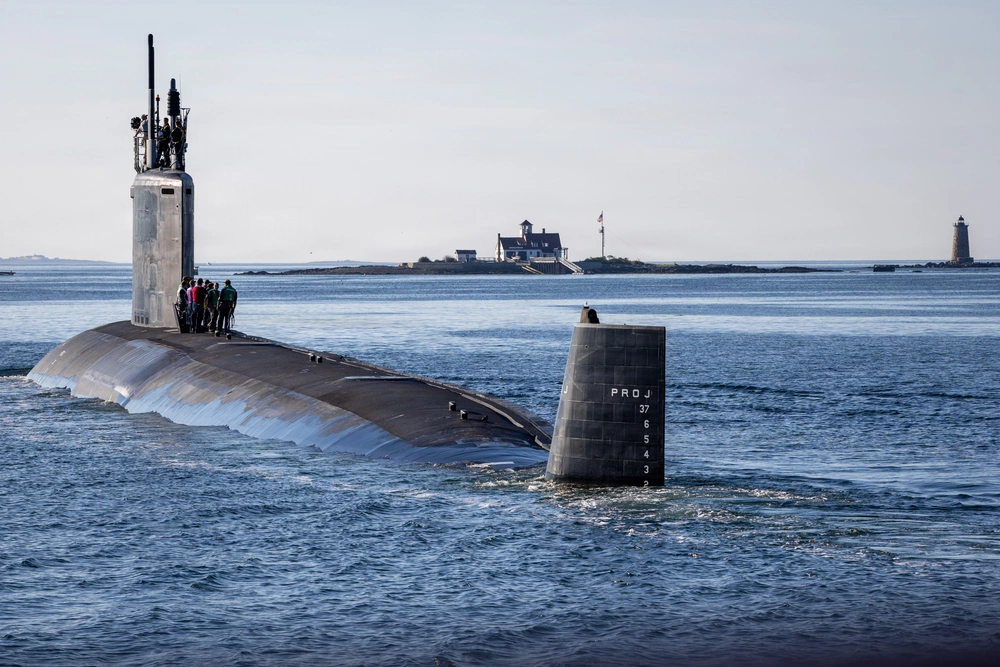
The notice does not name a platform. In the US Navy, hull treatment work is most closely associated with submarines. Virginia-class boats carry a urethane coating formally known as the Mold-In-Place Special Hull Treatment, designed to absorb active sonar energy and dampen the boat’s own radiated noise. The system has a documented durability record: the Navy first noticed debonding on USS Virginia (SSN 774) in 2007, and later said Virginia, North Carolina and Texas had each lost 5 to 7 percent of their coatings. In 2017, USS Mississippi returned to Pearl Harbor with large sections missing. Hull treatment design therefore involves adhesion and maintainability as much as acoustic performance.
Non-acoustic signatures cover the ways a platform can be detected without sound. Publicly available technical literature generally groups them into magnetic, electric, pressure, thermal and wake signatures, relevant to influence mines and airborne magnetic anomaly detection, among other sensors. APS has a record in the field: in September 2011, it won a $367,507 DARPA contract under the Shallow Water Agile Submarine Hunting (SWASH) program, which sought non-acoustic means of detecting submarines in coastal waters.
The notice offers no detail on the special studies of foreign technologies. Within the Navy, scientific and technical intelligence analysis of foreign naval platforms, including their signatures, and foreign materiel exploitation fall to the Office of Naval Intelligence’s Farragut Technical Analysis Center, which also houses the National Acoustic Intelligence Laboratory. The contract announcement does not indicate whether APS’s work connects to that enterprise, which countries or systems are in scope, or whether it involves physical hardware.
Analysis: The contract bundles three functions the Navy usually discusses separately: designing hull treatments, measuring how platforms radiate across acoustic and non-acoustic domains, and studying what foreign developers are doing in the same field. Placing them under one engineering vehicle points to a design loop in which measurement and foreign benchmarking feed treatment choices directly. The single-offer result is the more consequential industrial signal. Even under a competitive solicitation, only one firm bid, which suggests that for this scope the capability currently resides with a General Dynamics subsidiary tied to the Navy’s lead submarine design yard. For a capability central to US undersea advantage, that concentration is a sustainment risk as much as a strength.
With $3 million obligated against an announced value near $50 million, the volume of work will depend on future funding increments through September 2030. Key unknowns remain: the platforms involved, whether the effort follows on from earlier APS contracts, and what the foreign technology studies cover. Further obligations and contract modifications, published in the Pentagon’s daily contract announcements, will be the main public indicators of how the effort develops.