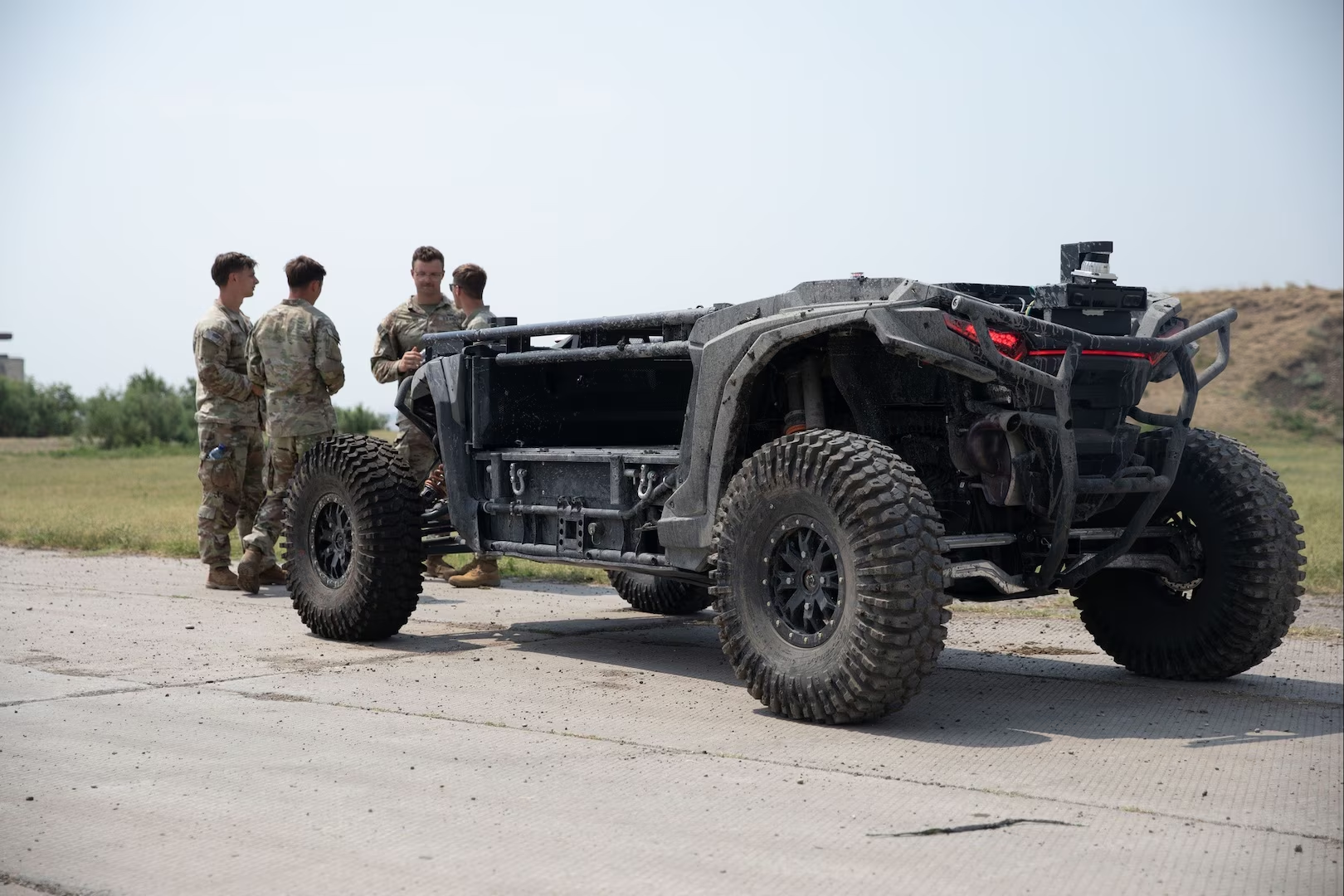
Gen. Christopher LaNeve, Vice Chief of Staff of the Army and Acting Chief of Staff of the Army, has selected U.S. Army Futures and Concepts Command (FCC) for redesignation as U.S. Army Futures and Autonomous Systems Command (FASCOM), the Army announced on October 13, 2026. The three-star command will absorb five research, experimentation and analysis organizations and oversee autonomy experiments across the Army’s corps-level formations, while Fort Rucker, Alabama, becomes the service’s UAS Autonomy Center of Excellence effective the same day.
The decision implements the Army Autonomous Initiatives memorandum signed on October 1 by Acting Secretary of the Army Adam Telle, which followed Secretary of War Pete Hegseth’s September 30 State of the Force address announcing an Autonomous Warfare Command. Telle’s memo directed the Army to build autonomous capability into at least six formation areas: aviation, armor, fires, sustainment, engineer and training. It also ordered a new Portfolio Acquisition Executive (PAE) for Autonomy to prioritize fielding autonomous fires, combat vehicles, watercraft resupply, breaching, and reconnaissance, surveillance and target acquisition (RSTA) capabilities, along with crewed-uncrewed teaming, no later than fiscal year 2028. “This goes beyond drones,” LaNeve said. “FASCOM will pioneer operational concepts that harness autonomous capabilities across all warfighting functions.”
How FASCOM Consolidates Army Autonomy Development Under One Command
FCC was activated at Fort Eustis, Virginia, earlier this year as a major subordinate command of Army Transformation and Training Command (T2COM), the four-star headquarters formed in October 2025 by merging Army Futures Command and Training and Doctrine Command. As FASCOM, led by a three-star general officer, it will consolidate the work of five organizations: the Combat Capabilities Development Command (DEVCOM), the Medical Research and Development Command (MRDC), the 75th Innovation Command, the Joint Modernization Command (JMC) and the Transformation Decision Analysis Center.
The grouping pairs laboratories with field validation. DEVCOM houses the Army’s science and technology centers, the 75th Innovation Command is the Army Reserve’s modernization and experimentation unit, and JMC runs operational assessments of new equipment with tactical units. According to the Army, the merger unifies the expertise the PAE for Autonomy will depend on to meet Telle’s directive to rapidly integrate autonomous technologies across the force. A single headquarters is meant to shorten the handoff from prototype to soldier evaluation to procurement decision.
Corps-Level Autonomy Experiments From I Corps to Eighth Army
One of LaNeve’s first taskings to FASCOM is the development of corps-level autonomous capabilities. Each formation will test equipment, evaluate tactics and recommend how to accomplish autonomous mission sets, an approach LaNeve said uses experimentation to validate concepts before scaling them across the Army. The assignments are:
- I Corps: an autonomous fires battery and an autonomous watercraft company.
- III Corps: an autonomous armored reconnaissance company.
- V Corps: an autonomous breaching company.
- XVIII Airborne Corps: autonomous aerial intelligence, surveillance and reconnaissance (ISR) and lift companies.
- Eighth Army: pairing of crewed and uncrewed rotary-wing aircraft.
The distribution tracks each formation’s operational focus. I Corps, headquartered at Joint Base Lewis-McChord, Washington, and aligned to the Indo-Pacific, gets fires and watercraft experiments suited to dispersed island and littoral terrain. V Corps, with its forward headquarters in Poznań, Poland, takes on breaching, a core requirement against prepared defenses in Europe. III Corps, the Army’s armor-heavy corps at Fort Hood, Texas, receives reconnaissance, the mission where uncrewed vehicles can absorb first contact instead of crews.
The Eighth Army experiment in Korea, first conceptualized at the Army Aviation Center at Fort Rucker, gives attack aviation pilots direct control of unmanned aircraft system (UAS) sensors to enable over-the-horizon targeting and synchronize crewed-uncrewed fires. “Fort Rucker is unique in that we can bring together warfighting experts and cutting-edge commercial capabilities to test technology the way we intend to fight it,” LaNeve said in designating the post as the UAS Autonomy Center of Excellence. He added that he will keep “clearing the way for Soldiers to innovate and solve tactical problems with the tools they have on hand.”
Autonomous Tanks, Fires and Breachers in Capability-Based Formations
LaNeve’s direction also calls for capability-based formations centered on autonomous long-range fires, protection, tanks, logistics and obstacle breaching. The Army said these were selected for their role in enabling operational maneuver and are aligned to the four elements of How the Army Fights, the operational warfighting guidance released on October 7: convergence, strike, close battle and endurance.
These experimental formations will receive some of the Army’s first 390A Robotic Technicians. The warrant officer specialty, developed within Army special operations, graduated its first 10 warrant officers at Fort Bragg, North Carolina, on October 2 after a 19-week course. LaNeve first announced its expansion beyond special operations units at the Maneuver Warfighter Conference in September, and Telle’s memo ordered expanded authorizations for 390A and 15X Tactical Unmanned Aircraft Systems Specialists across applicable Army units. “We’ve got to change our approach from bolting on technology to rethinking how we fight,” LaNeve said. “Technology doesn’t fight; Soldiers do.”
Analysis: Autonomy experimentation now runs through operational corps rather than a standalone futures enterprise. Army Futures Command, created in 2018, drew criticism from House appropriators in 2020 after its first major acquisition program, the Optionally Manned Fighting Vehicle, stalled over requirements confusion; FASCOM is designed to feed a single portfolio acquisition executive with data from units that would fight with the equipment. The fiscal 2028 deadline leaves roughly two budget cycles to turn company-level experiments into fielded capability. The binding constraint may be people rather than platforms: with only 10 graduated 390A technicians, staffing six formation areas and five corps experiments will set the pace.
The Army has not named FASCOM’s commander, set an effective date for the redesignation, said whether the command stays under T2COM, or disclosed which platforms, manning and funding the experimental companies will receive. The next milestones are the PAE for Autonomy’s first acquisition decisions, fiscal 2027 appropriations, the start of corps experiments, and the definition of FASCOM’s role relative to the joint Autonomous Warfare Command.