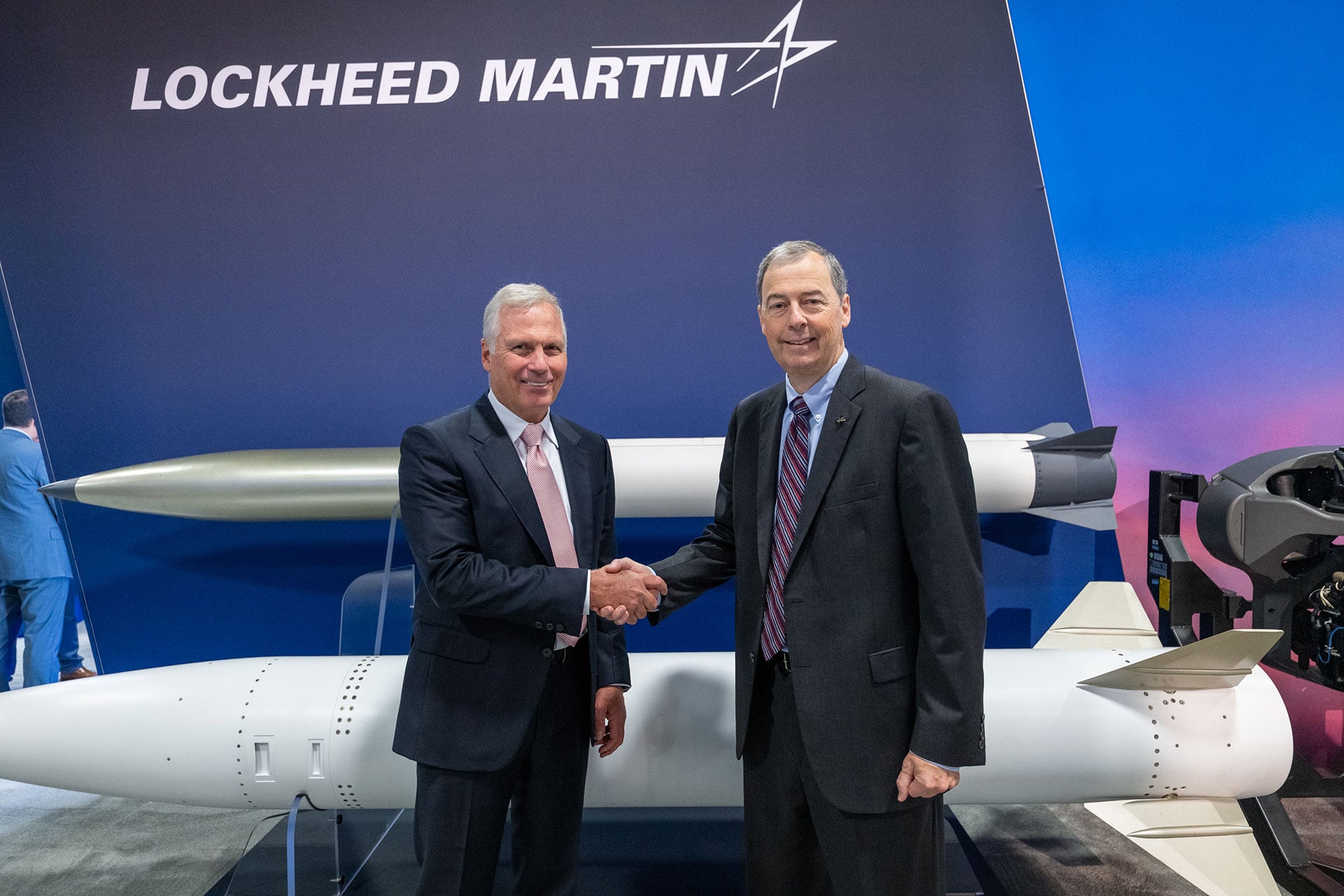
Lockheed Martin and Italian propulsion group Avio signed a strategic cooperation agreement on October 13, 2026, under which Avio’s U.S. subsidiary will produce solid rocket motors (SRMs) for the Extended Range Guided Multiple Launch Rocket System (ER GMLRS) and the Precision Strike Missile (PrSM). Production will take place at Avio USA’s new plant in Hurt, Virginia, once the motors complete qualification. The announcement, datelined Washington, came during the Association of the United States Army (AUSA) Annual Meeting, held October 12-14.
The agreement formalizes a non-binding term sheet the two companies signed on November 10, 2025, and lands two weeks after Avio USA broke ground in Virginia on September 29, 2026. SRMs remain one of the tightest chokepoints in U.S. munitions production: the domestic market has long rested on Northrop Grumman and L3Harris Technologies, through its Aerojet Rocketdyne business, while Army demand for precision fires has climbed steadily since 2022. Under the new framework, Lockheed Martin gains access to a share of Avio’s merchant supply capacity. Neither company disclosed a contract value, motor quantities, or a delivery schedule.
Inside the Avio Solid Rocket Motor Plant Rising in Hurt, Virginia
The facility sits at the Southern Virginia Multimodal Park in Pittsylvania County and covers approximately 900,000 square feet, according to Avio USA. The company says the site will turn out thousands of SRMs per year for U.S. tactical missile programs and expects to create roughly 1,500 technical jobs. HITT Contracting is the general contractor. Construction is scheduled to finish in late 2028, with first production expected in early 2029.
Avio CEO Giulio Ranzo said the group has launched “an investment of over $500M in new production capacity for SRMs in the United States,” with the stated aim of becoming a merchant supplier to multiple defense customers. Raytheon, an RTX business, holds a parallel memorandum of understanding with Avio and funded preliminary engineering work on the Mk 104 rocket motor in 2024, so the Hurt lines will serve competing primes from a single site.
Avio USA operates under a Defense Counterintelligence and Security Agency (DCSA) Special Security Agreement, the standard mitigation structure for foreign-owned contractors performing classified work. Its CEO, James Syring, is a retired U.S. Navy vice admiral and former director of the Missile Defense Agency. The Rome-based parent brings more than 50 years of solid propulsion experience: it is prime contractor for the Vega launcher, a subcontractor on Ariane, and a leading SRM subcontractor for major European tactical missile programs.
ER GMLRS and PrSM Propulsion Demands Behind the Agreement
The two programs named in the agreement sit at opposite ends of the Army’s long-range fires portfolio, and both are motor-limited. ER GMLRS extends the 227 mm guided rocket to approximately 150 kilometers, compared with roughly 70 kilometers for baseline GMLRS according to publicly available specifications, through a longer motor and tail-controlled flight. It fires six rounds per pod from the M142 High Mobility Artillery Rocket System (HIMARS) and the M270 launcher. The Army’s fiscal 2027 budget lists ER GMLRS Unitary in production, plans initial ER GMLRS Alternative Warhead production with 300 rockets requested, and an Army market-research notice asks industry to sustain 19,002 GMLRS-family rockets per year from fiscal 2028, against a current capacity of 14,004. Every one of those rounds needs a motor.
PrSM Increment 1, the replacement for the Army Tactical Missile System (ATACMS), carries two missiles per pod, doubling launcher loadout, and reaches targets at roughly 400 to 500 kilometers. The program cleared Milestone C on July 2, 2025. On June 23, 2026, the Army awarded an $8.4 billion modification that raised the cumulative contract value to $13.3 billion through September 2032, supporting a ramp toward 400 missiles per year. Northrop Grumman currently supplies the Increment 1 motor from the Allegany Ballistics Laboratory in West Virginia. On fiscal 2027 budget averages, a PrSM costs about $1.8 million against roughly $219,000 for a GMLRS round, which makes any motor shortfall on PrSM far more expensive in lost combat power.
Avio Joins Northrop, L3Harris, and General Dynamics in Lockheed’s Motor Supply Base
The Avio agreement extends a push by Lockheed Martin Missiles and Fire Control, under way since 2024, to widen its propulsion base. In August 2024, Lockheed teamed with General Dynamics Ordnance and Tactical Systems to load Lockheed-designed GMLRS motors at Camden, Arkansas, an effort that has now reached a motor firing. Avio adds an independent merchant source with its own propellant heritage and a European production base behind it.
“A reliable and diverse supply chain for solid rocket motors is fundamental to our strategy for a stronger defense industrial base,” said Tim Cahill, president of Lockheed Martin Missiles and Fire Control. Syring said the Lockheed Martin programs “contribute to a strong foundation for the factory operations” as Avio USA continues construction and hiring ahead of manufacturing.
Analysis: The agreement will not move 2027 or 2028 output; every near-term rocket still depends on Northrop Grumman, L3Harris, and General Dynamics. Its value lies in the post-2029 supply structure. For ER GMLRS, Avio becomes an additional source in an already diversifying base. For PrSM, it offers the first credible alternative to a single motor supplier on a $13.3 billion program, which is the more consequential gain. The risk sits in execution: a greenfield plant, a new workforce, and a qualification campaign that both companies have yet to detail. The merchant model also means Lockheed and Raytheon will draw on the same lines, so allocation rules in a surge scenario remain an open question.
The next markers are construction progress in Hurt, the scope and schedule of motor qualification for ER GMLRS and PrSM, and whether the Army funds facilitization or second-source qualification directly. Contract values, unit quantities, and any extension to PrSM Increment 2 or other Lockheed Martin munitions have not been announced. If the 2029 production target holds, the Hurt plant would come online as the Army’s GMLRS and PrSM ramps approach their planned peak rates.