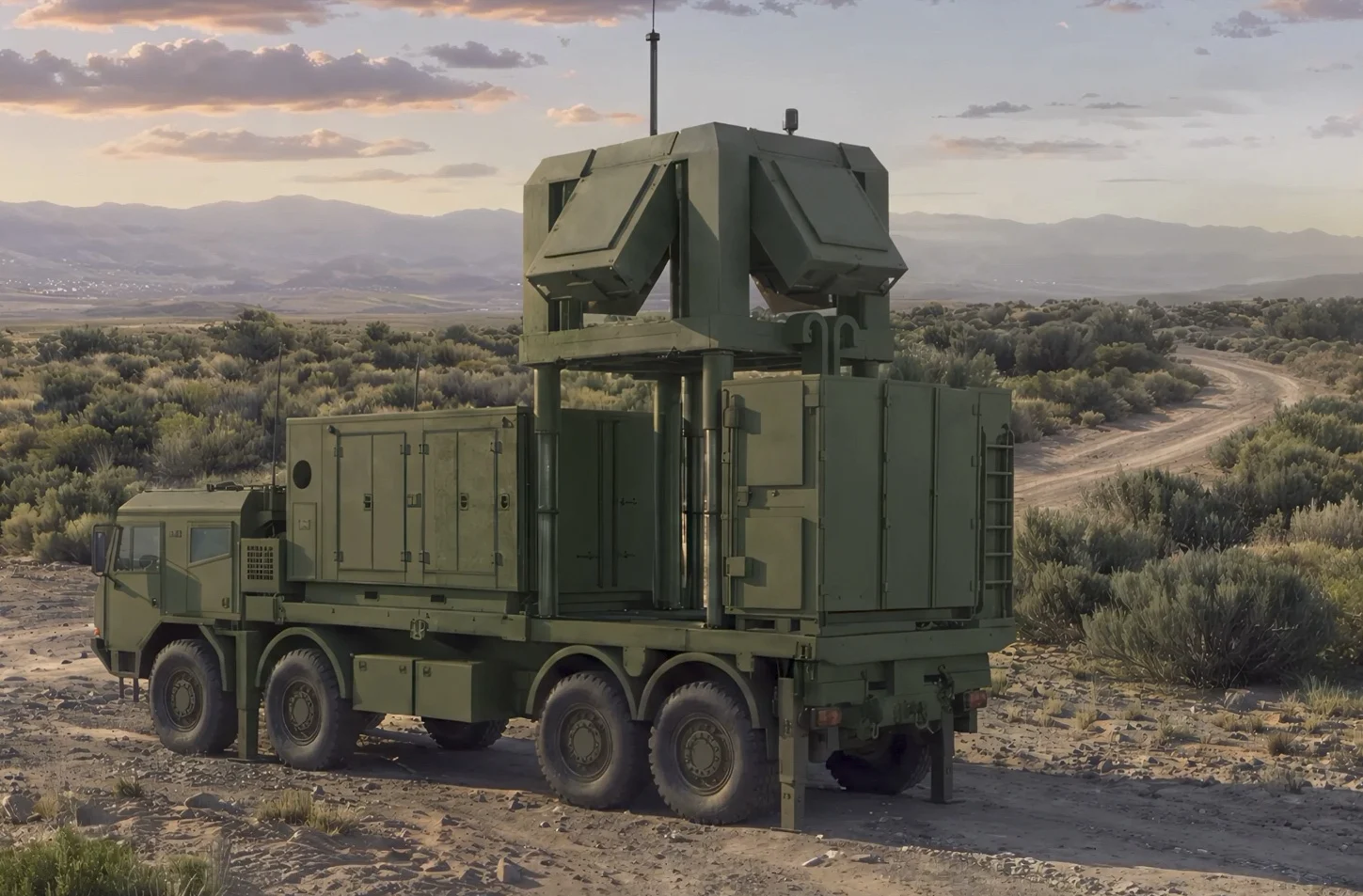
Leonardo DRS has begun initial production of the C-Band Extended Multi-Mission Hemispheric Radar (cxMHR), a fully digital, software-defined Active Electronically Scanned Array (AESA) sensor built for integrated air and missile defense (IAMD). The company announced the launch on October 12, 2026, at the Association of the U.S. Army (AUSA) Annual Meeting and Exposition in Washington, D.C.
The cxMHR extends a radar line Leonardo DRS acquired when it completed its all-stock merger with Israel’s RADA Electronic Industries in November 2022. The Multi-Mission Hemispheric Radar (MHR) family already sits at the core of the U.S. Army’s Stryker-based Maneuver Short-Range Air Defense (M-SHORAD) system, which carries four MHR radars per vehicle for continuous air surveillance. The new sensor arrives as the Army and its allies rebuild layered air defense against mixed raids of drones, loitering munitions, cruise missiles and short-range ballistic missiles, a threat set that has driven radar requirements since Russia’s full-scale invasion of Ukraine in February 2022.
cxMHR Radar Architecture: Four Digital C-Band Panels on One Vehicle
The cxMHR integrates four AESA panels, an Identification Friend or Foe (IFF) system, command-and-control equipment and supporting peripherals into a single ISO-containerized system. According to the company, the configuration can move by air, land or sea and deploys on a single vehicle. The four fixed panels deliver continuous 360-degree hemispheric coverage without a rotating antenna, so the radar can revisit any sector without waiting for a mechanical scan cycle, a key factor against fast, low-flying targets that appear late.
Leonardo DRS describes the cxMHR as a 4D AESA radar, a designation that typically covers range, azimuth, elevation and radial velocity. The company states detection ranges beyond 90 kilometers against unmanned aircraft systems (UAS) and loitering munitions, and beyond 330 kilometers against transport aircraft. It has not published detection figures for tactical ballistic missiles, cruise missiles or rockets, although all three appear in the stated threat set, nor has it released weight, power draw, elevation coverage or simultaneous track capacity.
The move to C-band, which spans 4 to 8 GHz, marks a shift for the family. Existing members such as the Improved and Enhanced MHR (ieMHR) and the Extended MHR (exMHR) operate in S-band, while the Next-Gen MHR (nMHR) uses X-band, according to company product literature. C-band generally balances the longer reach of S-band against the finer resolution of X-band, and it is the band chosen for Raytheon’s Lower Tier Air and Missile Defense Sensor (LTAMDS) and Hensoldt’s TRML-4D, which equips the IRIS-T SLM system. That places the cxMHR closer to medium-range air defense fire control than to the short-range counter-UAS niche where the MHR line built its reputation.
AI-Enabled Fire Control and Open Interfaces for IAMD Integration
Leonardo DRS pairs the aperture with AI-enabled tracking and classification, which the company says yields fire-control-quality tracks, extended detection range and rapid target updates. A fire-control-quality track is precise enough to cue an interceptor or effector directly rather than simply populate an air picture, which matters for weapons with short engagement timelines such as guns, short-range missiles and directed-energy systems. The company has not disclosed how its classification models were trained or validated.
The radar is built to Modular Open Systems Approach (MOSA) standards. Supported interfaces include Forward Area Air Defense (FAAD) command and control, Medusa, SAPIENT, Lattice, ASTERIX, MICAD and RAFT, among others. FAAD is the Army’s short-range air defense command-and-control backbone, Lattice is Anduril Industries’ command-and-control software, SAPIENT is a sensor integration standard developed by the UK Ministry of Defence and used in NATO counter-UAS interoperability trials, and ASTERIX is the EUROCONTROL surveillance data format. The mix of U.S., commercial and European protocols points to export ambitions alongside U.S. service demand.
“We are ready to deliver this advanced IAMD capability at the speed and scale required by our customers,” said Max Cohen, senior vice president and general manager of Leonardo DRS RADA Technologies. The company has not named a launch customer, a contract value or a production rate.
Analysis: The cxMHR reflects an industry push to merge surveillance and fire control into one rapidly deployable sensor. Medium-range radars such as the AN/MPQ-65 used with Patriot are large, high-value assets and priority targets. A single-vehicle, containerized radar with 330-kilometer reach against large aircraft and fire-control tracks against drones could give commanders more sensors to disperse, relocate and replace, if unit cost proves competitive. That case rests on figures DRS has not released, notably performance against ballistic missiles and resilience to electronic attack.
The cxMHR is on display at AUSA through October 14, 2026, at booth 6341 in Hall D, alongside the wider MHR family. Indicators to watch include a first named customer, any U.S. Army test or evaluation event, published ballistic missile detection data and integration demonstrations with FAAD or allied command-and-control networks. Initial production has started, but no fielding timeline has been disclosed.