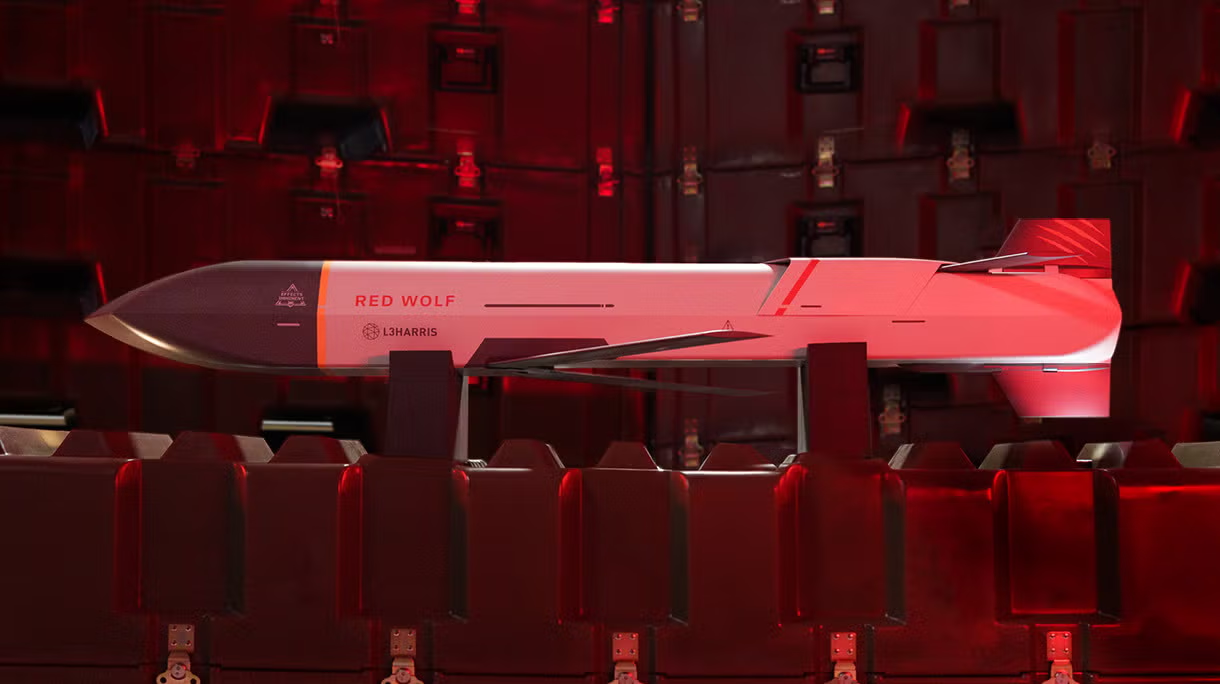
L3Harris Technologies and Divergent Technologies signed a teaming agreement on October 13, 2026, to scale production of affordable mass munitions, starting with the application of Divergent’s additive manufacturing processes to L3Harris’ Red Wolf and Green Wolf launched effects. The companies did not disclose financial terms, production quantities, or which structures Divergent would manufacture.
The agreement lands as Red Wolf moves from demonstration into a funded Marine Corps procurement effort. On January 30, 2026, Naval Air Systems Command (NAVAIR) awarded L3Harris an $86.2 million Other Transaction Agreement (OTA) to develop, test, and manufacture Red Wolf for the Marine Corps’ Precision Attack Strike Munition (PASM) program, which arms the AH-1Z Viper attack helicopter. On the same day as the Divergent announcement, L3Harris and the Army Special Operations Aviation Command’s Systems Integration Management Office completed the first Red Wolf launch from an MH-60 helicopter, opening an integration path to Black Hawks and other H-60 variants.
L3Harris Divergent Teaming Targets Red Wolf and Green Wolf Production
The companies will initially focus on the Wolf Pack family, which L3Harris describes as modular vehicles delivering long-range precision strike and non-kinetic effects from a common host air vehicle. That shared airframe is the industrial logic of the deal: a structure produced once can feed both the kinetic Red Wolf and the electronic warfare Green Wolf, spreading production across two product lines.
Divergent’s manufacturing platform, the Divergent Adaptive Production System (DAPS), combines AI-assisted generative design, laser powder bed fusion metal printing, and robotic fixtureless assembly. Because DAPS requires no dedicated tooling, a production cell can switch between parts by changing digital inputs rather than retooling a line. For a vehicle family whose payloads and configurations are still evolving, that shortens the path from design change to flight-ready hardware, and it allows the same cells to absorb surge orders without new capital equipment.
“Today’s evolving battlefield demands highly capable, affordable munitions to counter low-cost threats at scale,” said Quinlan Lyte, President, Advanced Effects, Missile Solutions, L3Harris. Divergent CEO and co-founder Lukas Czinger said the company would apply DAPS to current production programs while identifying opportunities to scale manufacturing across future aerospace and defense systems.
Long Beach Factory 2 and Divergent’s Existing Missile Workload
Divergent brings capacity already committed to other missile programs. In June 2026, the Torrance, California-based company announced Factory 2, a 430,000-square-foot facility in Long Beach, California, planned to house 64 Monolith One printers within 24 months. Each Monolith One uses 24 kilowatts of laser power across a 700 x 700 x 835 millimeter build volume. Divergent says the site could produce more than 30,000 500-pound-class missile airframes or 60,000 100-pound-class warhead casings per year.
The company is a second source for the Tomahawk midbody structure under contract with Raytheon, builds airframes for CoAspire’s Rapidly Adaptable Affordable Cruise Missile (RAACM) under the Air Force’s Family of Affordable Mass Missiles effort, and supports the Low Cost Containerized Munitions program. Outside the United States, Divergent printed a 4.5-meter fuselage from 26 metal parts for a Saab unmanned aircraft prototype slated to fly in 2026. The company raised a $290 million Series E round at a $2.3 billion valuation in September 2025.
Range, Payload, and Launch Platforms Across the Wolf Pack Family
Red Wolf is the kinetic strike variant. Green Wolf carries an electronic warfare payload with electronic attack and detect, identify, locate, and report (DILR) functions. L3Harris specifies high subsonic speed, a range of more than 200 nautical miles at low altitude, and endurance above 60 minutes. The company has not released propulsion, seeker, or warhead details.
That range defines the program’s operational value. Publicly available specifications put the AGM-114 Hellfire at roughly 8 kilometers and the Spike NLOS at about 32 kilometers, which keeps attack helicopters inside the envelope of short-range air defenses. A 200-nautical-mile standoff lets an AH-1Z or MH-60 engage surface combatants and air defense nodes from well outside those envelopes, turning rotary-wing aircraft into long-range strike shooters for distributed maritime operations.
The Wolf Pack’s 60 flight demonstrations include 13 fixed-wing, three rotary-wing, and 44 ground launches. Across those events, the vehicles carried 10 radios, six electronic warfare payloads, and one seeker, and integrated two autonomy engines. The software supports real-time in-flight collaboration, dynamic re-targeting, and coordinated swarming, and an optional parachute recovery system allows refurbishment in theater.
Analysis: The agreement splits system design from structural production, the same model Divergent runs with Raytheon on Tomahawk and with CoAspire on RAACM. For L3Harris, it adds airframe capacity without investment in conventional tooling and aligns Wolf Pack manufacturing with its affordable mass pitch. Printed structures address only one constraint, however. Small turbojet engines, seekers, and electronic warfare payloads remain pacing items across the low-cost cruise missile market, and additive manufacturing does not solve them. A teaming agreement also commits neither side to volume; its value depends on whether PASM and Army launched effects requirements convert into multi-year production orders.
The next indicators are contractual. NAVAIR expects L3Harris to deliver all PASM units, training, and support equipment for the AH-1Z by the end of fiscal 2027, while the MH-60 flight positions Red Wolf for Army aviation requirements. Divergent expects Factory 2 to begin printing Tomahawk structures in the first half of 2027, a test of whether Long Beach can absorb new programs while ramping existing ones. Neither company has said when the first Divergent-built Wolf Pack structures will fly.