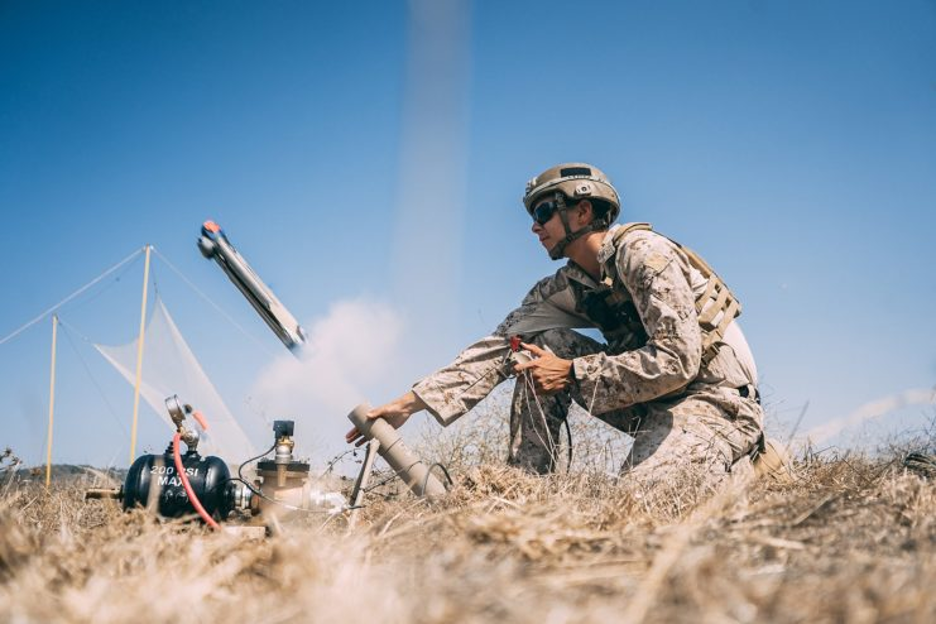
AeroVironment (AV) and Australian munitions group NIOA have signed a memorandum of understanding (MOU) to explore local production, integration and sustainment of AV’s one-way attack systems in Australia. The companies signed the agreement at LAND FORCES 2026 in Perth, held October 6 to 8, 2026, and AV disclosed it on October 13, 2026. The MOU is non-binding and commits neither party to manufacturing, technology transfer or distribution.
The deal lands as Canberra pushes to field loitering munitions while building a sovereign guided weapons industry. Australia announced its first Switchblade 300 purchase on July 8, 2024, without disclosing quantity or cost; the order was reportedly placed through the Foreign Military Sales channel. In parallel, the Advanced Strategic Capabilities Accelerator (ASCA) launched Mission Talon-Strike in May 2025 to field a domestically built medium-range precision loitering munition, and in October 2025 moved the mission into delivery with Innovaero’s One Way Loitering (OWL)-B vehicle under an 18-month, A$20.8 million (excluding GST) contract. The 2026 Integrated Investment Program lifts approved Guided Weapons and Explosive Ordnance (GWEO) investment above A$6 billion.
What the AeroVironment NIOA Agreement Covers and Leaves Open
The MOU sets a framework to identify a path toward localization, co-production and sustainment of AV’s one-way attack systems in Australia. Potential work streams include local manufacturing and integration, in-country support, and Australian variants carrying NIOA-developed payloads, warheads and mission effects “where technically, commercially and legally feasible,” according to AV.
NIOA could also become AV’s Australian distributor and authorized support partner, subject to final agreements and government approvals. That role would span customer engagement, training, logistics, maintenance coordination and inventory management. The two firms further share a non-binding ambition to make Australia a regional center of excellence for launched effects and loitering munitions serving Australian and allied customers.
“AV’s one-way attack systems are proven capabilities with growing demand from U.S. allies and partners around the world,” said Wahid Nawabi, AV chairman, president and chief executive officer. “Our collaboration with NIOA creates a pathway to expand that capability in Australia and explore how Australian industry can contribute to the manufacture, integration, support and sustainment of AV’s one-way attack systems.”
The announcement does not name a specific system, but AV filed it under its Switchblade family: the 300 Block 20, 400, 600 and 600 Block 2. The companies disclosed no contract value, production quantities, facility location or schedule. Any transfer will require U.S. and Australian government approvals and separate definitive agreements.
NIOA, founded in Queensland in 1973, brings an established munitions footprint. Its Australian Missile Corporation has been a GWEO Enterprise partner since 2022; it owns Barrett Firearms; it is a major tenant at the government-owned Benalla munitions facility in Victoria; and it partners with Rheinmetall in the Maryborough, Queensland, artillery shell forging plant. In 2026 the group also renewed its teaming agreement with L3Harris on sovereign rocket motor and warhead manufacturing, and agreed with Innovaero to develop and manufacture modular warheads and launch systems for loitering munitions.
Switchblade 300, 400 and 600 Block 2: The Systems in Play
Publicly available specifications frame what localization could mean. Australia bought the Switchblade 300 without naming the variant; the current Block 20 weighs 3.3 kg, dashes at 161 km/h and reaches 30 km with its extended-range antenna. AV has since added a modular payload bay accepting an explosively formed penetrator (EFP), which gives the backpackable round a light-to-medium armor option.
The Switchblade 400, which won a U.S. Army prototype agreement under the Low Altitude Stalking and Strike Ordnance (LASSO) program, is an 18 kg all-up round with a 12 kg munition, rocket-assisted take-off and a 3.17 kg payload capacity. AV quotes more than 65 km of maximum attack range with operator handoff, 35 minutes of endurance, a 113 km/h cruise, a 145 km/h dash and sub-meter accuracy, with automatic target recognition and a MANET link of 25 to 40 km. For a light infantry unit, that reach far exceeds the man-portable Javelin, qualified to 2.5 km with its standard launch unit and demonstrated at 4 km with the Lightweight Command Launch Unit.
The Switchblade 600 Block 2 carries an anti-armor warhead, reportedly of the same General Dynamics type fitted to the Javelin, plus a secondary payload bay. It offers more than 50 minutes of flight, over 100 km of range using relay handoff between operators, a 113 km/h loiter and 185 km/h sprint, M-code GPS, onboard automatic target recognition and an IP67 maritime rating, launched from a 1.5 m tube. That combination fits Australia’s littoral and archipelagic geography, where ground and vessel-launched strike must cover wide water gaps.
The payload clause carries the most weight. An Australian warhead would reduce dependence on U.S.-controlled energetics, a recurring constraint on allied co-production of American munitions. AV reported in October 2025 that it had raised Switchblade 600 output from 40 to 240 systems per month over the previous year, so a second line abroad would add surge depth rather than fill a supply gap.
Loitering Munitions in Australia: Sovereign Warheads and Next Steps
The MOU lets AV position itself inside an Australian market that has explicitly prioritized sovereign design. Canberra’s sovereign medium-range program, Talon-Strike, backs Innovaero’s OWL-B, and NIOA already partners with Innovaero on warheads and launchers. NIOA therefore emerges as the common munitions integrator across both a U.S. family and a domestic one, a hedge that serves NIOA regardless of which system the Australian Army scales. For Washington, a co-production node in Australia would extend AUKUS-era industrial integration into attritable strike, positioning loitering munition stocks and repair capacity closer to Indo-Pacific contingencies.
Next milestones include definitive agreements, U.S. export approvals and any Australian Defence order beyond the initial Switchblade 300 buy. The 18-month OWL-B contract runs to roughly April 2027, and an updated GWEO plan due this year should signal how much loitering munition production Canberra intends to fund onshore. Neither company has set a date for either step.