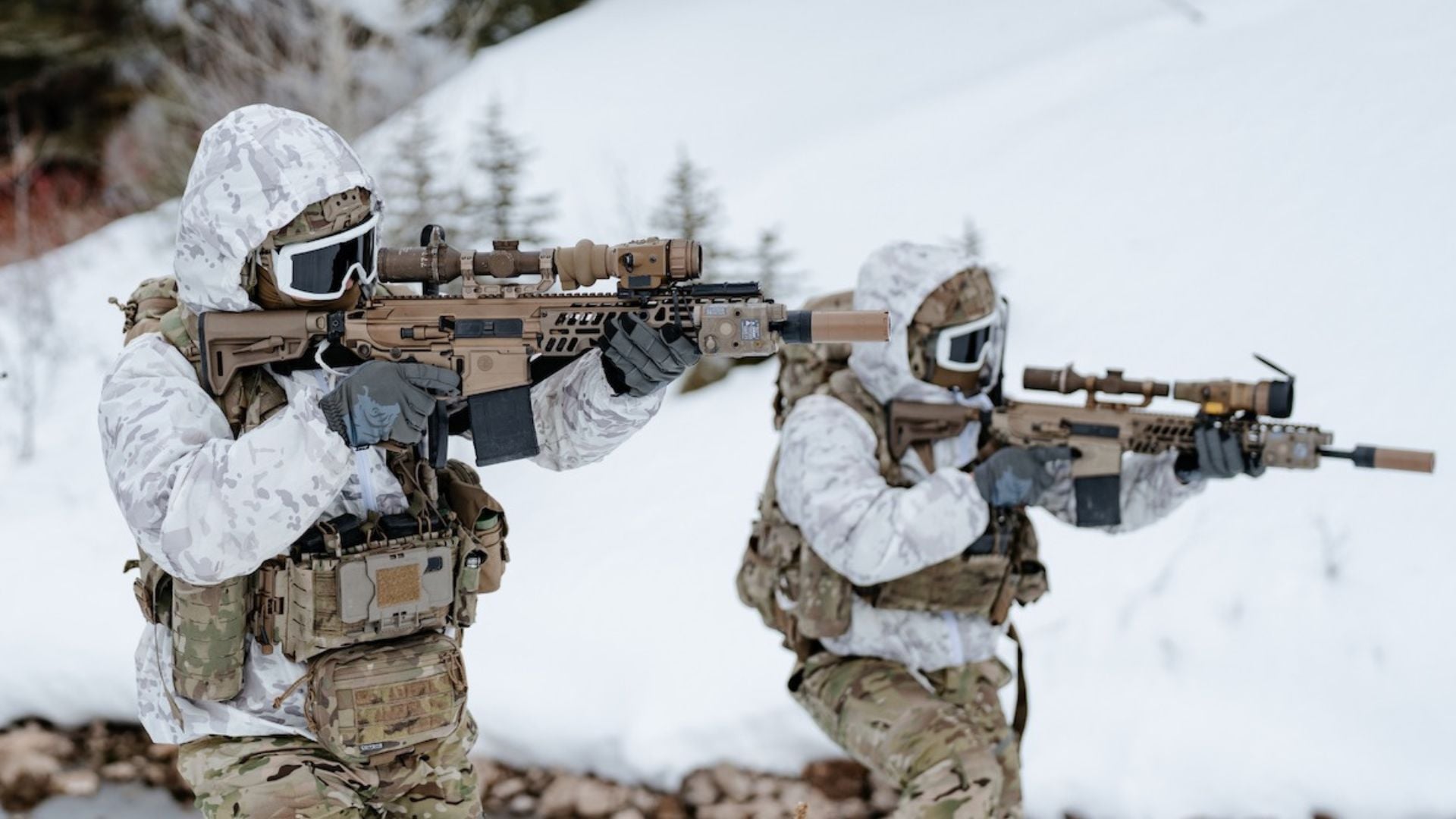
The U.S. Army has placed a $63 million production order with Leonardo DRS for the Family of Weapon Sights-Individual (FWS-I), the clip-on thermal sight issued to dismounted infantry, the Arlington, Virginia-based company announced on October 13, 2026. The order was issued under the Army’s existing indefinite-delivery/indefinite-quantity (IDIQ) contract for the system.
The award follows previously announced FWS-I production orders worth more than $134 million in November 2023 and $117 million in August 2024. Army Contracting Command awarded the underlying firm-fixed-price contract on April 28, 2022, valued at $579 million over five years, with production at the company’s Electro-Optical Infrared Systems facility in Melbourne, Florida. Program Executive Office (PEO) Soldier designed FWS-I as the weapon-mounted half of a paired system, and its battlefield value depends on the helmet display it feeds. That dependency matters more in 2026, as the Army rebuilds its head-borne soldier display architecture.
FWS-I Thermal Weapon Sight: Detector, Optics, and Rapid Target Acquisition
FWS-I is an uncooled long-wave infrared (LWIR) sight built around a proprietary vanadium oxide (VOx) microbolometer focal plane array. Company data sheet figures list a 640 x 480 detector with a 17-micron pixel pitch operating in the 7 to 14 micron band. Because the array needs no cryogenic cooler, the sight avoids the weight, power draw and cooldown delay of cooled mid-wave infrared sensors; publicly available specifications put start-up at under six seconds from power-on. The 17-micron pitch is coarser than the 12-micron detectors now common in new uncooled cores, and Leonardo DRS has not said whether current production lots carry an updated detector.
The optics provide an 18 x 13.5 degree wide field of view and a 6 x 4.5 degree narrow field of view, for 1x to 3x system magnification, with human recognition listed at greater than 950 meters. The sight weighs 525 grams with three L91 AA lithium batteries, measures roughly 5 x 3.2 x 3.2 inches, mounts on a MIL-STD-1913 Picatinny rail, operates from minus 40 to plus 49 degrees Celsius and survives immersion to 1 meter. In clip-on mode it sits in front of a day optic without disturbing zero; it also works as a standalone sight or handheld imager. Army officials have cited the M4 carbine, M16A4 rifle, M249 Squad Automatic Weapon, M136 AT4 and M141 Bunker Defeat Munition as host weapons.
The operationally decisive feature is Rapid Target Acquisition (RTA). The sight transmits its imagery and aiming reticle wirelessly to a helmet-mounted display, so a soldier can aim from the hip or around cover without shouldering the weapon. Leonardo DRS says the function works without active lasers, removing a signature that night-vision-equipped adversaries can detect. In 2018 range testing of the Enhanced Night Vision Goggle-Binocular (ENVG-B) with the sight, Army officials reported a 100 percent improvement in M4 qualification, a 300 percent improvement in target detection and a 30 to 50 percent cut in time to employ the weapon.
How the $579 Million IDIQ Fits the Army’s Post-IVAS Soldier Architecture
The company’s announcement names the Integrated Visual Augmentation System (IVAS) as a display partner alongside ENVG-B. That pairing no longer reflects Army plans. In July 2026, the Government Accountability Office reported that the Army had determined none of the roughly 10,000 IVAS units developed would be fielded, and that the IVAS 1.2 effort would transition to a rapid prototyping program, Soldier Borne Mission Command (SBMC). The Army approved the transfer of Microsoft’s IVAS contract to Anduril on April 10, 2025, and has since awarded SBMC prototyping agreements to Anduril, worth $159 million, and startup Rivet, worth $195 million, covering an 18-month sprint.
For FWS-I, ENVG-B therefore remains the fielded display that turns the sight into a networked aiming system. The Army planned to field an initial 10,000 ENVG-B pairs from late 2019 through 2021. Whether SBMC prototypes will accept the existing FWS-I wireless link, or impose a new interface standard, has not been disclosed. Every sight bought under the current IDIQ depends on that answer for its RTA value.
Leonardo DRS chief executive John Baylouny said the order reflects “the Army’s continued focus on advanced sensing, connected soldier systems and mission-ready capability.” The company did not disclose unit quantities, delivery schedules or the formations the new lot will equip.
Analysis: At $63 million, the order is roughly half the size of the 2023 and 2024 lots, which reads as a continuation buy rather than a production ramp. The more consequential signal is that the Army keeps funding the weapon-side sensor while redesigning the head-borne display from scratch. That approach decouples the sensor at the muzzle from the display at the eye and places the burden on SBMC to absorb the existing FWS-I and ENVG-B inventory rather than replace it. If SBMC settles on a different wireless or data standard, the Army could own a large fleet of sights whose signature capability works only with legacy goggles. For Leonardo DRS, steady sight revenue now hinges on a role in the next display generation.
If the five-year term runs from the April 28, 2022 award, the IDIQ would expire around April 2027, putting any follow-on competition on the near-term calendar. Leonardo DRS has not said how much of the $579 million value remains unordered. The next markers are SBMC prototype evaluations, any Army statement on RTA interoperability requirements, and whether a successor thermal sight effort is structured as a new competition or an extension of the current vehicle.