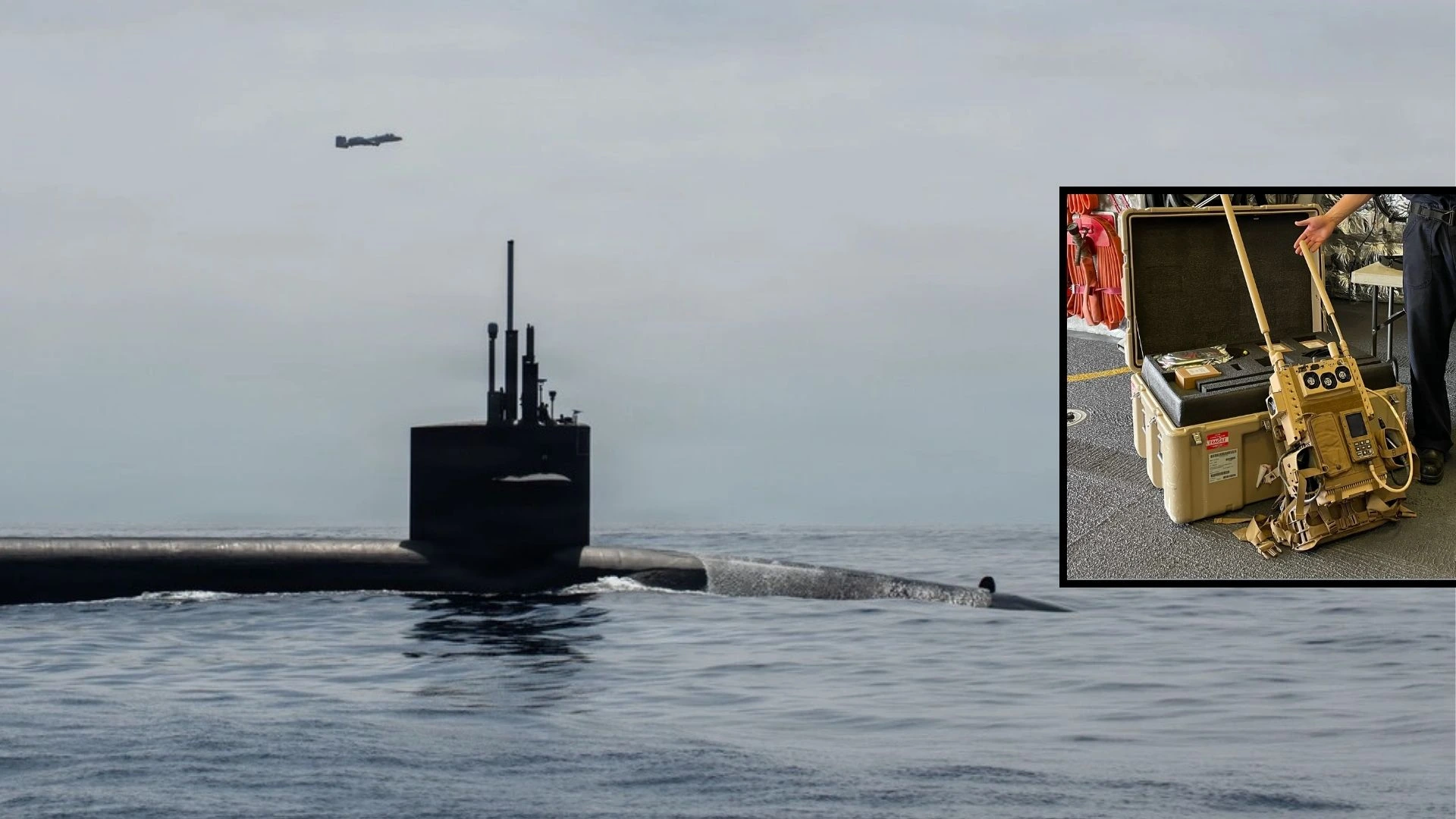
The US Navy is fitting Northrop Grumman’s Drone Restricted Access Using Known Electromagnetic Warfare (DRAKE) counter-drone system aboard its Ohio-class nuclear-powered guided-missile submarines (SSGNs), including lead boat USS Ohio (SSGN 726), according to Navy officials cited by Janes. The non-kinetic electronic warfare (EW) system detects, tracks and jams small uncrewed aircraft systems (UAS), giving the boats a defensive option during surfaced transits, harbor approaches and pierside periods, when a submarine loses its concealment.
The move carries into the submarine force a capability the surface fleet has operated since as early as 2021. It coincides with a new round of DRAKE software and hardware updates, including an Android-based operator interface, which Northrop Grumman fellow Michael Johnson outlined to Janes around the Association of the United States Army (AUSA) 2026 annual meeting in Washington, D.C. The boats receiving the system have also outlasted their retirement schedule: the Navy had planned to inactivate USS Ohio and USS Florida (SSGN 728) in fiscal year 2026, but Navy officials indicated in September 2025 that both would remain in service beyond that point, as combatant commanders leaned on SSGN strike capacity.
How the DRAKE Counter-Drone System Detects and Jams Small UAS
DRAKE is a software-defined radio (SDR) electronic countermeasure system. It monitors the radio-frequency (RF) environment for emissions associated with small drones, identifies and tracks the source, alerts the operator and, when authorized, applies selective jamming to sever the command link between the aircraft and its pilot. Northrop Grumman first demonstrated the concept at the Department of Defense’s Black Dart counter-UAS exercise in 2016, presenting it as a repurposing of mature counter-improvised explosive device (C-IED) technology against Group 1 drones, defined as aircraft under 20 pounds flying below 1,200 feet and slower than 100 knots.
That lineage runs through the Joint Counter Radio-Controlled Improvised Explosive Device Electronic Warfare (JCREW) program, a Naval Sea Systems Command program of record that reached full operational capability in July 2023 and is used by the US Navy, the Air Force, Australia and New Zealand. The current JCREW/DRAKE 2.0 configuration combines active, reactive and protocol-based jamming, displays threat data on a ruggedized tablet, and switches between counter-UAS and counter-IED modes without software changes. The family comes in mounted, dismounted and fixed-site variants for use afloat and ashore. Northrop Grumman has not published frequency coverage, effective jamming radius or output power.
The separation between sensing and jamming matters aboard a submarine. Johnson said operators can monitor nearby drones and decide whether to jam depending on the situation. For a platform whose defense rests on emission control, building a picture passively and transmitting only when the threat justifies the signature is the core operational value.
Ohio-Class SSGN Exposure During Surface Transits and Port Calls
USS Ohio was commissioned in 1981 as the first Ohio-class ballistic missile submarine and returned to service as an SSGN in February 2006. Publicly available specifications indicate a length of 560 feet and a submerged displacement of about 18,750 tons. Twenty-two of the 24 original missile tubes carry up to seven Tomahawk Land Attack Missiles (TLAMs) each, for a maximum of 154 missiles, while the boat can embark up to 66 special operations personnel and retains four 533 mm torpedo tubes for Mk 48 heavyweight torpedoes.
Ohio completed a three-year major maintenance period at Puget Sound Naval Shipyard and Intermediate Maintenance Facility in early 2025 and arrived at Naval Base Guam on April 23, 2025. A surfaced SSGN in a harbor or strait is a large, recognizable target, and a commercial quadcopter with an electro-optical camera can document its position, loading activity or a special operations embarkation. The Navy has not disclosed which DRAKE variant the SSGNs carry, where antennas are mounted, or how many of the four boats have received kits.
JCREW/DRAKE 2.0 Contract and the Android Interface Upgrade
DRAKE joined the Army’s Joint Counter-small Unmanned Aircraft Systems Office list of recommended detection and defeat systems in May 2023 and became a standalone Navy program of record in April 2024 under the Program Executive Office for Unmanned and Small Combatants. On September 26, 2024, Northrop Grumman received a follow-on production award for mounted and dismounted JCREW/DRAKE 2.0 systems as part of a contract valued at more than $161 million. The 2.0 standard adds signal processing capacity, wider frequency range and greater instantaneous bandwidth.
The Android interface targets the operator rather than the RF chain. Navy imagery has shown a Master-at-Arms running DRAKE aboard the destroyer USS Porter (DDG 78) during a simulated strait transit, and a familiar mobile interface lowers the training burden for crews handling the system alongside other duties. Johnson tied the update cycle to field use: “As they [DRAKE systems] are deployed, they are interacting with the UAS systems and learning from them.” Because DRAKE is software-defined, new threat libraries can be loaded without replacing installed hardware. Available disclosures do not establish whether the Android interface has reached the SSGNs.
Analysis: Putting a soft-kill jammer on the Navy’s highest-capacity strike submarines acknowledges that the SSGN’s vulnerability window sits at the pier and in the chokepoint, and that a low-cost drone now delivers imagery once reserved for dedicated surveillance assets. Russian Black Sea Fleet losses to uncrewed systems in and near its own harbors have made that threat concrete for every navy. DRAKE answers the RF-controlled share of it. It has no effect on fiber-optic-guided drones, now widespread on Ukraine’s front lines, or on aircraft flying preprogrammed autonomous routes, so SSGN force protection still depends on base defenses, emission discipline and staying submerged.
The Navy has not said whether DRAKE will migrate to Ohio-class ballistic missile submarines or Virginia-class attack boats, which share the same surfaced exposure in port. The larger variable is the SSGNs’ own lifespan: USS Michigan (SSGN 727) and USS Georgia (SSGN 729) were previously slated to leave service in fiscal year 2028, and the Block V Virginia-class boats expected to absorb part of the strike mission carry a fraction of the Ohio’s 154-missile load.