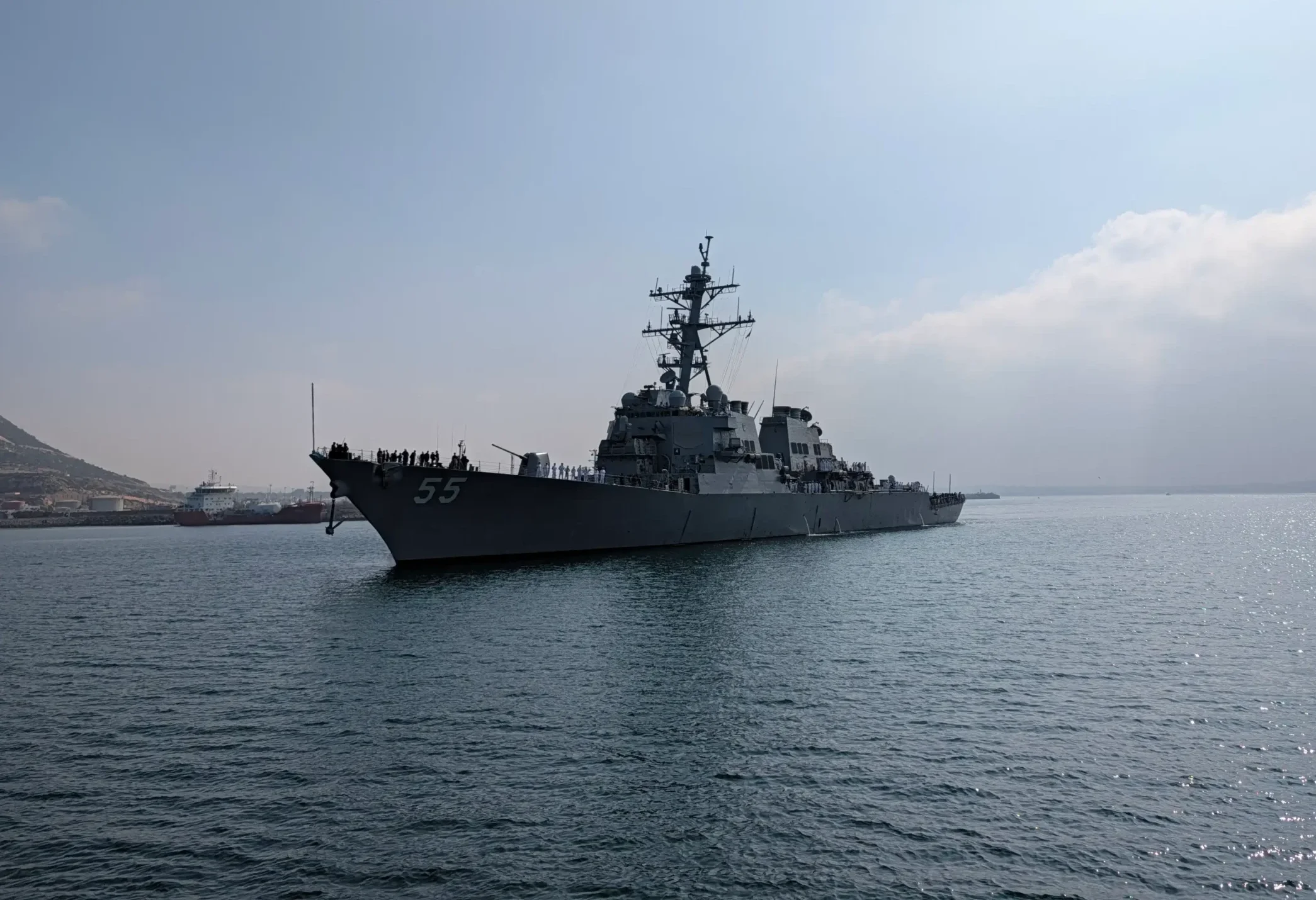
The US Navy Arleigh Burke-class guided-missile destroyer USS Stout (DDG 55) departed Agadir, Morocco, on October 13, 2026, after a scheduled port visit that began October 11, according to US 6th Fleet. The Norfolk-based warship is deployed independently to the US Naval Forces Europe-Africa (NAVEUR-NAVAF) area of responsibility, which it entered after leaving Virginia in September.
The call on Morocco’s Atlantic coast places a US surface combatant alongside one of Washington’s oldest partners. The relationship rests on the 1786 Treaty of Peace and Friendship, which the Navy describes as the longest-standing treaty relationship in US history. Morocco has held Major Non-NATO Ally status since 2004 and hosts African Lion, US Africa Command’s largest annual exercise. Cmdr. Kevin Taylor, Stout’s commanding officer, said “Morocco’s leadership in regional maritime security made this a highly valuable visit, and our Sailors were proud to represent the Navy while experiencing all the country has to offer.”
USS Stout Morocco Visit Fits an Independent 6th Fleet Deployment
The Navy has not disclosed Stout’s mission set, planned duration or any task group assignment for this deployment. As an independent deployer, the destroyer operates outside a carrier strike group, a posture that lets 6th Fleet task a single hull for maritime security operations, partner engagements and port calls.
The deployment follows a demanding operational record. Stout returned to Naval Station Norfolk on June 1, 2025, after an eight-month deployment with the Harry S. Truman Carrier Strike Group across the 5th and 6th Fleet areas, a cruise that included combat operations in the Red Sea. A former commanding officer has written that Stout served as the strike group’s ballistic missile defense commander in the Red Sea in early January 2025, and that its crew conducted the only Standard Missile-3 (SM-3) engagement of that Red Sea deployment.
The ship also holds a Navy endurance mark. In 2020, with COVID-19 restrictions curtailing port calls, Stout set a consecutive underway record of 215 days at sea, escorting the USS Bataan (LHD 5) Amphibious Ready Group and the Dwight D. Eisenhower and Nimitz carrier strike groups before arriving in Rota, Spain, on October 3, 2020.
Flight I Aegis Destroyer Capabilities: Sensors, Weapons, and Limits
Commissioned on August 13, 1994, and built by Ingalls Shipbuilding in Pascagoula, Mississippi, Stout belongs to the original Flight I configuration of the DDG 51 class. Publicly available specifications indicate a length of 505 feet, a beam of 66 feet and a full-load displacement of roughly 8,300 long tons. Four General Electric LM2500 gas turbines driving two shafts deliver about 100,000 shaft horsepower and speeds above 30 knots.
The combat system centers on Aegis and the AN/SPY-1D phased-array radar, which cues 90 Mark 41 Vertical Launching System cells able to carry SM-2 and SM-3 interceptors, Evolved SeaSparrow Missiles, Tomahawk land-attack missiles and Vertical Launch ASROC anti-submarine rockets. A 5-inch Mark 45 gun, Phalanx close-in weapon systems and Mark 32 torpedo tubes complete the loadout, while the AN/SQS-53C hull-mounted sonar supports anti-submarine warfare. Stout fired Tomahawks at Libyan targets during Operation Odyssey Dawn in 2011.
Those figures carry a caveat. Flight I hulls lack the helicopter hangars introduced on Flight IIA ships, so Stout cannot embark MH-60R Seahawks for sustained organic anti-submarine or surface search; its flight deck supports refueling and vertical replenishment only. The Navy has not specified which Aegis baseline or modernization package the ship carries on this deployment. In 2018, the service announced plans to extend Arleigh Burke-class service lives to 45 years, which would keep a 1994 hull in the fleet into the late 2030s.
Analysis: A single Flight I destroyer calling on Agadir shows how the Navy sustains presence along Africa’s Atlantic seaboard without committing high-demand carrier or amphibious groups. Older Aegis hulls such as Stout carry real air and missile defense credentials, as the 2025 Red Sea engagement showed, yet they increasingly absorb routine engagement missions while newer Flight III ships enter service. For Morocco, a partner whose coastline spans the Atlantic and the approaches to the Strait of Gibraltar, regular visits by such units reinforce a security relationship built on exercises and port access.
6th Fleet has not announced Stout’s next port call, any planned exercises or the length of the deployment. Indicators to watch include whether the destroyer moves into the Mediterranean, operates with NATO maritime groups or remains along West Africa, and whether it supports partner training ahead of the 2027 edition of African Lion.