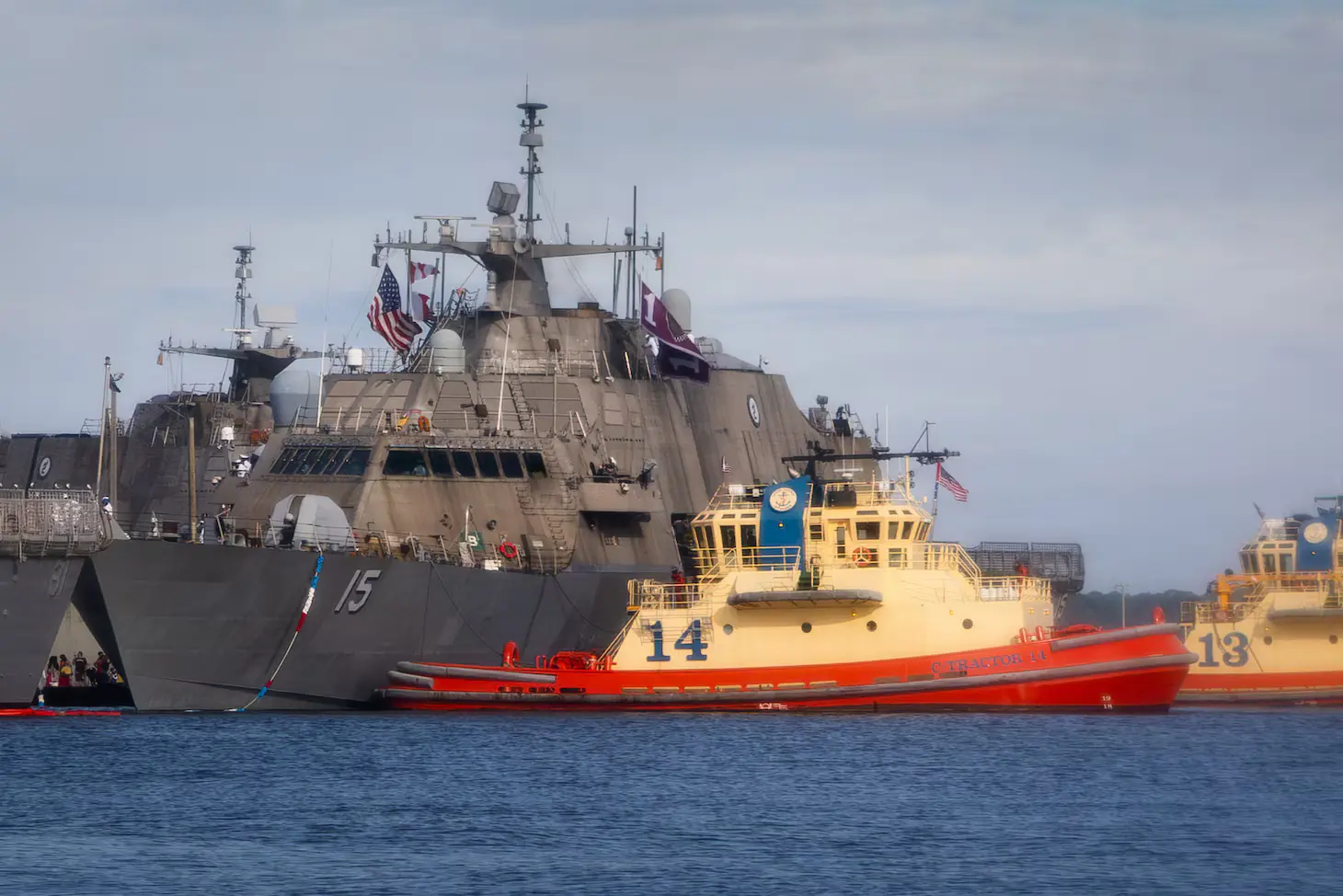
The U.S. Navy Freedom-class littoral combat ship USS Billings (LCS 15) returned to Naval Station Mayport, Florida, on October 10, 2026, after a six-month deployment to the U.S. 4th Fleet area of operations in support of U.S. Southern Command (SOUTHCOM). According to the Navy, interdictions supported by the ship resulted in the seizure of more than 2,500 kilograms of illicit narcotics and the apprehension of suspected traffickers.
Billings departed Mayport on March 27, 2026, and returns to a shrinking community. The Navy decommissioned USS Fort Worth (LCS 3) at Naval Base San Diego on July 29, 2026, the sixth Freedom-variant hull removed from service, leaving 10 of the 16 ships built still in commission. For the Mayport-based hulls, counter-illicit trafficking patrols in the Caribbean and Eastern Pacific have become the core mission, trading the high-end warfighting roles the class was conceived for against persistent, lower-cost presence in a theater that rarely receives major surface combatants.
USS Billings Interdiction Operations With Coast Guard and HSM-48
Billings sailed with an embarked U.S. Coast Guard Law Enforcement Detachment (LEDET) and a detachment from Helicopter Maritime Strike Squadron (HSM) 48. The pairing reflects a legal constraint as much as an operational one: Navy personnel do not conduct law enforcement boardings themselves, so the LEDET provides the authority to stop, board and seize, with tactical control of the ship shifting to the Coast Guard during an interdiction.
HSM-48, based at Naval Station Mayport, operates the MH-60R Seahawk. Publicly available specifications indicate the aircraft carries a multi-mode surface search radar and a forward-looking infrared turret, giving the ship detection and tracking reach far beyond its own horizon against go-fast boats and low-profile vessels. The Freedom-class flight deck and hangar are sized for up to two MH-60-series helicopters, making aviation, rather than the gun, the decisive asset in this mission set. The Navy did not disclose the number of interdictions or the types of vessels involved.
The Navy framed the effort in sharper terms than routine counterdrug reporting. \”Whether executing high-stakes interdictions, transporting vital drinking water in support of disaster relief efforts, or contributing to coalition efforts, these Sailors helped impose total systemic friction on narco-terrorist networks,\” said Rear Adm. Carlos Sardiello, commander of U.S. Naval Forces Southern Command/U.S. 4th Fleet.
Billings also worked alongside the Dominican Republic Navy and the Jamaica Defence Force to improve information sharing and address shared security challenges, according to the Navy.
Freedom-Class Design Trade-Offs Shape the SOUTHCOM Mission
Built by a Lockheed Martin-led team at Fincantieri Marinette Marine in Wisconsin and commissioned in Key West, Florida, on August 3, 2019, Billings is the eighth Freedom-variant LCS. Publicly available specifications indicate a steel semi-planing monohull of 387.6 feet (118 meters) and a full-load displacement of roughly 3,500 metric tons. Its combined diesel and gas turbine plant pairs two Rolls-Royce MT30 gas turbines with two Colt-Pielstick diesel engines driving four waterjets, for speeds above 40 knots.
That sprint speed matters when closing on smuggling craft, but the armament is light: a BAE Systems Mk 110 57 mm gun and a Mk 49 Rolling Airframe Missile launcher, operated by a core crew of about 70 sailors. The class has also carried a combining gear defect, identified in 2021, that the Navy and Lockheed Martin have been correcting across affected hulls. The Navy release does not state whether Billings has received that fix.
The ship’s reconfigurable mission bay and deck space proved useful beyond law enforcement. After an earthquake in Venezuela in June, Billings transported more than 77,000 pounds, or about 35 metric tons, of drinking water in support of humanitarian assistance, according to the Navy.
Analysis: The deployment shows where the Freedom variant has found a durable role: low-end, aviation-centric presence missions that would otherwise consume destroyer days the Navy needs in the Indo-Pacific and the Middle East. Each retirement removes a hull from that rotation, and no dedicated small surface combatant replacement is arriving at scale in the near term. With SOUTHCOM now framing the counterdrug fight in counter-narco-terrorist terms, demand for these ships in the 4th Fleet area is unlikely to fall as quickly as the class itself shrinks.
The Navy has not announced the next maintenance availability or deployment date for Billings. Ships returning from a six-month cycle typically enter a maintenance and training period before redeploying. The key unknown is whether the remaining Mayport-based Freedom-class hulls appear in upcoming decommissioning plans, a decision that will determine how long the 4th Fleet can sustain this tempo with littoral combat ships.