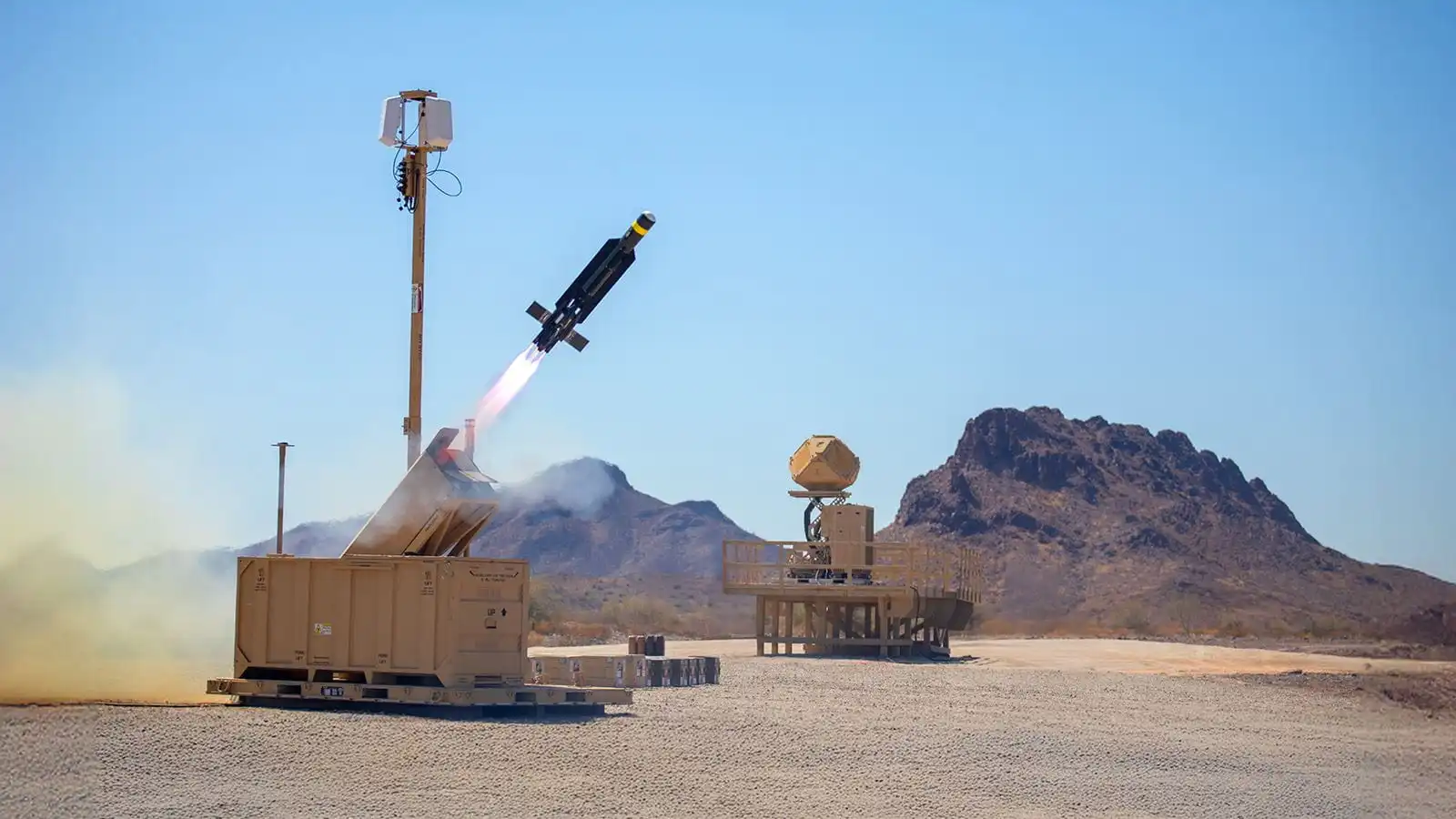
Raytheon, an RTX business, has been awarded $729 million to deliver Ku-band Radio Frequency Sensor (KuRFS) radars and Coyote effectors for the Low, slow, small unmanned aircraft Integrated Defeat System (LIDS) to the U.S. Army, Qatar and Jordan, the company announced on October 13, 2026. Raytheon describes the award as the first international sales of KuRFS and Coyote, and says it covers a mix of fixed-site and mobile LIDS configurations.
The award arrives one day after Raytheon disclosed three company-funded tests of a rocket-boosted Coyote upgrade, and just over a year after the Army placed a $5.04 billion order on September 29, 2025, for fixed and mobile Coyote launchers, kinetic and non-kinetic interceptors and KuRFS radars, with work running through September 28, 2033. LIDS has become the Army’s primary answer to the one-way attack drones that Iran-aligned groups have launched against U.S. positions across the U.S. Central Command (CENTCOM) area of responsibility, including the January 28, 2024, strike on Tower 22 in Jordan that killed three U.S. soldiers.
Inside the Raytheon LIDS Contract: Customers, Configurations, Unknowns
Raytheon has not disclosed the split among the three customers, the quantities of radars, launchers and interceptors, the delivery schedule, or whether the Army portion is an order under the September 2025 vehicle. It did confirm the composition: KuRFS for 360-degree detection and Coyote kinetic and non-kinetic effectors, in fixed-site (FS-LIDS) and mobile (M-LIDS) form.
Qatar’s path to this contract runs through the Foreign Military Sales (FMS) process. The State Department approved a possible sale on November 29, 2022, covering 10 FS-LIDS systems of systems, 200 Coyote Block 2 interceptors, Coyote launchers, a counter-unmanned electronic warfare system, Ku-band radars and Forward Area Air Defense Command and Control (FAAD C2), at an estimated $1 billion. Doha reportedly finalized that acquisition in May 2025. Qatar also hosts Al Udeid Air Base, the largest U.S. installation in the Middle East.
Jordan’s demand signal is more recent. In February 2026, the State Department approved a potential $280 million FMS case for Ku-band Multi-Function Radio Frequency System (KuMRFS) radars integrated with command-and-control systems, with RTX’s Tucson-based missile defense business as prime contractor. That notification covered sensors; Raytheon’s October 13 release frames the new award as delivering both KuRFS and Coyote, but does not specify which customer receives which elements.
U.S. volumes frame the export numbers. A December 2023 notice of intent to sole source set a minimum fiscal 2025 to 2029 requirement of 6,000 Coyote kinetic interceptors, 700 non-kinetic interceptors, 252 fixed-site launcher systems, 25 mobile launcher systems, 118 fixed-site KuRFS and 33 mobile KuRFS.
KuRFS Radar and Coyote Block 2 Interceptor in the LIDS Kill Chain
KuRFS began life as a sense-and-warn radar built to cue defenses against rocket, artillery and mortar fire in Iraq and Afghanistan. It is an active electronically scanned array (AESA) operating in the Ku band, whose short wavelengths give fine resolution; Raytheon says the radar discriminates small drones from birds and clutter and can track an object as small as a 9 mm round. The scaled Ku720 variant provides the sensing layer on vehicle-mounted M-LIDS, and Raytheon reports that the radar family has logged more than 1.5 million operational hours.
In the Army architecture, the radar feeds Northrop Grumman’s FAAD C2, which fuses tracks and assigns engagements, while an electronic warfare system from SRC provides a soft-kill layer against control links. Coyote is the hard-kill end of the chain. The Block 2 is a rail-launched interceptor that uses a boost rocket motor and then a small turbine engine for sustained flight. U.S. arms sales notifications describe it as a high-speed, highly maneuverable, semi-active guided airframe carrying a proximity blast-fragmentation warhead. Publicly available specifications indicate an engagement range of roughly 15 km for current Block 2 variants, compared with a propeller-driven Block 1 that dashed at about 70 knots.
The non-kinetic Coyote Block 3NK adds a recoverable option with a payload designed to defeat swarms while limiting collateral damage, which Raytheon demonstrated in an Army test disclosed in February 2026. Pricing data remain thin, but a February 2024 rapid acquisition award of $75 million for 600 Coyote Block 2C interceptors implies an average of about $125,000 per round, a figure that may include non-recurring costs. That is a fraction of the cost of the Standard Missile and Patriot rounds expended against drones in the region.
Coyote Block 2C+RM Upgrade and the Production Ramp
On October 12, 2026, Raytheon reported three successful developmental tests of the Coyote Block 2C+RM, which it says moved from concept to testing in 15 months on company funding. The upgrade integrates a tactical rocket motor for faster launch and flight, alongside a new seeker and warhead intended to defeat all classes of current and emerging drones. The test series confirmed initial integration with the existing counter-drone architecture and included the first launches of a Coyote fitted with the tactical motor, which Raytheon says shortens engagement times and enables faster successive shots.
Faster launch and higher speed compress the time between radar cue and intercept, which matters against jet-powered one-way attack drones and multi-track salvos. Greater range at higher altitudes, which Raytheon ties to the new contract, pushes intercepts farther from the protected asset.
“LIDS provides a proven and cost-effective layer of defense that ensures allied forces have the protection they need against hostile drones,” said Tom Laliberty, president of Land and Air Defense Systems at Raytheon. The company says RTX is investing to expand Coyote production. Further Gulf demand is pending: a 2026 FMS notification for the United Arab Emirates covers FS-LIDS with 240 Coyote Block 2 all-up rounds and four-pack launchers.
Analysis: The award turns LIDS from a U.S. Army program into a coalition architecture spanning the Gulf and the Levant. Qatar and Jordan both host U.S. forces, and fielding the same radar and interceptor, plus FAAD C2 in Qatar’s case, creates a basis for shared air pictures and common sustainment around installations that have already drawn drone fire. The constraint is industrial. The Army’s minimum requirement of 6,000 kinetic Coyotes over five fiscal years already sets a demanding rate for a sole-source production base, and every export round competes for the same capacity. Delivery schedules, not contract values, will determine whether these sales add protection or add backlog.
Key unknowns remain the customer split, quantities and delivery timelines, none of which Raytheon has released. The next indicators are further Army orders against the $5.04 billion vehicle, a contract action implementing the UAE notification, and any Army decision to fund qualification and production of Coyote Block 2C+RM once the company-funded test phase concludes.