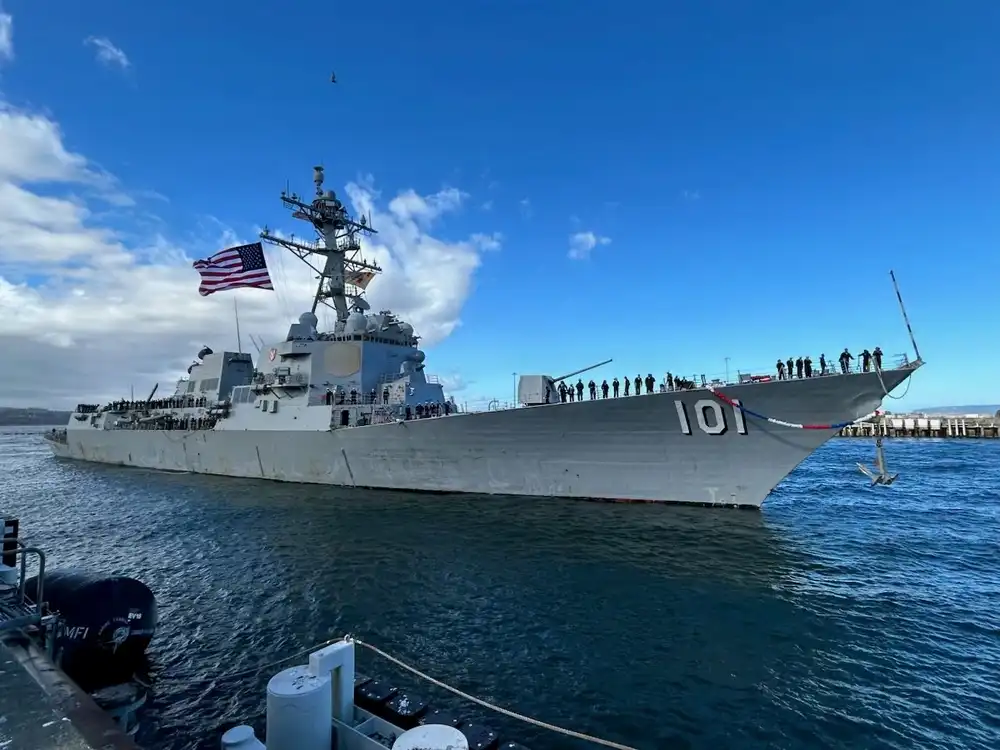
The U.S. Navy has ordered $15,078,910 in spare parts from Raytheon for the MK 99 fire control system, the AN/SPY-1 radar transmitter group and the AN/SPY-3 multifunction radar, the Pentagon announced on October 13, 2026. The firm-fixed-price delivery order covers 419 requirements across 46 National Item Identification Numbers, with work running through December 2034.
The Navy tied the purchase directly to the North Star goal set by Commander, Naval Surface Force: 75 mission-capable ships on any given day. Vice Adm. Roy Kitchener set that benchmark in 2022 with a fiscal 2024 deadline; in January 2024, his successor, Vice Adm. Brendan McLane, said the force was averaging only 50 to 60 mission-capable ships daily.
How the Aegis Radar Spare Parts Order Targets 75 Ready Ships
The Navy attributes the 419 requirements to four drivers: fleet stocking increases from remodeled allowances for operational availability and endurance supply, allowance change requests, maintenance activities, and higher stock levels at forward-deployed sites. An allowance is the quantity of a given item a ship or support activity is authorized to carry. Raising it moves radar and fire control components out of stateside depots and onto hulls and overseas sites, where a failed module can be replaced without waiting on a part shipped from the continental United States. Endurance supply refers to the parts depth a ship needs to sustain operations through long deployments between replenishments.
Naval Supply Systems Command Weapon Systems Support (NAVSUP WSS) in Philadelphia issued the order as delivery order 00383-27-F-NE00 under basic ordering agreement N00383-25-D-NE01. It carries no options, so any additional demand would require a new delivery order. Fiscal 2026 Navy working capital funds cover the full amount, obligated at award and not expiring at the end of the fiscal year. That funding model matters: the supply system buys inventory up front and recovers the cost when fleet units requisition parts, allowing NAVSUP to build depth ahead of failures rather than chase casualty reports.
NAVSUP solicited only Raytheon and received a single offer, invoking 10 U.S. Code 3204(a)(1), which permits sole-source awards when only one responsible source can satisfy the requirement. Raytheon will perform 95% of the work in Andover, Massachusetts, home to the company’s long-running Aegis transmitter and fire control production, and the remaining 5% in Chesapeake, Virginia.
What the SPY-1 Transmitter, MK 99 and SPY-3 Parts Sustain
The AN/SPY-1 is the S-band passive electronically scanned array at the core of the Aegis Combat System. Lockheed Martin builds the radar, but Raytheon supplies its transmitter group and says it delivered the first unit in 1981. The transmitter feeds the radar’s four fixed array faces through high-power crossed-field amplifier vacuum tubes, 32 per transmitter according to publicly available descriptions, and like all high-power tubes they wear with operating hours. A transmitter casualty degrades the ship’s primary air search and tracking sensor. The SPY-1D has equipped Arleigh Burke-class destroyers since USS Arleigh Burke (DDG 51) in 1991, with the littoral-optimized SPY-1D(V) on Flight IIA hulls, while the five remaining Ticonderoga-class cruisers carry the SPY-1B.
Once SPY-1 establishes a track, the MK 99 slews an AN/SPG-62 continuous-wave illuminator onto the target for terminal homing by the Standard Missile-2 (SM-2), the Evolved Sea Sparrow Missile (ESSM) Block 1, and the SM-6 when fired in semi-active mode. The SPG-62 is a mechanically steered X-band dish roughly 2.29 meters (7.5 feet) across, with a publicly cited average power of 10 kilowatts. Destroyers carry three and cruisers four. Because Aegis time-shares illuminators across interceptors during saturation raids, each one lost cuts simultaneous terminal engagement capacity. The Navy has been replacing the illuminators’ traveling wave tube transmitters with solid-state units to raise mean time between failures.
The AN/SPY-3 is a Raytheon X-band active electronically scanned array operating near 10 GHz, optimized for horizon search and precision tracking of low-flying threats. Its installed base is four ships: the three Zumwalt-class destroyers and USS Gerald R. Ford (CVN 78). Later Ford-class carriers, starting with John F. Kennedy (CVN 79), are fitted with the SPY-6(V)3 instead. With no new-build demand to keep production warm, spares must be stocked deliberately. The Zumwalt class was excluded from the North Star count when the metric was defined.
Analysis: The dollar value is modest, but the order marks a shift from cannibalization toward forward-positioned depth for the Aegis engagement chain, and SPY-1 demand will persist into the next decade. SPY-6(V)4 backfits target Flight IIA hulls, starting with USS Pinckney (DDG 91) between late 2026 and 2028, while 12 Flight I destroyers had their service lives extended to between 2028 and 2035 in October 2024. The Navy is still mining hulls for parts: USS Lake Erie (CG 70) and USS Shiloh (CG 67), decommissioned in late September 2026, were designated logistics support assets, the Navy’s category for hulls used for cannibalization and equipment removal. Reliance on a single Raytheon production base remains the structural risk.
The announcement does not disclose which forward-deployed sites receive the added stock, the delivery schedule, or how the value splits across the three systems. The order follows a $271.5 million Raytheon contract for MK 99 production and Aegis modernization equipment, announced August 3, 2026, that could reach $302.5 million with options. Further delivery orders under the same basic ordering agreement would show whether the Navy is funding readiness-driven sparing at scale.