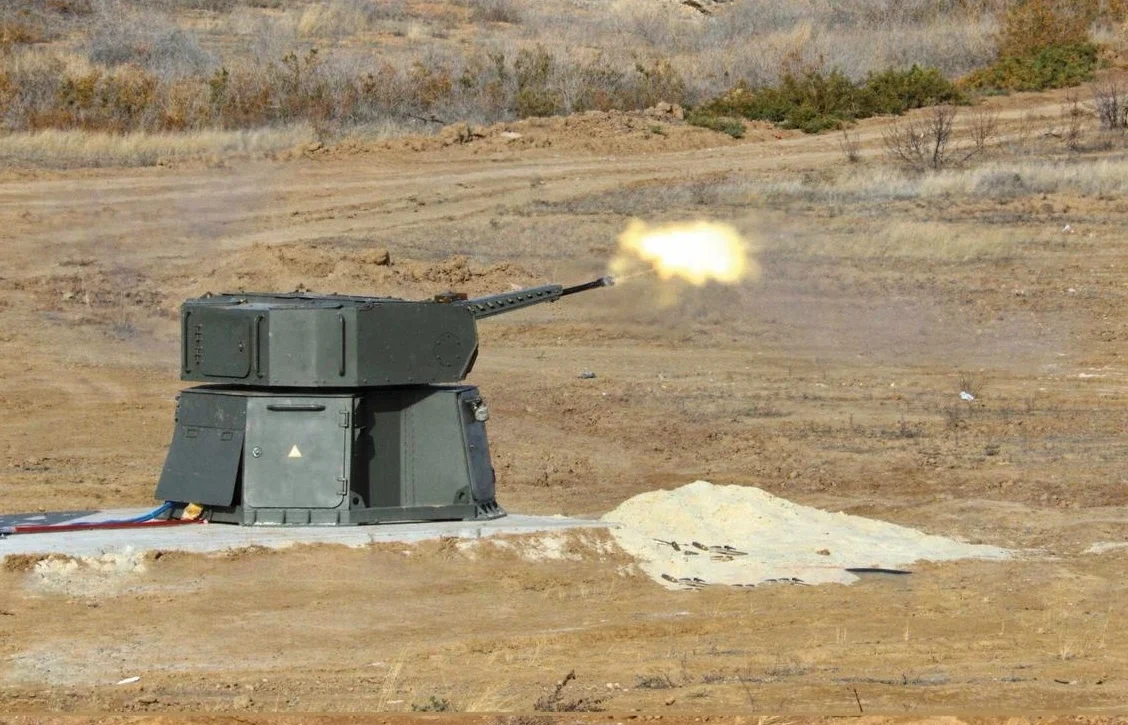
Russian state defense conglomerate Rostec is marketing its 30mm ZAK-30 Tsitadel anti-drone gun as a lower-cost competitor to Rheinmetall’s Skynex and the US Phalanx and Counter-Rocket, Artillery and Mortar (C-RAM) systems, claiming in a statement this week that combat use in Ukraine has demonstrated advantages in automation, cost per shot and effectiveness. Rostec has released no independent test data.
The pitch caps a five-month effort to move Tsitadel from domestic point defense into the export catalog. Rostec unveiled the system at the First International Security Forum near Moscow, held from May 26 to May 29, 2026, presenting it as a round-the-clock shield for fixed sites such as plants, depots and energy facilities. In September, the system made its first foreign appearance at the El Alamein International Airshow 2026 in Egypt. The timing reflects pressure at home: Ukrainian long-range drone strikes on refineries deep inside Russia have exposed gaps in its air defense network.
How the Tsitadel Anti-Drone Gun Engages Small UAVs
Tsitadel fires 30mm shells packed with shrapnel and fitted with a remotely set fuze. The fire control computer calculates the optimal detonation point along the target’s flight path, so each round bursts just ahead of the drone and fills its path with fragments. Rostec says this cuts the number of rounds needed per kill compared with impact-fuzed ammunition, a key factor against cheap multicopters.
Detection and tracking rely on a radar paired with an electro-optical sensor operating in the visible and infrared bands. According to Rostec, the system automatically detects and tracks targets, computes firing solutions and lays the gun; the company has not specified whether each engagement requires operator authorization. Rostec rates the engagement envelope at up to 1 km slant range against fixed-wing drones and up to 800 m against small multicopters. Each combat module holds 300 rounds, and several firing units can be controlled from a single command post positioned roughly 1 km away.
Rostec has not disclosed the gun’s designation or rate of fire. Russian media reporting suggests the module derives from the BM-30-D Spitsa weapon station and its 2A42 cannon, the main armament of Russian infantry fighting vehicles. Publicly available specifications indicate the 2A42 fires 30x165mm ammunition at selectable rates of 200 to 300 or 550 to 800 rounds per minute. Patent materials filed by the developers describe configurations adding 7.62mm and 12.7mm machine guns and vertically launched missiles, and a Russian industry source has said a mobile version on Ural trucks is planned.
Tsitadel vs Skynex and Phalanx: Caliber, Rate and Reach
Rostec argues that Skynex’s 35mm Advanced Hit Efficiency and Destruction (AHEAD) rounds produce a dense fragment cloud but make the system heavier and costlier. The Oerlikon Revolver Gun Mk3 at the core of Skynex fires up to 1,000 rounds per minute, and each AHEAD round ejects 152 tungsten sub-projectiles in front of the target. Publicly available specifications put its effective range at about 4,000 m, with the X-TAR3D search radar cueing up to four guns. Germany financed two Skynex systems for Ukraine under a contract worth about €182 million, and the system now protects key Ukrainian sites against drones and cruise missiles.
The Phalanx comparison is narrower. The Block 1B mounts a 20mm M61A1 Gatling gun firing up to 4,500 rounds per minute from a 1,550-round magazine, and the land-based C-RAM variant has defended US bases in Iraq and Afghanistan against rockets and mortars. Rostec’s point that Phalanx does not fire programmable rounds is accurate, but the system was built to shred anti-ship missiles and indirect-fire projectiles, not to economize against cheap drones.
Russian military commentator Dmitry Kornev framed the trade-off bluntly: “When fighting drones, economics are extremely important.” He also claimed Tsitadel outclasses Germany’s Gepard, the 35mm self-propelled gun Ukraine has used against Shahed-type attack drones since 2022.
Analysis: The comparison obscures the most consequential figure in Rostec’s own data: reach. At 800 m to 1 km, Tsitadel is a terminal point-defense weapon covering roughly a quarter of Skynex’s engagement radius. Defending a sprawling refinery would require multiple firing units per site, raising acquisition and manning costs that a cheaper round alone does not offset. The stronger value proposition is volume: a simple 30mm gun derived from an existing infantry fighting vehicle weapon station can be built at scale by an industry already tooled for it. For export customers seeking affordable counter-UAS layers outside Western supply chains, that may matter more than parity with Skynex.
Key figures remain undisclosed: per-round cost, kill rates, production volumes and the number of units on combat duty. Whether the programmable 30mm round enters serial production, and whether the truck-mounted variant reaches the field, will decide if Tsitadel becomes a credible export product or remains a domestic stopgap. A first foreign contract following the Egyptian debut would be the clearest signal.