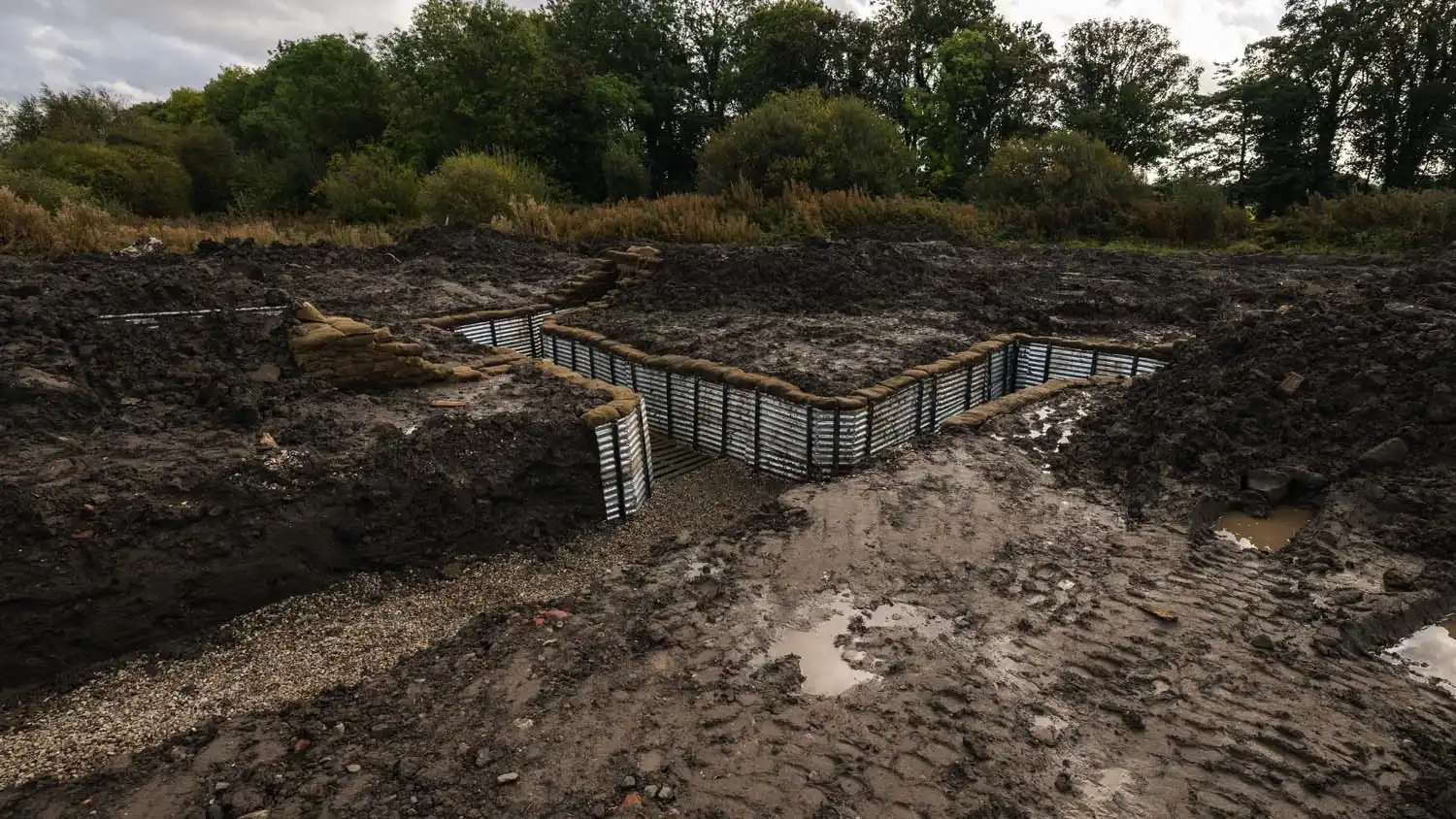
British commando engineers have built and tested an underground hospital in Scotland, excavating a 20-by-20-meter casualty complex in six days so surgical teams could resuscitate and operate on simulated casualties during Exercise Strike Warrior, the Royal Navy announced on October 14, 2026. The prototype, built by 24 Commando Royal Engineers at Barnsford Bridge near Glasgow, draws directly on Ukraine’s buried frontline stabilization points, which spread after Russian drones turned visible medical facilities and evacuation routes into routine targets.
The build ran within Strike Warrior 2026, a multinational exercise held across Scotland from September 21 to October 9 that the Royal Navy described as the largest test of all arms of the UK Commando Force in 15 years, involving more than 2,000 personnel from six nations.
It reflects a conclusion now spreading through NATO medical planning: in a drone-saturated battlespace, the deployable tented or vehicle-based Role 2 facility, the echelon that delivers damage control surgery and resuscitation, can no longer count on mobility or the Red Cross emblem for protection. The World Health Organization (WHO) has verified more than 3,100 attacks on health care in Ukraine since February 2022, including strikes on ambulances and medical supply chains.
Inside the Underground Hospital Built at Barnsford Bridge
Engineers from 54 Commando Squadron moved vehicles, plant and engineering equipment onto the site and carried out excavation, revetment, construction and fortification over six days, removing approximately 243 cubic meters of rock and soil. The resulting footprint covers roughly 400 square meters, about one-and-a-half tennis courts. Medics and engineers co-designed the layout, including a trench system configured for maximum blast protection.
Once handed over, the facility was occupied by a Special Operations Surgical Team and the Commando Forward Surgical Group from 48 Commando, the former Commando Logistic Regiment, renamed on August 1, 2026. Teams worked through power allocation, casualty flow by clinical priority, internal movement, pest control and temperature monitoring.
The Royal Navy has not disclosed burial depth, overhead cover specifications, bed or operating table count, or ventilation and power architecture. The excavated volume relative to the footprint, combined with the reference to a trench system, points to a sunken, revetted design rather than the deep-buried modules Ukraine fields. Lieutenant Michael Mathers, Access Troop commander of 54 Commando Squadron, said the project exposed troops to the realities of peer conflict, “where survivability, protection, and concealment are critical to success.”
How Ukraine’s Stabilization Points Took Role 2 Surgery Underground
Ukraine’s Ministry of Defense fielded its first underground stabilization point in September 2024, built with steel producer Metinvest’s Steel Front initiative and the Medical Forces group East. The complex links six enlarged steel bunker modules, each 7.6 meters long and 2.5 meters in diameter, housing two operating theaters, two resuscitation stations and staff areas. Publicly available specifications indicate it can run up to four surgeries simultaneously and integrates ventilation, water supply, drainage, alternative power and electronic warfare systems, at a cost above UAH 20 million. The project calls for more than 20 such sites.
A second facility, unveiled by Metinvest in September 2025, covers 350 square meters across four modules buried more than 6 meters deep. Lieutenant Colonel Roman Kuziv of Ukraine’s Medical Service has credited the first site with saving more than 6,000 soldiers in its first year, a figure that has not been independently verified. On August 24, 2026, the Dutch foundation Protect Ukraine announced plans for a 600-square-meter stabilization complex 8 meters underground, at an estimated 2.5 million euros including equipment and armored evacuation vehicles.
The driver is evacuation. Persistent reconnaissance drones and first-person view (FPV) strike drones have made daytime casualty movement near the line of contact hazardous, stretching the golden hour into holds of many hours or days. Ukraine responded by pushing surgery forward and down, closer to the point of injury but out of sight.
Clinical Trade-Offs of Surgery Below Ground for Commando Medics
The Barnsford Bridge trial surfaced the problems Ukrainian surgeons manage daily. Placing a clinical environment in what the Royal Navy described as essentially a hole in the ground introduced soil contaminants, bacteria, pests and environmental conditions that degrade both clinician performance and casualty survivability. Clinicians accustomed to space, light, air circulation, plumbing and electricity had to work in confined compartments with restricted resupply.
Chief Petty Officer Ellie Walls of the Commando Forward Surgical Group framed the core judgment: “we have to evaluate if the risks from being below ground outweigh the risks from being above ground.” She tied the need to build, survive, work and live in such spaces to the fact that medics “are not always protected by the Red Cross and can be routinely targeted.”
Analysis: The UK prototype and Ukraine’s stabilization points solve the same problem with different trade-offs. Ukraine relies on prefabricated industrial steel modules installed in static sectors; the Commando Force tested a field-expedient build using organic engineer plant and local soil, an approach better suited to an amphibious force with limited sealift, but one that commits an engineer troop and heavy equipment for six days, itself a detectable signature.
Either way, the logic marks a doctrinal shift: forward surgical capability becomes a fixed, hardened node rather than a mobile one, making engineer support a prerequisite for casualty care. The US Army’s Center for Army Lessons Learned reached the same conclusion in August 2025, recommending dispersed, hardened medical facilities while warning that such sites cannot easily relocate and demand effective camouflage, concealment and deception.
The Royal Navy said the Barnsford Bridge build is part of an effort to develop, trial and standardize subterranean facilities across the UK Commando Force and the Corps of Royal Engineers, moving from prototype to full operational capability. No timeline, funding line or design standard has been published. Open questions include whether the UK will procure prefabricated protective modules, how the design performs in the frozen and rocky ground of the High North, and whether the lessons migrate to the British Army’s wider field hospital structure.