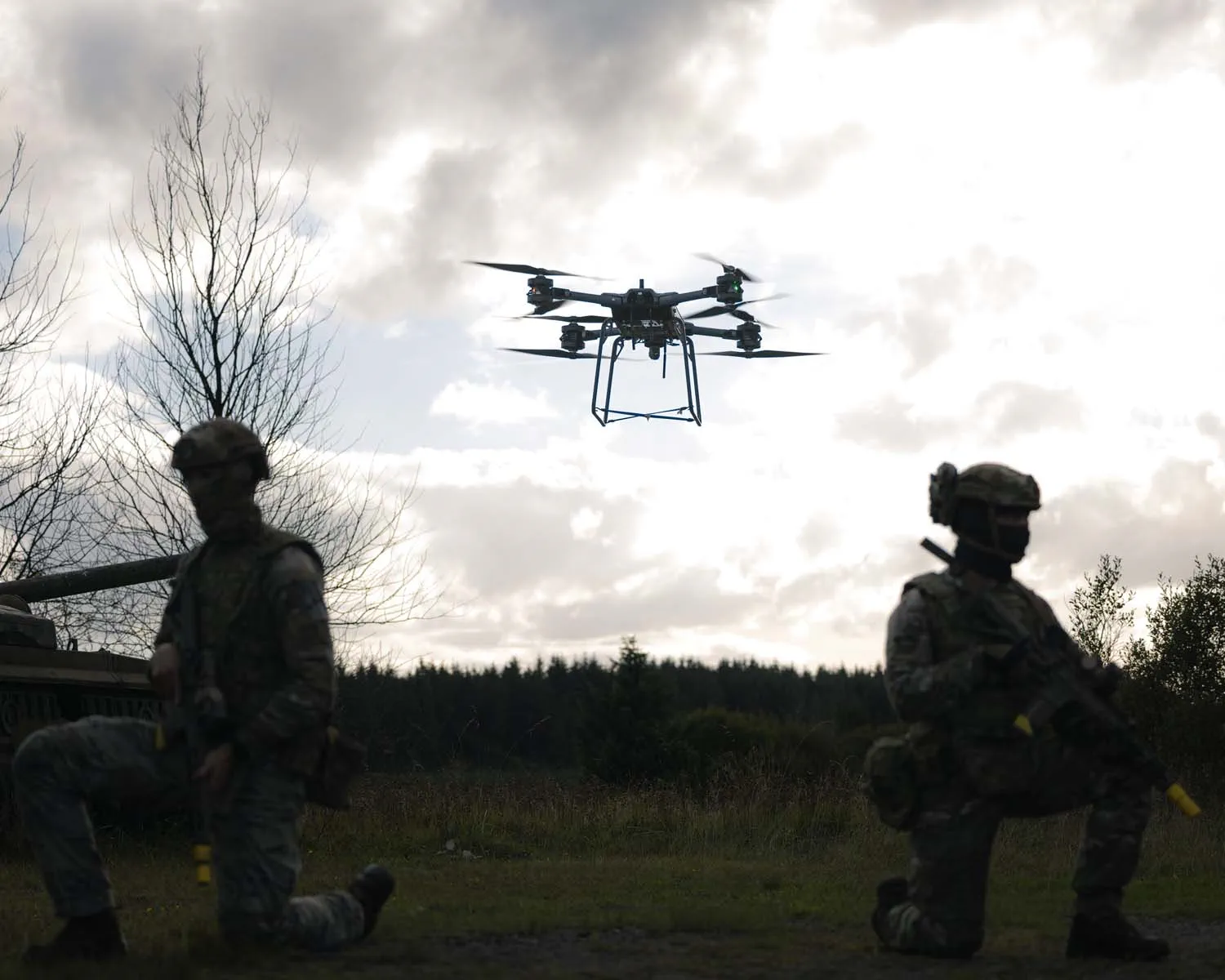
Royal Marines drone operators from 48 Commando (Support Group) are refining procedures intended to allow a freshly trained team to prepare and launch a Malloy T-150 heavy-lift drone within three minutes by day and five minutes by night, the Royal Navy announced on October 27, 2026. The drills, refined over five days at the Spadeadam Training Area in Cumbria, are designed to get uncrewed resupply sorties airborne before an adversary can detect the launch team electromagnetically or by other means and strike it.
The work was led by Malloy Flight, Delta Squadron, of the Devon-based unit formerly known as the Commando Logistic Regiment, during Exercise Strike Warrior 26. The commando-led exercise, which began on September 21 and ran for four weeks, brought together more than 2,000 personnel from the UK, the Netherlands, Canada, Germany, Norway and the United States, supported by eight warships and 19 aircraft and helicopters, to rehearse allied crisis-response operations in the High North and North Atlantic. The Royal Navy describes it as the largest test of the UK Commando Force in 15 years, since the force deployed en masse to Afghanistan on Operation Herrick.
Royal Marines Drone Teams Compress the Launch Cycle at Spadeadam
The driver is the battlefield in Ukraine, where launch sites and ground control stations become priority targets as soon as their emissions or physical signature are detected. Every minute a team spends unpacking, loading and running pre-flight checks is a minute of exposure. By cutting setup to three minutes in daylight and five after dark, Delta Squadron aims to shrink the window between arrival at a launch point and the aircraft leaving the ground.
At Spadeadam, the T-150s flew day and night beyond visual line of sight (BVLOS), delivering supplies to commandos on the front line. Teams repeatedly rehearsed supply drops in areas under heavy surveillance. According to the Royal Navy, the training showed that new drone teams can learn to set up safely, prepare a load and launch a sortie in under a day. Training speed matters as much as launch speed: a capability that depends on a small cadre of specialists does not scale in a high-attrition conflict.
Major Rhys Adkins, Officer Commanding of Delta Squadron, said the activity proved the unit can rapidly give commandos the skills to conduct drone operations wherever required, while warning that tactics must keep evolving “to ensure we do not fall behind.”
Malloy T-150 Payload, Range and Role in Commando Logistics
The T-150 is an all-electric heavy-lift uncrewed air system built by Malloy Aeronautics, now a BAE Systems company. Although the Royal Navy refers to it as a quadcopter, the airframe carries eight rotors. BAE Systems lists a maximum payload of 68 kg and a top speed of 60 mph (about 97 km/h), and published specifications put its maximum range between 8 and 45 km depending on payload. The Royal Navy’s latest release cites a payload of up to 63 kg and has not explained the gap. Removable, hot-swappable batteries and a remote payload release let crews turn the aircraft around without long recharge cycles, which directly supports the rapid-launch drills.
The Royal Navy declared the T-150 ready for front-line operations in September 2025 after two years of trials. 48 Commando uses it to move food, water, fuel, stores and ammunition across the battlefield. The US Marine Corps fields a variant of the same airframe as the TRV-150C, and T-150s supplied by the UK have been used by Ukrainian forces.
Major Adkins framed the value in manpower terms, saying the drone means commandos “don’t have to carry as much equipment” and that one uncrewed system can deliver an effect 12 times the size of the team operating it, keeping personnel out of exposed resupply runs.
Analysis: The Spadeadam drills treat the launch team, not the aircraft, as the critical vulnerability in drone logistics. Major Adkins tied the work directly to the First Sea Lord’s hybrid navy concept and the Royal Navy’s warfighting headmark for 2029, and the emphasis on teaching untrained troops in under a day signals that the Commando Force intends to field uncrewed resupply as a mass skill rather than a niche specialty. The limits are physical: published figures put the T-150’s maximum range as low as 8 km depending on payload, which keeps launch points relatively close to forward positions for heavy loads, and the Royal Navy has not disclosed how the procedures perform under active electronic warfare or satellite navigation denial.
Delta Squadron says it will continue to analyse, test and refine the procedures. Open questions include whether the three- and five-minute benchmarks will be standardized across UK Commando Force drone units, how many T-150 airframes 48 Commando currently operates, and how the drills will feed into Commando Force training ahead of the 2029 warfighting headmark. None has been publicly addressed.