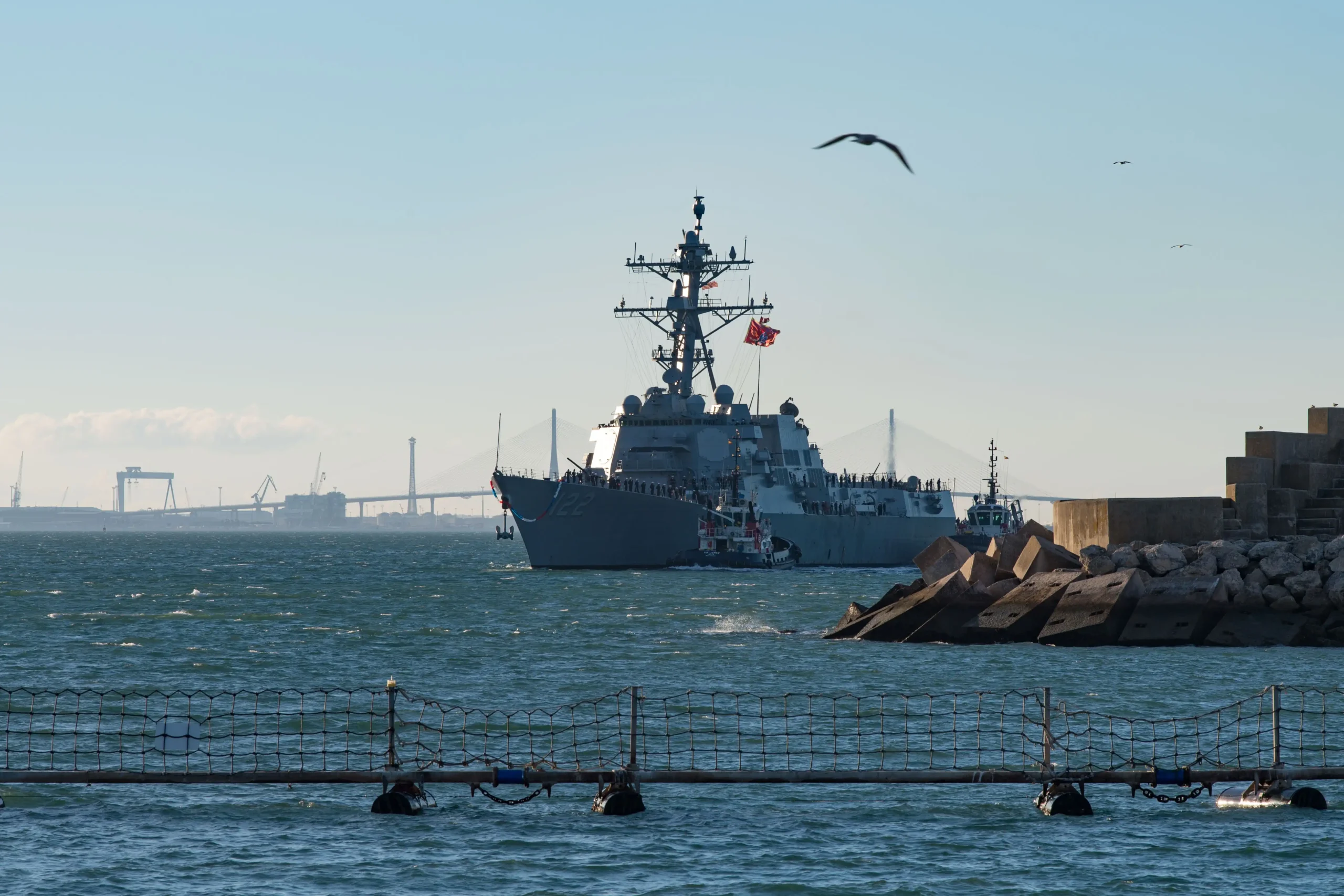
The Arleigh Burke-class guided-missile destroyer USS John Basilone (DDG 122) arrived at its new homeport of Naval Station Rota, Spain, on October 14, 2026, after shifting from Naval Station Mayport, Florida. The ship becomes the sixth U.S. destroyer permanently based at Rota and joins Commander, Task Force 65 (CTF 65) and Destroyer Squadron 60 (DESRON 60), which control forward-deployed surface combatants for U.S. Naval Forces Europe-Africa and U.S. 6th Fleet.
The arrival completes the expansion of Forward Deployed Naval Forces-Europe (FDNF-E) from four to six destroyers, announced at NATO’s Madrid summit in June 2022 and formalized in a May 2023 agreement between Washington and Madrid. The first of the two additional ships, USS Oscar Austin (DDG 79), reached Rota in October 2024. U.S. Fleet Forces Command announced the homeport change on September 30, 2026. The FDNF-E construct began in 2014, when USS Donald Cook and USS Ross moved to Spain as the U.S. naval contribution to NATO ballistic missile defense under the European Phased Adaptive Approach.
USS John Basilone Brings Late-Production Flight IIA Aegis Firepower
General Dynamics Bath Iron Works in Maine built the ship, which was christened on June 18, 2022, delivered on July 8, 2024, and commissioned in New York City on November 9, 2024. It is among the final Flight IIA hulls; the Navy began fielding the Flight III configuration with USS Jack H. Lucas (DDG 125) in 2023. The ship honors Marine Gunnery Sgt. John Basilone, who received the Medal of Honor for defending Henderson Field on Guadalcanal in October 1942 and a posthumous Navy Cross for actions on Iwo Jima in 1945.
The Navy lists ballistic missile defense, integrated air and missile defense, anti-submarine warfare, surface warfare, and maritime interdiction among the ship’s missions. Publicly available specifications for Flight IIA restart ships indicate a full-load displacement of roughly 9,200 to 9,500 tons, a length of 155 meters (509 feet), and four General Electric LM2500 gas turbines producing about 100,000 shaft horsepower for speeds above 30 knots. The combat system pairs the AN/SPY-1D(V) radar with an Aegis Baseline 9-family configuration that lets the ship engage aircraft, cruise missiles, and ballistic missiles simultaneously.
Armament centers on 96 Mk 41 Vertical Launching System (VLS) cells able to carry Standard Missile-2 (SM-2), SM-3, and SM-6 interceptors, Evolved SeaSparrow Missiles, Tomahawk land-attack missiles, and vertical-launch anti-submarine rockets, alongside a Mk 45 5-inch gun, Mk 32 torpedo tubes, and twin hangars for MH-60R Seahawk helicopters. That magazine is the operational point: John Basilone carries six more cells than the Flight I USS Arleigh Burke (DDG 51) and lifts the Rota squadron to 570 VLS cells in total.
How a Six-Destroyer Rota Force Changes 6th Fleet Availability
The squadron now comprises Arleigh Burke, Oscar Austin, USS Roosevelt (DDG 80), USS Bulkeley (DDG 84), USS Paul Ignatius (DDG 117), and John Basilone. Basing near the Strait of Gibraltar gives the ships direct access to the Atlantic and the Mediterranean and spares them the transatlantic transits that consume weeks of a deployment from the U.S. East Coast. Their operating area runs from the Arctic Circle to the Cape of Good Hope.
Demand on that force has been sustained. Rota-based destroyers in the eastern Mediterranean have helped defend Israel against Iranian missile attacks and protected merchant shipping from Houthi strikes in the Red Sea. The war with Iran that began on February 28, 2026, has also lengthened deployments for naval forces supporting U.S. Central Command, raising the value of hulls already positioned in theater. Vice Adm. J.T. Anderson, commander of U.S. 6th Fleet, said operating in the European theater gives crews opportunities to project combat power, maintain operational readiness, and defend the maritime approaches to the homeland.
Sustainment is moving forward as well. In early October, Arleigh Burke entered dry dock at Navantia’s Cádiz shipyard for planned maintenance and modernization, the first overhaul of its kind for a Rota-based destroyer carried out in Europe. Forward Deployed Regional Maintenance Center personnel and the crew are executing the availability alongside Navantia.
Analysis: The sixth hull is less a symbol than a scheduling solution. A four-ship force had little margin to cover ballistic missile defense patrols, High North presence, and Middle East contingencies while cycling ships through maintenance. Six destroyers allow a rotation in which one or two hulls can sit in an availability without stripping the theater of Aegis coverage. Combined with in-theater dry docking, the expansion ties Rota’s value to Spanish industrial capacity as much as to geography. The binding constraint now shifts from hull count to interceptor inventory, as SM-3 and SM-6 rounds expended in the Mediterranean compete with Central Command and Indo-Pacific requirements.
The Navy has not said when John Basilone will begin its first patrol from Rota. Cmdr. T. Max Murphy, the commanding officer, said the crew is “honored to bring Gunnery Sgt. Basilone’s legacy to Europe.” More than 300 sailors and their families join a U.S. community at Rota that Spanish defense sources put at roughly 6,000 people. The next markers are Arleigh Burke’s return from Cádiz, whether the Navy extends European dry docking to other FDNF-E hulls, and how it plans to replace the Flight I lead ship as it ages.