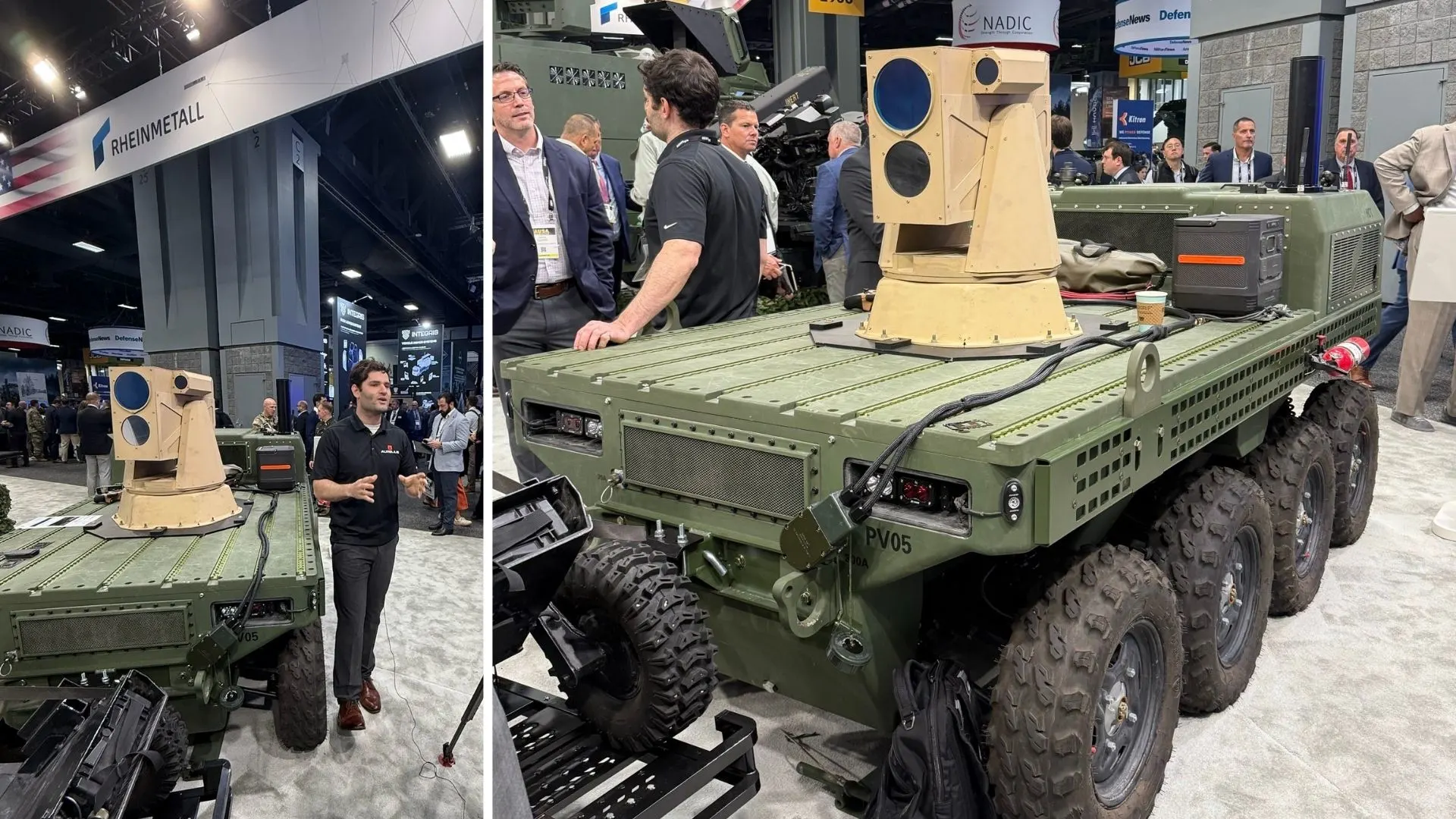
Aurelius Systems displayed its Archimedes autonomous counter-drone laser mounted on an American Rheinmetall uncrewed ground vehicle (UGV) at the Association of the U.S. Army (AUSA) Annual Meeting and Exposition, held October 12 to 14, 2026, in Washington. The turret operated in motion at Rheinmetall’s booth, where the two companies pitched mobile laser defense to Army buyers. It is not the pairing’s first public outing: Aurelius exhibited the laser on a Rheinmetall vehicle in June 2026 at the Reindustrialize conference in Detroit, in a display developed with American Rheinmetall and electric-vehicle startup Harbinger.
The display follows a partnership announced in July 2026 that targets a growing vulnerability: robotic resupply vehicles that cannot defend themselves against Group 1 and Group 2 drones, the commercial quadcopters and one-way attack aircraft that dominate the battlefield in Ukraine. Integration begins on the Ox, American Rheinmetall’s entry in the Army’s Ground Optionally Autonomous Transport (GOAT) competition, the program formerly known as Small Multipurpose Equipment Transport (S-MET) Increment II.
Inside the Archimedes Laser: Sensors, Power, and Autonomy
Archimedes is a lightweight turret that pairs a near-infrared fiber laser with machine vision and radar. Aurelius says the system detects, tracks, and burns down drones without an operator initiating each engagement, and claims defeat of Group 1 and Group 2 targets at more than 1 kilometer.
Aurelius has not disclosed the beam power of the current configuration. Publicly available information indicates that a 2-kilowatt prototype became the first laser weapon fired at the Naval Postgraduate School’s Joint Interagency Field Experimentation (JIFX) 25-2 event at Camp Roberts, California, in February 2025, engaging quadcopters at 50 and 110 meters in rain and wind. Closing the gap between that demonstration and the 1-kilometer claim implies major gains in output and beam control; no independent range data has been released.
Power architecture explains the UGV fit. Archimedes is designed to draw power from the grid, a generator, or a battery. Show-floor images show a compact, tan pedestal turret with a large primary aperture and a smaller secondary optic, fixed to the vehicle’s flat cargo deck. Aurelius builds the system largely from commercial components and launched a manufacturing division in April 2026 to produce multi-kilowatt fiber laser source modules domestically, aiming to hold unit cost down while each shot costs only the electricity needed to fire it.
From T-REX to GOAT: Test Record and Army Program Path
Archimedes downed more than 20 quadcopters and more than five previously unseen Army-supplied drones during the Pentagon’s Technology Readiness Experimentation (T-REX) 26-2 event at Camp Atterbury, Indiana. At the Army’s Operation Jailbreak exercise at Fort Carson, Colorado, Aurelius linked Archimedes and its command-and-control software with Anduril’s Lattice and the Army’s Forward Area Air Defense Command and Control (FAAD C2) system.
The San Francisco company, founded in 2024 by chief executive Michael LaFramboise and John Marmaduke, closed a $40 million Series A round on August 5, 2026, co-led by Draper Associates and KAS Venture Partners.
The Army selected American Rheinmetall and HDT Expeditionary Systems in September 2024 to build eight prototypes each, sized to haul up to 2,000 pounds. A single winner is expected in 2027, with a potential production run of up to 2,195 vehicles. HDT delivered its Hunter WOLF to the 3rd Brigade, 10th Mountain Division at Fort Polk, Louisiana, in May 2026.
Analysis: Pairing a laser with a cargo robot targets a real gap in Army maneuver. Autonomous resupply vehicles are slow and predictable, which makes them attractive targets for first-person-view drones, while dedicated short-range air defense assets are too scarce to escort every logistics run. A self-defending mule pushes counter-drone capacity to the lowest echelon at near-zero cost per shot. The open questions are physical: magazine depth on battery power, thermal management on a small chassis, and beam performance in dust and smoke. Until Aurelius publishes output and dwell-time figures, the system cannot be benchmarked against the Army Multi-Purpose High Energy Laser (AMP-HEL) prototypes already mounted on Infantry Squad Vehicles and Joint Light Tactical Vehicles.
The next decision point is the GOAT downselect in 2027, and whether the Army writes a counter-drone mission module into the production requirement. Watch for disclosed power figures, a funded Army demonstration on the Ox, and how much of the more than $2 billion for directed energy in the fiscal 2027 request reaches small, mass-produced systems.