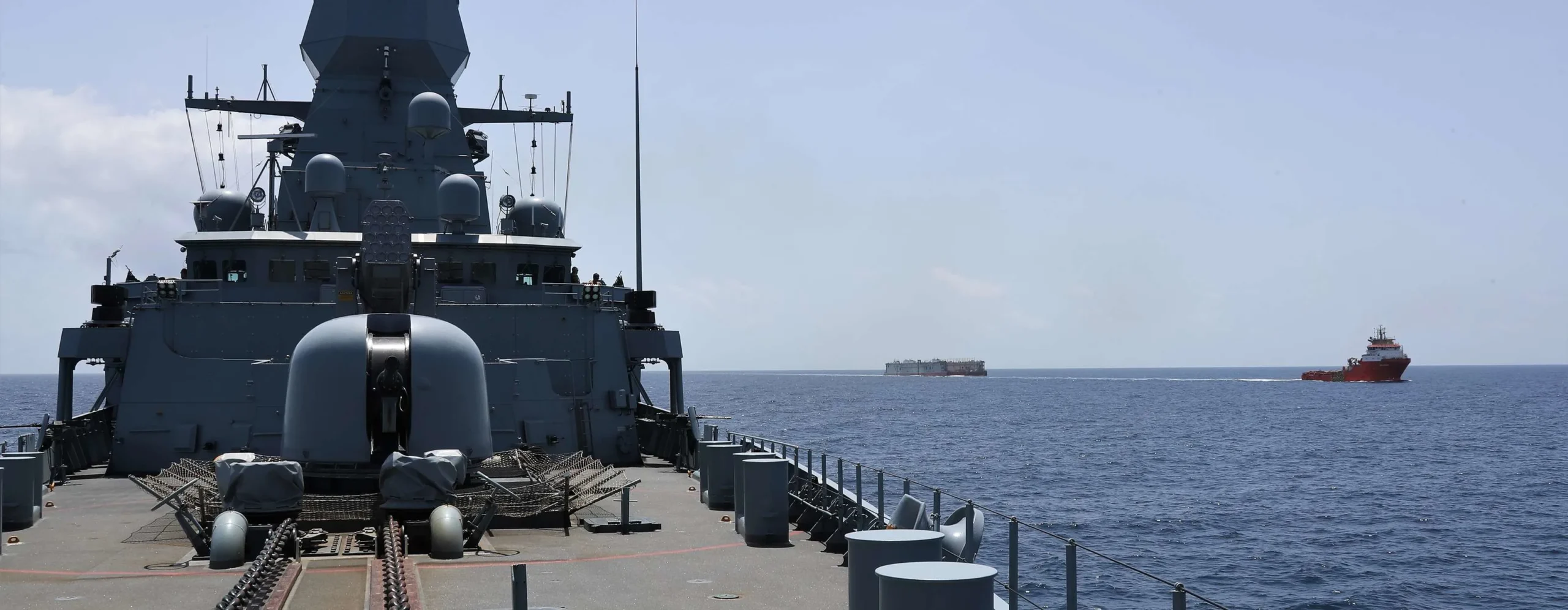
The German Bundestag on October 15, 2026, voted to extend the Bundeswehr’s participation in the European Union’s EUNAVFOR Aspides maritime security operation in the Red Sea until October 31, 2027. The renewed mandate keeps the personnel ceiling unchanged at up to 350 soldiers and preserves the option of committing a German warship, although Berlin’s current contribution consists of staff officers and airborne maritime surveillance flights. Lawmakers adopted the government motion by roll-call vote after a 30-minute floor debate.
The extension comes as the threat that created Aspides returns to the southern Red Sea. Yemen’s Houthi movement began striking commercial shipping in November 2023, halted after the October 2025 Gaza ceasefire, and resumed attacks in July 2026, declaring a blockade of Saudi-linked shipping on July 20. A United Nations Secretary-General report dated September 10 recorded attacks on three merchant vessels between August 9 and September 9, including an August 11 strike on the Tanzania-flagged cargo ship Tihamah that killed four seafarers. On September 10 and 11, Houthi forces seized the port of Mocha and Perim Island, gaining positions that overlook the Bab al-Mandab Strait. The German Federal Ministry of Defense (BMVg) assesses that the attacks continue undiminished, pushing carriers onto the weeks-longer Cape of Good Hope route.
What the Renewed Aspides Mandate Authorizes Through 2027
The motion, Bundestag document 21/8294, authorizes the protection of merchant vessels against multidimensional attacks at sea, close escort throughout the area of operations, and the compilation and sharing of a maritime situational picture, including from the air. The operation carries executive powers, including the use of weapons. At the EU level, Aspides remains strictly defensive: it draws on UN Security Council resolutions including 2722 (2024), 2768 (2025), and 2812 (2026), and does not conduct strikes on land.
The renewal adds an intelligence task. German forces are directed to collect and share information on suspicious activity around critical undersea infrastructure, a task the EU added to Aspides in 2026, after a 2025 Council decision had already extended the operation’s information gathering to the so-called shadow fleet. The Red Sea corridor carries major subsea cables between Europe and Asia.
Geographically, the mandate covers the Bab al-Mandab Strait and international waters of the Red Sea, the Gulf of Aden, the Arabian Sea, the Gulf of Oman, and the Persian Gulf. Vessel protection, however, is excluded north of the latitude of Muscat in the Gulf of Oman, in the Strait of Hormuz, and in the Persian Gulf, and Aspides currently holds no mine clearance authority. The 350-person cap dates from the October 2025 renewal, which halved the previous ceiling of 700. The government motion budgets approximately €18.9 million in additional deployment expenses for November 1, 2026, to October 31, 2027, down from approximately €23.9 million for the previous 12-month mandate.
From Frigate Hessen to Staff Officers and Surveillance Flights
Germany’s footprint has contracted since the Bundestag first approved participation on February 23, 2024. The Deutsche Marine initially committed the Sachsen-class air defense frigate Hessen (F221). Publicly available specifications indicate a sensor and weapons suite built around the APAR active phased-array multifunction radar and the SMART-L long-range volume search radar, a 32-cell Mk 41 vertical launch system firing SM-2 Block IIIA and Evolved Sea Sparrow Missiles, and two RAM launchers for point defense. Hessen shot down Houthi one-way attack drones in late February 2024.
Today the German contribution consists of staff personnel at the Hellenic EU Operational Headquarters in Larissa, Greece, and aboard the operation’s flagship, plus a maritime surveillance aircraft that has flown regular sorties since late October 2024. Those flights have drawn hostile attention: in July 2025, a Chinese warship lased a German maritime surveillance aircraft flying a routine Aspides mission over the Red Sea, prompting the Federal Foreign Office to summon China’s ambassador. The aircraft returned safely to the German contingent’s base in Djibouti.
Surface units still pass through the theater under the Aspides umbrella. In June 2026, the Frankenthal-class minehunter Fulda and the tender Mosel, carrying about 140 personnel, were integrated into Aspides during their Red Sea transit toward Djibouti, staging for a possible Hormuz mine countermeasures mission that requires its own parliamentary approval.
Bab al-Mandab and Hormuz Stretch a Thinly Resourced EU Operation
The German vote rests on an EU mandate that expires first. On February 23, 2026, the Council of the EU extended Aspides until February 28, 2027, with common costs of €14.9 million for the period beginning March 1, 2026. Hellenic Navy Rear Admiral Vasileios Gryparis commands the operation from Larissa, and a further strategic review is scheduled for 2026 to 2027. The Bundestag mandate therefore runs eight months beyond the current EU legal basis.
Pressure is building to widen the operation’s role. In a note dated May 26, 2026, the European External Action Service proposed that Aspides take the primary role in clearing mines from the Strait of Hormuz, once conditions allow, as the EU’s contribution to an ad hoc coalition led by France and the United Kingdom. Any such change requires unanimity among the 27 member states. Saudi Arabia, meanwhile, activated a Multinational Maritime Defense Alliance in August 2026, adding another coalition framework for Red Sea security.
Analysis: Berlin has renewed a mandate sized for a warship deployment while fielding staff officers and a patrol aircraft. The 350-person ceiling is legal headroom to commit a seagoing unit such as a frigate without returning to parliament; it does not put hulls in the Red Sea. That gap matters more now than a year ago: with Houthi forces holding Mocha and Perim Island, the threat sits closer to the Bab al-Mandab shipping lanes, and Aspides depends on partners sustaining scarce air defense escorts. The shadow fleet and undersea infrastructure tasking shows Germany applying its Baltic threat model to the Red Sea, where surveillance aircraft add value without a German combatant on station.
The next decision points sit in Brussels: the EU strategic review and a Council decision on renewing Aspides beyond February 28, 2027. Any Hormuz mine clearance role would require unanimity and likely a revised Bundestag mandate. The BMVg has not disclosed the vote tally or whether a German warship will rotate back in. The current Bundeswehr mandate expires on October 31, 2027.