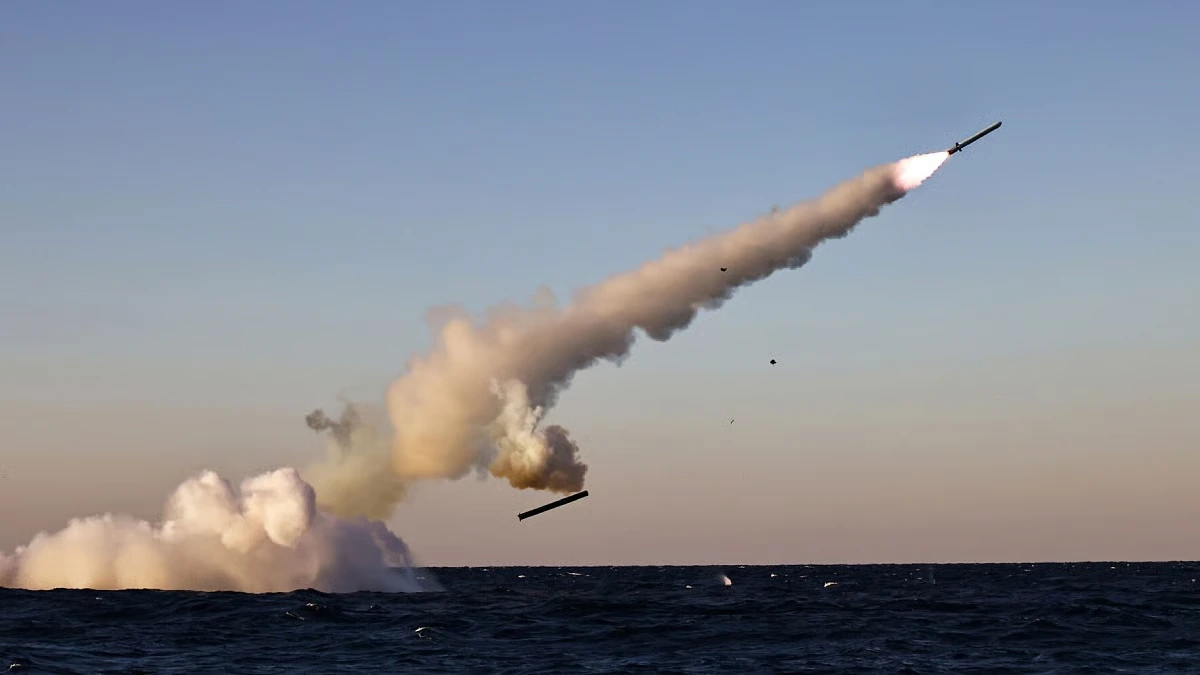
North Korea test-fired two types of submarine-launched strategic cruise missiles into the East Sea on October 14, 2026, in what South Korean analysts assess was the first missile launch by the Hero Kim Kun Ok, the converted missile submarine Pyongyang designates a tactical nuclear attack submarine. South Korea’s Joint Chiefs of Staff (JCS) said one missile left a vertical launch tube and the other a torpedo tube.
The Korean Central News Agency (KCNA) said the Missile Administration conducted the firing to “examine the current mobilized posture of the underwater combat systems.” Kim Jong Un did not attend; Kim Jong Sik, a member of the Workers’ Party Central Military Commission, and Missile Administration chief Jang Chang Ha supervised. The test followed ballistic launches on October 3 and October 12 and is the first disclosed submarine-launched cruise missile (SLCM) event since January 28, 2024.
Vertical Tube and Torpedo Tube: Inside the North Korea Cruise Missile Test
KCNA withheld missile designations, ranges, flight times and the launch position, and did not name the boat. Its photographs show a surfaced submarine and two missiles breaking the water at different angles, one near-vertical and one inclined. South Korean experts matched the hull to the Hero Kim Kun Ok, hull number 841, launched at the Sinpo shipyard on September 6, 2023. If confirmed, it is the boat’s first publicly documented weapon launch.
Despite its label, the Hero Kim Kun Ok is a diesel-electric submarine rebuilt from a Soviet-designed Romeo-class hull, a type North Korea acquired from China in the 1970s and later built locally. The rebuilt boat is rated in the 3,000-ton class. The nuclear designation describes its intended armament, not its propulsion. State media photos show 10 missile hatches on an enlarged sail, four large and six small, with the larger ones assessed as sized for submarine-launched ballistic missiles (SLBMs).
The dual-tube finding indicates both weapons-release paths on the boat are functional. Vertical cells allow faster, larger salvos and cut warning time for defenders. Torpedo-tube ejection produces an inclined launch that places the missile on a low-altitude cruise profile almost immediately, a point Hong Min of the Korea Institute for National Unification highlighted as complicating detection and interception.
The JCS did not announce the launches on the day, in line with its practice of publicizing only ballistic missile events. On October 15 it said it had tracked both missiles from pre-launch to the end of flight, using undisclosed assets. Flight-tracking data showed a U.S. Navy MQ-4C Triton drone operating for roughly nine hours over central Korea and the East Sea on October 14.
Hwasal-2 and Pulhwasal-3-31: Range, Warhead, and Interception Challenges
South Korean analysts believe the salvo paired a longer-range Hwasal-2 with a shorter-range Pulhwasal-3-31, though Pyongyang has confirmed neither. The Hwasal-2, first tested in January 2022, is a land-attack cruise missile North Korea describes as nuclear-capable; the earlier Hwasal-1 is credited with roughly 1,500 kilometers. During a February 23, 2023 drill, KCNA claimed four Hwasal-2 rounds flew 2,000 kilometers, a figure South Korea’s defense ministry treated with skepticism.
The Pulhwasal-3-31 appeared in January 2024 as a dedicated SLCM. In its last disclosed submarine firing, KCNA said two rounds flew for 7,421 and 7,445 seconds, more than two hours. Its reported range reaches up to 2,000 kilometers, and open-source assessments liken its design to Russia’s Kalibr. Pyongyang says it can carry the Hwasan-31, the standardized tactical nuclear warhead it displayed in March 2023. At the upper end of that envelope, an East Sea launch would place all of South Korea and U.S. bases in Japan within reach.
Cruise missiles typically fly around 100 meters above the surface, beneath the coverage of radars optimized for high-arcing ballistic trajectories. Firing two types with different ranges, speeds and approach axes at staggered intervals forces air defenses to engage threats arriving from different directions at different times. Cruise missile tests also fall outside United Nations Security Council restrictions, which target ballistic missile activity, giving Pyongyang a channel to rehearse nuclear delivery at lower diplomatic cost.
Analysis: The absence of Kim Jong Un, the working-level supervision and KCNA’s language on mobilized posture point to a shift from developmental testing toward operational qualification of the Hero Kim Kun Ok. That adds a sea-based nuclear delivery option to Pyongyang’s land-based missile forces, built around a low-altitude profile that strains defenses designed for ballistic threats. The boat’s limits remain material: a Romeo-derived diesel-electric hull is acoustically noisy, endurance-limited and must snorkel to recharge, keeping it within reach of allied anti-submarine warfare (ASW) forces in the East Sea. The burden shifts toward persistent maritime surveillance and low-altitude cruise missile defense.
Key unknowns include the missiles’ actual ranges, the impact zone and whether the boat fired submerged. South Korea’s annual Hoguk joint field exercise runs from October 19 to 30, alongside two combined field training drills with U.S. forces that were not held when Ulchi Freedom Shield ended early in August. The larger milestone remains the 8,700-ton nuclear-powered strategic guided missile submarine Pyongyang showed under construction in December 2025, while President Donald Trump said on October 12 he may meet Kim during an upcoming Asia trip.