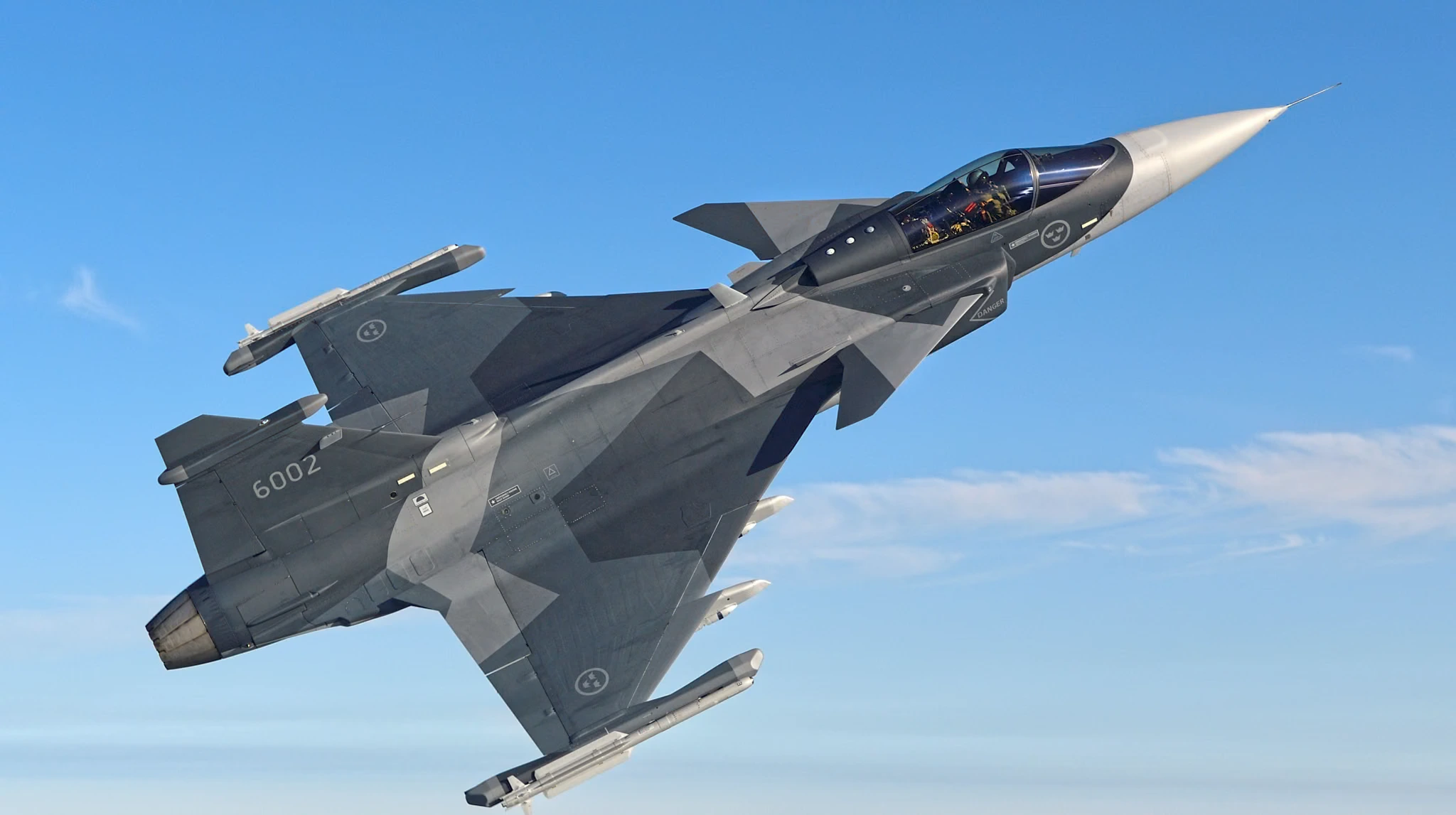
Sweden’s Defence Materiel Administration (FMV) has ordered a new-generation flight control computer for the JAS 39 Gripen from Saab, the company announced on October 15, 2026. The development contract is valued at SEK 1.3 billion, roughly $130 million, with deliveries planned during 2030. The unit will replace the computer flying today in both the Gripen C/D and the Gripen E/F.
The order targets obsolescence in the fighter’s most safety-critical subsystem. According to FMV, the current computer was originally developed for the JAS 39A, which first flew on December 9, 1988, and is now approaching the end of its technical life with no long-term sustainment path. The Gripen E aircraft ordered for the Swedish Air Force so far reuse flight control computers drawn from earlier Gripen versions, a stopgap that cannot cover the new airframe’s full service life. Saab said the replacement is designed to meet long-term requirements for availability, performance and security of supply.
Inside the Gripen Flight Control Computer and Its JAS 39A Legacy
The flight control computer is the core of the Gripen’s fly-by-wire system, converting stick inputs into control surface deflections. On the Gripen, that function is structural rather than incremental: the canard-delta airframe is deliberately unstable in pitch and relies on the computer to stabilize it continuously through seven primary control surfaces. Publicly available specifications describe a triplex digital fly-by-wire system, with a mechanical backup retained only for the throttle. Saab engineering material indicates the aircraft keeps good flying qualities with six of seven primary surfaces operating and remains maneuverable with five.
That heritage explains why FMV expects extensive development work and verification testing before the new unit is cleared for flight. Flight control system issues delayed the first flight by about 18 months. The pitch-control software was then implicated in two early losses: a prototype that crashed on landing in February 1989 after pilot-induced oscillation, and a production aircraft destroyed at a 1993 air display after the system over-amplified the pilot’s stick inputs. The type entered Swedish service in 1996, and the Ada programming language was later adopted for the primary flight control software.
Neither Saab nor FMV has disclosed the new computer’s processor architecture, redundancy scheme, supplier base, or whether existing control laws will be ported unchanged. Carl-Fredrik Edström, FMV’s head of air and space materiel, described the computer as a central, safety-critical element of the JAS 39 system and said the program must serve both current and future versions of the aircraft.
How the New Computer Affects Gripen E, C/D and Export Fleets
The timing follows rapid growth in the Gripen enterprise. Sweden has 60 Gripen E on order and received its first aircraft in October 2025, while retaining a smaller Gripen C/D force into the mid-2030s. Sixteen former Swedish C/D aircraft are slated to transfer to Ukraine from early 2027. On June 30, 2026, Kyiv signed a firm SEK 24.6 billion order for 16 new-build Gripen E, with deliveries expected from 2029, and Sweden’s air force chief signaled in July that Stockholm intends to buy additional Gripen E to backfill the transferred jets.
Export commitments widen the sustainment question. Brazil has 36 Gripen E/F on order and flew its first locally assembled Gripen E in October 2026; Thailand ordered four Gripen E/F in August 2025 and Colombia signed for 17 in November 2025. Saab and FMV have not said whether the new computer will enter the production line, reach export aircraft, or be offered as a retrofit to the Czech, Hungarian, South African and Thai C/D fleets.
The program will also test a core Gripen E selling point. Saab says the E’s split avionics architecture separates the roughly 10 percent of code dedicated to flight-critical functions from the 90 percent handling tactical functions, and uses abstraction layers so that parts of the system can be replaced with minimal impact on the rest. A fast requalification would support that claim; a protracted one would qualify it.
“We look forward to continuing our close collaboration with FMV. The new flight control computer will contribute to Gripen’s capability and performance for decades to come,” said Marcus Wandt, head of Saab’s Aeronautics business area.
Analysis: The contract buys sovereign control over the Gripen’s single most critical line-replaceable unit rather than new capability. A fleet that Sweden, Ukraine, Brazil, Thailand and Colombia intend to operate for decades cannot rest on 1980s-era computer hardware recycled from earlier airframes; that is a fleet-wide obsolescence risk independent of airframe hours. The order lands one week after Saab and GKN Aerospace signed an October 8, 2026 agreement, following a Swedish government decision, to deepen national expertise on the Gripen E/F engine. Together, the two moves suggest Stockholm is methodically reducing the number of flight-critical components it cannot sustain on its own terms.
Key details remain undisclosed: whether the 2030 delivery marks a qualified production standard or a development milestone, how many units Sweden will procure, and the retrofit sequence across C/D and E/F airframes. FMV has not indicated when flight testing will begin. How Saab sources legacy-standard computers for Ukraine’s 16 Gripen E due from 2029 remains another open question.