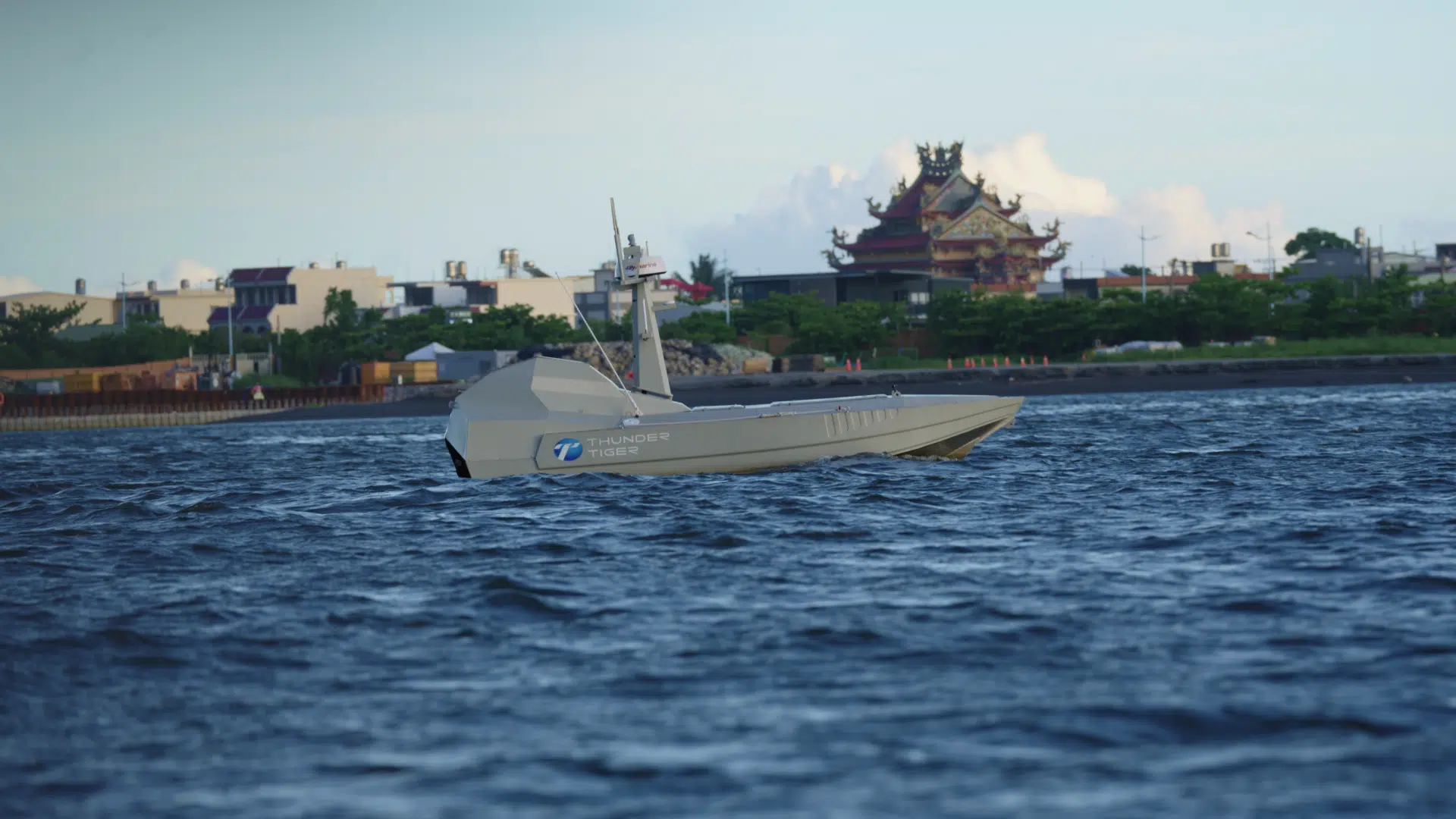
Taiwan’s Thunder Tiger Corp. and US autonomy developer Shield AI ran two SeaShark unmanned surface vessels (USVs) as an autonomous team under Shield AI’s Hivemind mission autonomy software at Dapeng Bay, Pingtung County, on July 29, 2026. A SeaShark 600 and a SeaShark 800 split a patrol area, fused radar and Automatic Identification System (AIS) data into a shared track on a simulated intruder, and escorted it out of the zone before resuming patrol without operator replanning. Shield AI called it Hivemind’s first multi-platform autonomous maritime demonstration and its first integration of maritime radar and AIS data. Shield AI detailed the mission in a case study released in October 2026.
The demonstration lands as Taipei tries to fund unmanned systems at scale along more than 1,500 kilometers of coastline. The Ministry of National Defense (MND) has sought funding for 1,320 USVs, but the Legislative Yuan left funding for locally built drones and unmanned surface vessels out of the NT$780 billion special defense budget it passed in May 2026. On September 3, 2026, the Cabinet earmarked NT$55.9 billion in a supplementary budget for coastal drones and small one-way USVs. Personnel from the National Chung-Shan Institute of Science and Technology (NCSIST) and the Coast Guard Administration observed the event.
Integrating Hivemind on SeaShark USVs: From Digital Twin to Sea Trials
The two companies signed a memorandum of understanding in May 2026 to integrate Hivemind across Thunder Tiger’s unmanned systems, starting with its USVs. Engineers built mission behaviors against digital models of both hulls, then moved to vehicle-in-the-loop testing on the actual hardware. Shield AI puts the span from initial software integration to live demonstration at six weeks. Thunder Tiger cited Hivemind’s integration on more than 30 platforms as the reason for its choice.
The SeaShark 800 is Thunder Tiger’s flagship attack USV. Publicly available specifications indicate an 8.1-meter hull displacing 2.7 metric tons fully loaded, speeds above 50 knots and a low radar cross-section aluminum hull. Range and payload figures vary: the company cited 600 kilometers at the April 2025 unveiling, while June 2025 reporting gave up to 500 kilometers and an explosive payload of up to 1,200 kilograms. It passed an NCSIST test demonstration in Yilan County in June 2025.
The smaller SeaShark 600 Stealth, a 6-meter craft introduced in September 2025, carries 300 to 600 kilograms and switches between reconnaissance and attack roles. It is rated at about 50 knots with a range of 350 kilometers. The company builds the line in Taoyuan at about one USV per week.
Radar and AIS Fusion Enables Autonomous Patrol-to-Escort Retasking
Planners divided the patrol area into two sectors, one per SeaShark, each monitored with maritime radar and AIS, then sent a third boat in as the vessel of interest. Radar returns estimated its position while its AIS broadcasts supplied identity and location; because the two sources update at different rates, they reported slightly different positions for the same contact. Hivemind compared reported positions and motion over time, correlated the reports to a single boat and fused them into one continuously updated track, which it shared across both USVs. The SeaShark 600’s electro-optical/infrared (EO/IR) sensor streamed live video of the contact to operators ashore.
Hivemind then suspended both patrol assignments and triggered a higher-priority Escort behavior, placing one SeaShark on the contact’s port side and the other on its starboard side. That geometry gave operators complementary full-motion video and positioned the USVs to support interdiction if directed. Once the vessel of interest left the area, Hivemind ended the escort and returned both craft to their sectors without the operator rebuilding the patrol plan.
The scenario had limits: the target broadcast AIS, no contact ran dark, only two vessels operated at sea, and no electronic warfare conditions were reported.
Five USVs, 8.3 Times the Coverage: Modeling Hivemind at Fleet Scale
In simulation, five USVs running adaptive mission autonomy covered a 50-nautical-mile stretch, against 6 nautical miles for five USVs on fixed patrol patterns, with both groups holding a 95% vessel identification rate. That equals roughly 8.3 times the coverage from the same hull count. Shield AI cautions that real coverage depends on sensor performance, vessel speed and operating conditions.
The difference from Thunder Tiger’s earlier work is task allocation. In November 2025, the company ran six SeaShark 680 boats from a single control station at the same Dapeng Bay site, cycling through preset formations over a frequency-hopping datalink, but a human dictated those patterns. Under Hivemind, the operator sets the objective and the software assigns sectors, reprioritizes and recovers.
“We are very optimistic about Hivemind, which brings autonomy to USVs for area search, target tracking, and the execution of these missions,” Chen said.
Analysis: Dapeng Bay shows where the constraint on Taiwan’s USV force is moving: from hull production, which Thunder Tiger already runs at a weekly cadence, to the software and operator bandwidth needed to employ hulls in numbers. A navy and coast guard facing persistent People’s Liberation Army and maritime militia pressure cannot assign one operator per boat at fleet scale, and recruiting shortfalls make that ratio a hard planning constraint. Pairing US mission autonomy with domestic hulls also fits Taipei’s push for Taiwan-US co-development, which the supplementary budget is believed to fund through NT$64.5 billion in classified lines. The demonstration validated cooperative intelligence, surveillance and reconnaissance (ISR) and escort, not autonomous strike, and the 8.3x figure remains a simulation output.
The next decision point is legislative. The Legislative Yuan must review the Cabinet’s supplementary budget and spending plans under the unmanned systems act passed in August, which provides NT$40 billion a year for six years, and the MND plans to buy 100 small one-way USVs in 2027. No SeaShark order has been publicly confirmed. Open questions include Hivemind’s performance against AIS-dark contacts and under jamming, team sizes beyond two vessels at sea, and when the memorandum’s extension to Thunder Tiger’s aerial platforms yields a mixed air-sea demonstration.