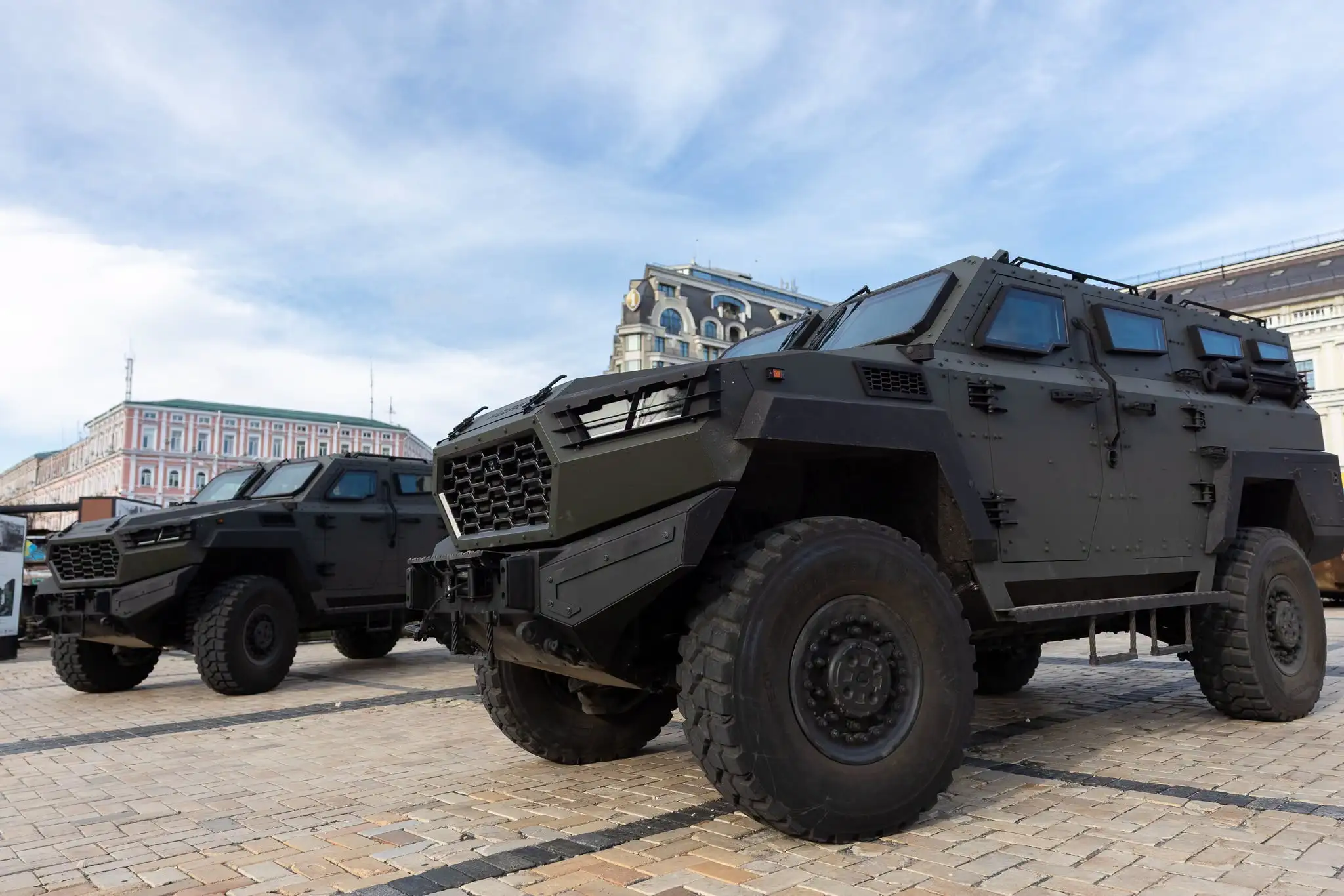
Ukraine’s Support Forces have received a new batch of equipment from the Demining Capability Coalition led by Lithuania and Iceland, the Support Forces Command announced on October 15, 2026, with photos of the handover showing Kyiv-built Inguar-3 mine-resistant ambush protected (MRAP) vehicles. The command did not disclose the number of vehicles or the full contents of the delivery. Its commander, Maj. Gen. Dmytro Herega, thanked partners for their consistent support and stressed that engineer units conducting both combat and humanitarian demining need dependable equipment.
Ukraine remains the most heavily mine-contaminated country in the world, with roughly one-third of its territory affected, according to the Lithuanian Ministry of National Defence. Engineer units clear routes for front-line operations while humanitarian teams work to return farmland, forests and industrial sites to use. Sapper teams routinely operate within range of artillery and first-person-view (FPV) drones, which makes protected transport between clearance sites a survivability requirement, not a convenience.
Inguar-3 Protection and Mobility: What the Ukraine Demining Coalition Bought
Kyiv-based Inguar Defence designed the Inguar-3 as a purpose-built MRAP on its own frame chassis rather than a converted commercial truck. The company revealed the 4×4 in March 2024 and ran it through roughly 10,000 km of trials that year, including combat evaluation with the National Guard’s Azov brigade in the Serebryansky Forest and the Sumy sector. It secured its first orders, from two undisclosed Ukrainian government customers, at the end of 2024.
The manufacturer rates the steel and aluminum armor to STANAG 4569 Level 3, the NATO standard covering 7.62 mm armor-piercing rounds, fragments from a 155 mm shell detonating 60 meters away, and an 8 kg anti-tank mine blast, which Inguar Defence claims under both the wheels and the hull center (Mine Level 3a/3b). The company describes a monocoque armored body with particular attention to engine-bay protection. Its specifications also list automatic fire suppression with optical sensors, air filtration, a 12-tonne winch and a camera set that gives the driver a 360-degree view.
A 356-hp Deutz diesel and an Allison automatic transmission drive an independent suspension with planetary gears and front, rear and inter-axle differential locks. A central tire inflation system and 395/85 R20 tires with run-flat inserts keep the vehicle moving after punctures. The baseline layout carries two crew and six dismounts, according to the manufacturer. Inguar Defence has not published a combat weight for the enclosed version shown in the handover photos; for its drone-crew pickup derivative on the same chassis, it lists 11,900 kg unladen, 14,500 kg gross, a 120 km/h top speed and more than 777 km of range.
For sappers, that package lets a full team and its equipment move between sites under blast and fragment protection that coalition-supplied trucks and minibuses do not offer. STANAG 4569, however, does not rate protection against shaped-charge warheads, which many FPV drones carry. Ukrainian troops reported in October 2025 that an Inguar-3 survived three direct drone strikes in quick succession, a claim that has not been independently verified.
Lithuania and Iceland Scale Demining Coalition Procurement Through 2026
Lithuania launched the coalition in 2023 and co-leads it with Iceland; it now counts 23 members, five observers and 12 partner organizations. Member states paid approximately €150 million into the coalition fund between 2024 and 2026, and the coalition had used it to buy and transfer €89 million in equipment by late June, according to the Lithuanian Ministry of National Defence. Lithuania alone committed €77 million to the fund over that period, on top of bilateral deliveries of urgent military and engineer equipment.
Fund purchases have ranged from mine detectors, demining kits, individual explosive ordnance disposal (EOD) kits and night-vision devices to all-terrain vehicles, 5-ton trucks, ambulances, minibuses, infantry fighting vehicles, MRAPs, mine rollers and electronic warfare systems. At its 22nd meeting, held in Lviv in June, the coalition handed over trucks, MRAPs and minibuses bought with 2026 funds, and delegations visited Ukraine’s Humanitarian Demining School and a technology exhibition.
Outside the common fund, Ukraine has received €608 million in demining equipment from Germany, Lithuania, Finland, Denmark, Ireland, Iceland and Slovakia, as well as U.S. firm Tetra Tech, a Netherlands-financed United Nations Office for Project Services (UNOPS) project and Canada’s Mriya Aid. Another €205 million in equipment is due in 2026. The ministry said in June that contracts worth €46 million for MRAPs, trucks, electronic warfare systems and remote-controlled demining systems were underway, out of €95 million in acquisitions planned for the year. The Support Forces Command did not say whether this batch of Inguar-3s belongs to those contracts or which members financed it.
Analysis: Ukraine’s MRAP fleet has relied heavily on donated foreign types such as the U.S.-built MaxxPro. Buying Kyiv-built Inguar-3s routes coalition money into Ukraine’s own armored vehicle industry, which can shorten delivery timelines and keeps maintenance and spare parts in-country, the same logic Denmark applied in 2024 when it financed Ukrainian-built Bohdana howitzers. The vehicle is not fully sovereign: its Deutz engine and Allison transmission remain German and U.S. supply dependencies. Inguar Defence’s chief executive said at the end of 2024 that the company could produce far more vehicles and needed regular contracts to stay viable, so steady coalition demand may matter to the company as much as the vehicles matter to the sappers.
The remaining 2026 MRAP and remote-controlled demining system contracts should show how much of the coalition’s €95 million annual procurement flows to Ukrainian manufacturers. Still unknown are the number of Inguar-3s delivered, their mission fit, and whether Inguar Defence holds a multi-year coalition contract that would justify expanding production.