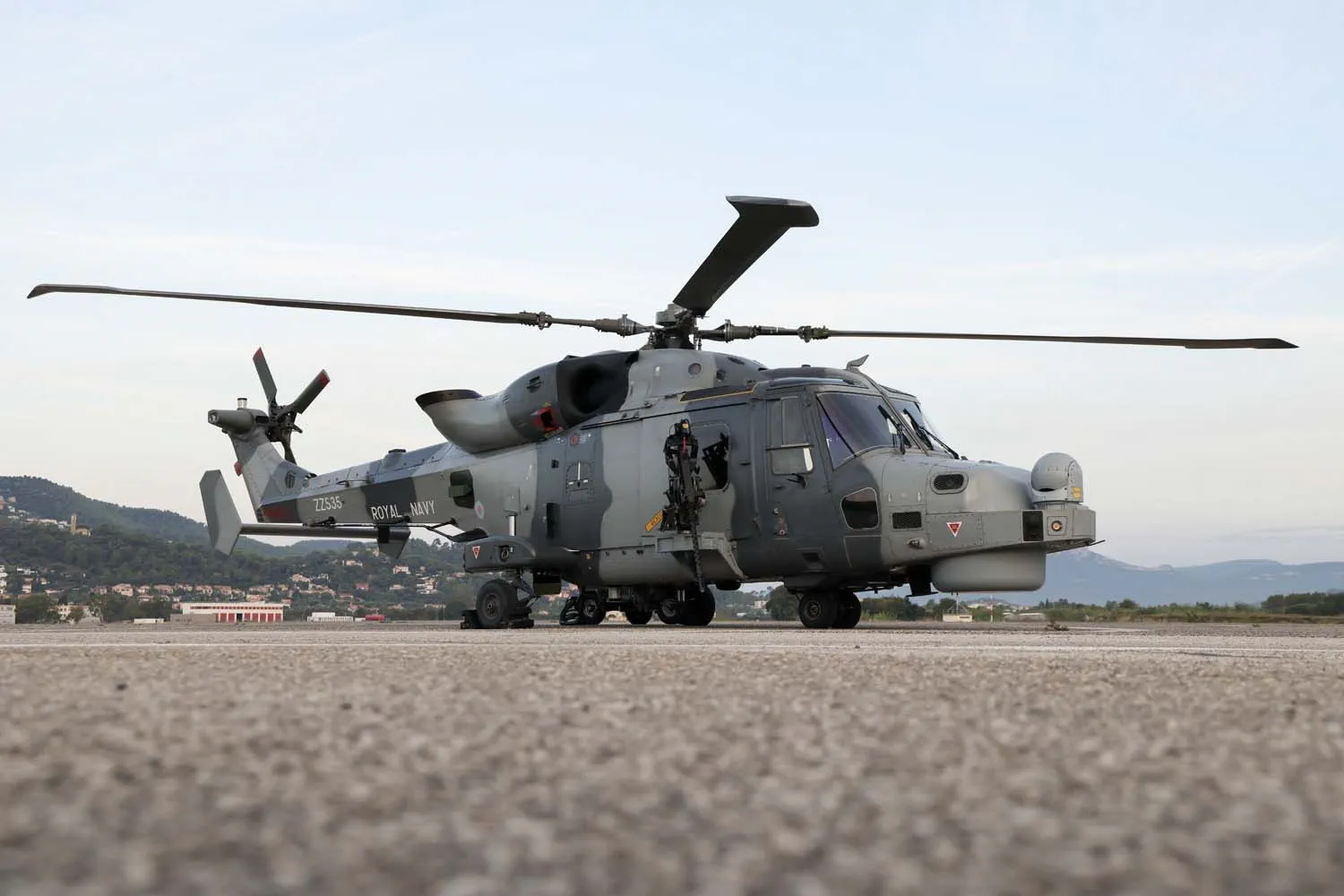
A Royal Navy Wildcat HMA2 helicopter from 815 Naval Air Squadron used Thales Martlet missiles to defend a French naval task group against uncrewed aerial and surface threats during Exercise Wildfire 26.2, the French Navy’s counter-drone drill held off Toulon from September 28 to October 2, 2026. The same exercise saw the first at-sea firing of Naval Group’s Rampart close-in launcher, which downed a target with a laser-guided rocket fired from a Mistral-class amphibious assault ship.
Wildfire is organized by the training division of the Force d’Action Navale (FAN), the French Navy’s surface force, to prepare crews for the drone threats they may face on deployment. The autumn 2026 iteration was its sixth edition. Six French ships took part: a FREMM DA air defense frigate, the two Horizon-class air defense destroyers, a La Fayette-class frigate, a Jacques Chevallier-class replenishment ship and, for the first time, a Mistral-class landing helicopter dock (LHD). Rafale Marine fighters, an Atlantique 2 maritime patrol aircraft and several helicopters supported the force, while the French procurement agency’s missile test center on Île du Levant generated the threats.
Royal Navy Wildcat and Martlet Engage Drones off Toulon
According to the Royal Navy, the Wildcat sat at the center of a series of air defense serials, detecting, tracking and engaging uncrewed aerial and surface targets before conducting live engagements with Martlet. The service did not disclose how many missiles were fired, which target types were destroyed, or whether the helicopter operated from a French deck.
The Leonardo AW159 Wildcat HMA2 is the Fleet Air Arm’s maritime attack helicopter, flown by 815 Naval Air Squadron from Royal Naval Air Station Yeovilton. Publicly available specifications indicate a maximum takeoff weight of about 6,000 kg, two LHTEC CTS800-4N turboshafts rated at roughly 1,000 kW each, and a Leonardo Seaspray 7400E active electronically scanned array radar paired with a Wescam MX-15 electro-optical/infrared turret. That sensor fit lets the aircraft detect and classify small, low-signature targets beyond a ship’s radar horizon.
Martlet, the Royal Navy name for the Thales Lightweight Multirole Missile (LMM) built in Belfast, is a laser beam-riding weapon weighing about 13 kg. Open-source data credit it with a speed of roughly Mach 1.5, a range of up to 8 km and a 3 kg blast-fragmentation warhead with proximity and impact fuzing. A Wildcat can carry up to 20 rounds. That magazine depth lets a helicopter thin out a drone raid without forcing a destroyer to spend a far more expensive Aster interceptor.
Lieutenant Harriet Austin of 815 NAS said the exercise “highlighted the effectiveness of the Wildcat and Martlet weapon system against modern threats while strengthening the close partnership between our two navies.” She added that such training “is essential to ensuring we are ready to defend maritime task groups alongside partnering NATO allies.”
Rampart Launcher Fires at Sea From French Mistral-Class LHD
Wildfire 26.2 also hosted the first at-sea test campaign for Rampart, Naval Group’s modular close-in weapon system previously designated the Multi-purpose and Modular Launching System (MPLS). Fired from the LHD, which Naval Group identified as Tonnerre, the launcher destroyed a target with a laser-guided rocket. Naval Group said the at-sea firings used both guided and unguided 68 mm rockets supplied by Thales. The company had conducted land-based firings at the Canjuers range in May 2026.
Rampart uses a turret with four interchangeable modules. In its rocket configuration, each module holds 20 Thales 68 mm laser-guided rockets, giving 80 rounds per launcher, or a total of 48 NATO-standard 70 mm rockets. The laser-guided version has a stated range of up to 5 km against aerial drones and small surface craft, and the system can operate autonomously from its own console or connect to a ship’s combat management system. On a Mistral-class hull, whose organic self-defense rests on Simbad very short-range missile mounts and guns, that adds a deep magazine of inexpensive effectors. It does not provide area air defense, which remains the job of the escorts.
The French Navy also tested interceptor drones designed to destroy hostile aerial drones and uncrewed surface vessels.
Analysis: Wildfire 26.2 shows London and Paris converging on the same answer to the drone problem: push cheap, short-range effectors outward and keep high-end interceptors for missiles. Wildcat and Martlet give the Royal Navy a mobile counter-drone layer that plugs into allied task groups, while the UK’s March 2025 agreement to supply more than 5,000 LMM to Ukraine for £1.6 billion indicates Belfast production is scaling. For France, Rampart’s sea trial moves the system from demonstrator toward a possible fleet fit, although no procurement decision has been announced.
Key unknowns remain. Neither navy has released engagement results, the qualification status of Rampart’s rockets, or a timeline for French Navy adoption. The next Wildfire edition will show whether Rampart returns for further trials and whether Royal Navy participation becomes routine.