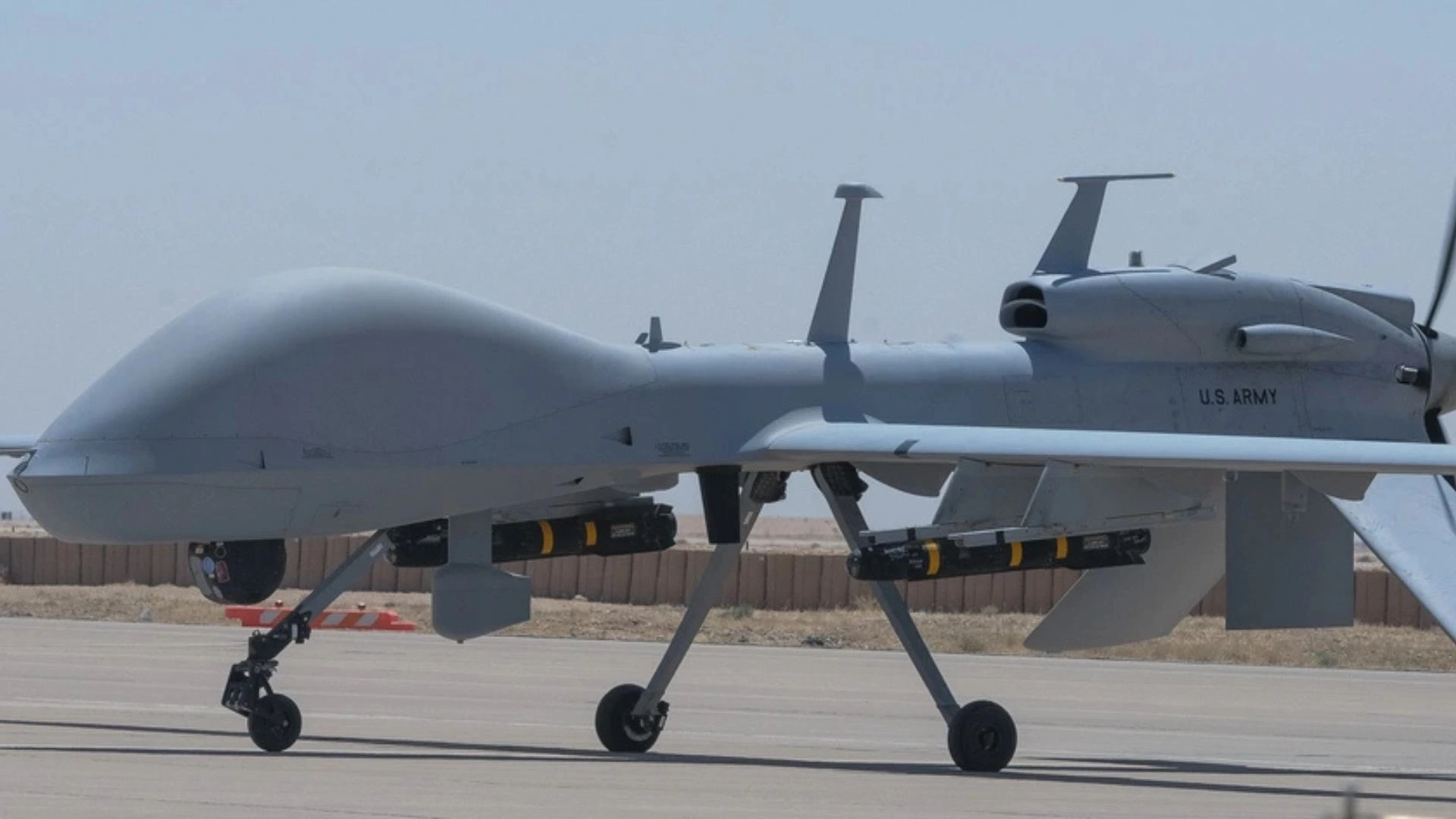
The US Army is preparing to issue a request for proposals (RFP) for its Group 4+ Short/Vertical Takeoff and Landing (S/VTOL) uncrewed aircraft system, the Gray Eagle replacement program meant to succeed the General Atomics MQ-1C in division formations. Maj. Gen. Phillip “Cain” Baker, commander of the US Army Aviation Center of Excellence, said at the Association of the United States Army (AUSA) annual meeting in Washington, D.C., that the service has absorbed extensive industry feedback and is moving ahead with the solicitation.
The RFP builds on an earlier solicitation and on the Group 4+ S/VTOL Challenge, which opened with a request for information (RFI) in December 2025. The Army stopped buying new Gray Eagles in May 2025 under the Army Transformation Initiative, when service leadership labeled the aircraft obsolete, and plans to retire older airframes around fiscal 2028 while upgrading newer ones. The fiscal 2026 National Defense Authorization Act bars retiring the Gray Eagle until a capability of equal or greater effectiveness exists, setting a statutory floor for any successor.
How the Army Is Shaping Its Gray Eagle Replacement Requirement
Baker framed the program as an architecture buy rather than an airframe competition. The short VTOL effort is “really about the architecture more than it is about the actual platform,” he said, describing an uncrewed system that must operate, feed information to soldiers and collaborate with other aircraft. The Army also intends to reuse work other services have done on similar aircraft to hold down cost.
The challenge documents follow that logic. The December 2025 RFI sought runway-independent aircraft of at least 1,320 pounds with electro-optical/infrared and atmospheric sensing, autonomous operations including collision avoidance, electronic countermeasures on an open systems architecture, and modules supplied as government-furnished equipment. The Army describes the target as a long-endurance, multi-mission platform for reconnaissance, surveillance and target acquisition (RSTA), precision strike and network extension in denied, disrupted, intermittent and limited (DDIL) environments.
Autonomy is the operational driver. Col. Nicholas Ryan, who leads the Army’s unmanned aviation transformation portfolio, has said today’s Gray Eagle ends its mission and returns to base when it loses its link, behavior the service considers untenable given the jamming and air defense density seen in Ukraine. Ryan set the minimum bar at outperforming the Gray Eagle in range and especially payload, with a first unit equipped in fiscal 2028 if funding allows. For reference, Army data lists the MQ-1C at a 3,600-pound gross takeoff weight with a 56-foot wingspan, a heavy fuel engine, a 25,000-foot ceiling, roughly 24 hours of endurance and up to four AGM-114 Hellfire missiles, all tied to a prepared runway.
Mojave vs X-BAT vs Thunder: Three Routes to Runway Independence
Three candidates have surfaced. General Atomics Aeronautical Systems (GA-ASI) is expected to offer Mojave, a STOL derivative of the Gray Eagle. Company data lists a 450-shaft-horsepower Rolls-Royce M250 turboprop, a 7,000-pound maximum gross takeoff weight, more than 25 hours of endurance and up to 16 Hellfires, four times the MQ-1C load. Takeoff runs are 400 feet for ISR and 1,000 feet with 12 Hellfires. GA-ASI and Hanwha Aerospace flew Mojave from a rough vehicle trail in South Korea in September 2026. Avionics commonality with the Gray Eagle 25M lowers transition risk, but Mojave still needs a strip.
Shield AI is pitching X-BAT, an autonomous tailsitter jet powered by a General Electric F110 engine with a thrust-vectoring nozzle. Publicly available specifications indicate a range of about 2,000 nautical miles and a ceiling above 50,000 feet. At about 22,000 pounds, X-BAT is roughly six times heavier than the MQ-1C; Shield AI argues its logistics footprint resembles that of the 23,000-pound AH-64 Apache. Shield AI said on October 8, 2026, that the US Navy had added $150 million, lifting total financing to $400 million. X-BAT has not yet flown; Shield AI expects vertical flights in 2026.
Anduril unveiled Thunder in July 2026, a Group 5 hybrid-electric tiltrotor developed with Archer Aviation and rotor specialist Karem Aircraft. Two configurable bays carry 10 missiles, 16 launched effects or 76 rockets under Anduril’s Lattice autonomy software, and the airframe breaks down into a 40-foot shipping container. Full-scale surrogates have flown, with first flight planned for 2027. Anduril designed Thunder as a low-flying attack teammate for the Apache rather than a high-altitude surveillance aircraft, and has not published endurance figures.
Analysis: By leading with architecture, the Army is decoupling the requirement from any single airframe class, which is why a turboprop, a fighter-sized jet and an attack tiltrotor can all compete for one division-level mission. The real discriminators will be autonomy that survives jamming, open interfaces for government-furnished payloads, and affordability at scale. The trade space is sharp: Mojave brings endurance and fleet commonality but only partial runway independence, while X-BAT and Thunder offer true vertical basing but have yet to make a first flight, with operating costs undisclosed. The congressional floor means the Army cannot trade Gray Eagle persistence for basing flexibility alone.
The Army has not given a release date for the RFP, nor disclosed quantities, unit cost targets or whether it will select more than one vendor. The fiscal 2028 fielding goal remains tied to funding. Meanwhile, the Gray Eagle line continues: GA-ASI announced on October 12, 2026, that the Arizona National Guard will receive eight Gray Eagle 25M aircraft by September 2027 and four more by the end of 2029. Flight tests of X-BAT and Thunder will show whether the newer contenders can mature in time.