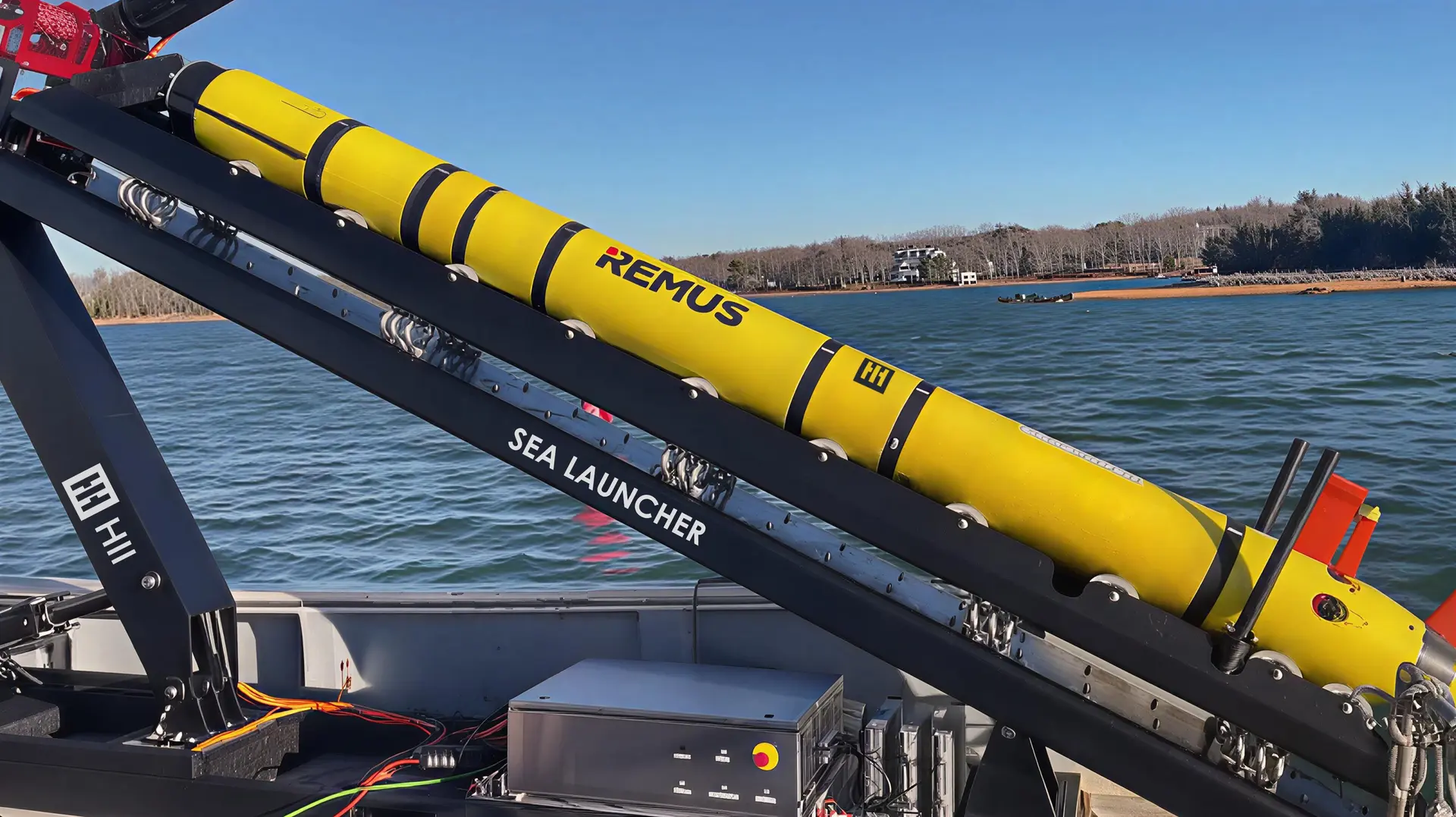
HII has validated key elements of a fully autonomous, end-to-end launch and recovery of its REMUS 620 medium unmanned underwater vehicle (UUV) using Sea Launcher, the company’s automated shipboard handling system, HII said on October 19, 2026. The trial used a representative ship configured for real-world mission conditions and follows an initial Sea Launcher demonstration the company announced on January 13, 2026.
The test arrives as the U.S. Navy pushes toward a hybrid manned-unmanned surface fleet. Navy officials have said that Surface Force Vision 2045, issued by Vice Adm. Brendan McLane, commander of Naval Surface Force, U.S. Pacific Fleet, targets a force that is 45 percent unmanned by 2045. McLane has framed the shift bluntly: “We must lead with urgency, pushing this innovation from concept to combat power. It’s not optional, it’s a combat imperative.” Scaling that force depends less on what individual drones can do than on the ship-to-vehicle interface that gets them into and out of the water.
How HII Sea Launcher Automates the Ship-to-UUV Interface
Sea Launcher targets the most hazardous manual step in UUV operations: sailors handling a vehicle weighing several hundred kilograms on an exposed deck, often from a moving ship in degraded weather. HII describes the system as extending autonomy beyond the vehicle into the shipboard infrastructure needed to operate it, with the stated goals of cutting risk to crews, expanding mission range, and shortening mission timelines.
The recovery sequence builds on an existing behavior rather than a new one. REMUS vehicles have performed autonomous line capture for years, a procedure HII says has been used repeatedly in U.S. Navy and allied deployments. Sea Launcher pairs that behavior with automated handling aboard the host vessel.
“This is proven technology applied in a highly relevant shipboard configuration,” said Duane Fotheringham, president of the Unmanned Systems business group within HII’s Mission Technologies division. He said the demonstration shows how that capability integrates with automated launch and recovery systems “onboard manned or unmanned vessels.”
Critical performance data remain undisclosed. HII has not published Sea Launcher’s maximum operating sea state, its turnaround time between recovery and relaunch, its deck footprint, or its weight, all parameters that will decide which hulls can carry it. HII also has not said when or where the latest trial took place or which vessel hosted it.
REMUS 620 Specifications: Endurance, Payloads, and Deployment Options
The REMUS 620 is HII’s second-generation medium-class UUV, unveiled in November 2022. Publicly available HII specifications describe a 12.75-inch-diameter vehicle offered in three rechargeable battery configurations, with base lengths of roughly 2.7 to 4.3 meters and weights of 188 to 326 kilograms. In its longest configuration, the vehicle is rated for up to 110 hours of endurance and 275 nautical miles of range under ideal conditions; heavier payloads such as synthetic aperture sonar (SAS) reduce both figures.
The 620 shares the size and weight of the REMUS 600 family that underpins the Navy’s MK 18 Mod 2 Kingfish mine countermeasures vehicle, easing integration into existing handling gear and training pipelines. Its battery sections can be swapped for charged modules between sorties, which compounds the value of automated recovery: the faster a vehicle comes aboard and turns around, the more sorties a single host generates.
The vehicle runs HII’s Odyssey autonomy suite and is marketed for deployment from submarines, surface combatants, amphibious ships, small manned or unmanned craft, and helicopters. Mission sets include mine countermeasures (MCM), hydrographic survey, intelligence, surveillance and reconnaissance (ISR), and cyber and electronic warfare payloads. HII says the wider REMUS family serves more than 30 navies.
ROMULUS USV Integration Turns Surface Drones Into UUV Hosts
Sea Launcher’s larger payoff depends on what carries it. HII plans to integrate REMUS and Sea Launcher with its ROMULUS family of unmanned surface vessels (USVs), producing an uncrewed host that could transit to an operating area, deploy UUVs, and recover them with reduced human involvement.
ROMULUS is moving from prototype toward serial production. On April 21, 2026, HII announced four additional ROMULUS 151 vessels to be built by Breaux Brothers Enterprises in New Iberia, Louisiana, alongside one hull already under construction. The first ROMULUS 151 hull completed structural build and was flipped in September 2026, and Halimar Shipyard in Morgan City, Louisiana, joined the production network in July. HII’s High-Yield Production Robotics (HYPR) initiative, launched in March 2026, integrates robotic welding, automated material handling, and digitally enabled quality assurance into an assembly line for ROMULUS vessels of roughly 20 to 190 feet.
HII figures for the 190-foot ROMULUS 190 cite a range of more than 2,500 nautical miles and space for four 40-foot ISO containers. HII has not detailed how Sea Launcher would be packaged aboard. According to HII, the Navy selected ROMULUS in June 2026 to advance to at-sea testing under its Medium Unmanned Surface Vessel (MUSV) effort, restructured as a production-focused marketplace after the service cancelled the Modular Attack Surface Craft (MASC) program in March.
Analysis: The test targets a constraint that rarely leads unmanned-systems marketing but governs operational tempo: launch and recovery is where autonomous operations revert to manual labor and where handling risk concentrates. A USV able to deploy and retrieve UUVs without a crewed mothership would let the Navy push MCM and seabed ISR into contested littorals while keeping destroyers and amphibious ships outside threat envelopes, a direct fit for distributed operations in the Indo-Pacific. The chain still rests on two unproven links. Sea Launcher’s performance envelope is unpublished, and the first ROMULUS 151 remains under construction. Until HII demonstrates the full sequence at sea, the dual-domain package is a design intent, not a fielded capability.
Milestones to watch include a complete Sea Launcher cycle aboard an unmanned host, release of sea state and turnaround data, and delivery of the first Louisiana-built ROMULUS 151 hulls. A Navy surface warfare official said in January 2026 that the service’s medium USV inventory would reach about 11 vessels; how the MUSV marketplace allocates future orders will determine whether a ROMULUS-REMUS package reaches a program of record. HII has not named a Sea Launcher customer.