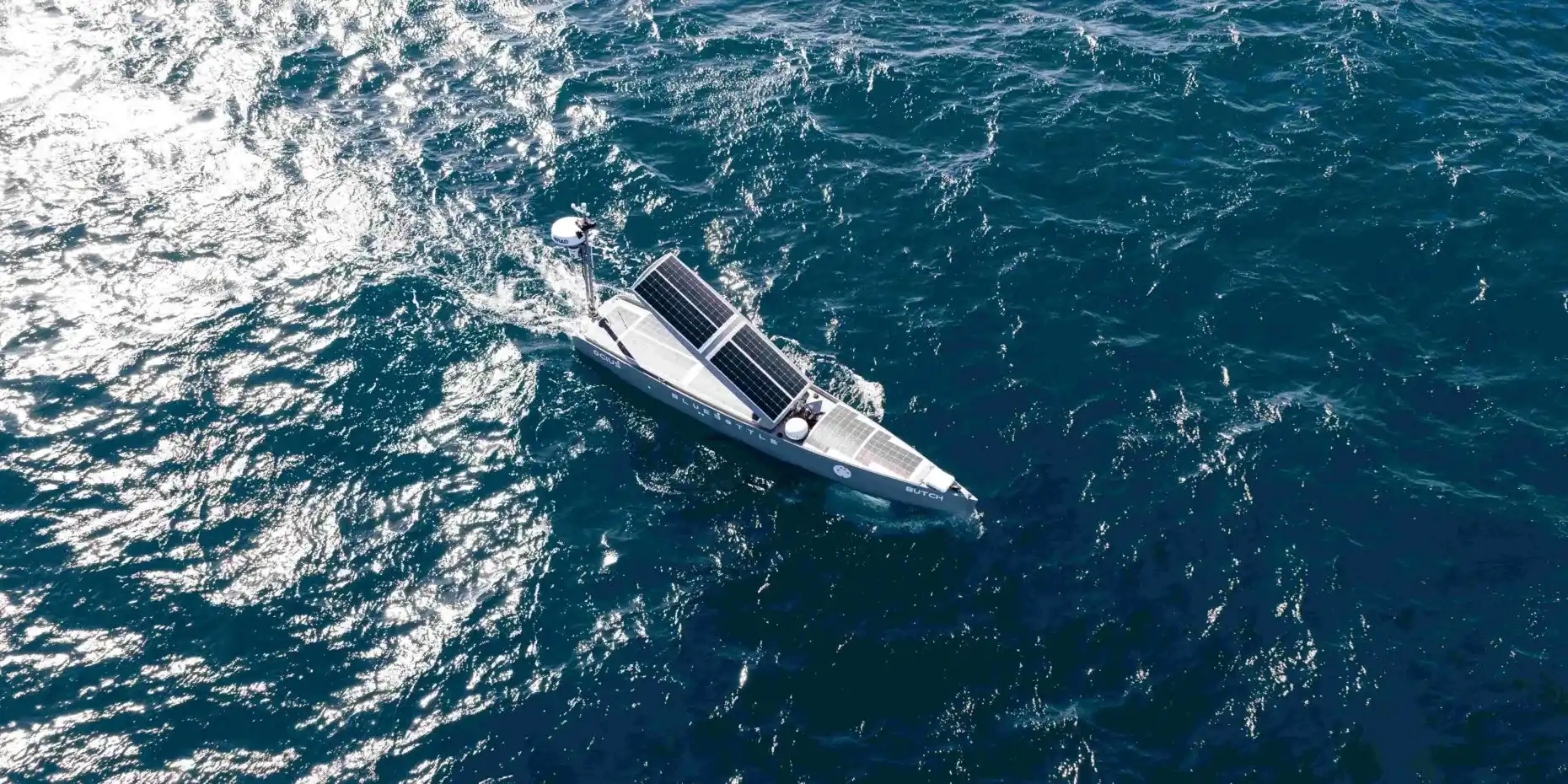
Ocius Technology has deployed two Bluebottle Hybrid uncrewed surface vessels (USVs) to the US Navy-led Maritime Big Play Pacific exercise, the first time the diesel-augmented variant of the Australian-built platform has taken part in a naval exercise anywhere. Both vessels carry ThayerMahan Outpost acoustic intelligence payloads running TransparenSea processing software to detect and track undersea threats, the company said on October 21, 2026.
Maritime Big Play is the AUKUS Pillar II exercise and experimentation series through which Australia, the United Kingdom and the United States are accelerating the operational use of autonomous and uncrewed systems at sea. The Pacific iteration runs in the Southern California operating area from October 5 to 25, 2026, according to the US Navy, and brings more than 40 government and industry technologies from the three partners into scenarios covering anti-submarine warfare (ASW), maritime strike and seabed operations. For Ocius, the event puts its newest variant in front of allied operators months after the Royal Australian Navy (RAN) committed to a 40-vessel Bluebottle fleet.
Bluebottle Hybrid USV Power Architecture and Payload Capacity
The baseline Bluebottle draws all of its energy from the environment. Publicly available specifications describe a single-hull vessel with a sail that doubles as a solar array and folds flat against the deck, a solar-covered top deck, and a flipper on the rudder that converts the hull’s pitching in waves into forward thrust. On earlier classes, solar output across sail and deck has been cited at up to 1,500 W and top speed at 5.6 to 6.5 knots. Ocius rates the current vessel for operations up to force 8 on the Beaufort scale. Following a 2024 design review, all Bluebottles are now built at the 24-foot size, with a hull Ocius lists at 7.4 meters.
The Hybrid adds a diesel generator to that renewable mix. According to Ocius, the generator supplies additional power when required, enabling persistent operations in low-light conditions such as high-latitude winters and supporting payloads with higher power demands. Company disclosures indicate the generator set draws on 400 liters of diesel. Ocius has not published endurance figures for the Hybrid under generator load, and that number remains the key unknown for planners.
The trade-off is operational, not cosmetic. A purely renewable Bluebottle has a sensor budget set by daylight and weather, which limits it at high latitudes and constrains power-hungry payloads such as active sonar, electronic warfare (EW) suites or communications relays. A diesel reserve decouples mission power from the sun, at the cost of a finite fuel supply and a refueling cycle the renewable variant avoids. Ocius Chief Executive Officer Robert Dane framed the variant around that envelope, saying the company aims to demonstrate the platform’s flexibility “in environments where additional power is required, including northern hemisphere operations and missions involving higher-power payloads.”
ThayerMahan Outpost and SEA1200 Undersea Surveillance Integration
The payload is the same acoustic suite Ocius selected for the RAN’s SEA1200 undersea warfare program. In August 2026, Ocius announced a contract with ThayerMahan to deliver 40 Outpost acoustic intelligence payloads with TransparenSea processing software under SEA1200, built around fully retractable thin-line acoustic arrays for persistent surface and subsurface intelligence, surveillance and reconnaissance (ISR). That order supports the RAN’s A$176 million contract, announced in March 2026, for 40 Australian-designed and built Bluebottles.
Bluebottles are in service with the RAN, the Royal New Zealand Navy and the Australian Border Force, and operate in the United States through ThayerMahan, which integrates them with its sonar systems and fields them as Outpost systems. Earlier US Navy exercise participation by the renewable Bluebottle centered on submarine detection, and Ocius says the vessels sustained operations through two hurricanes. The platform also holds AUKUS Authorised User Status.
Fielding the Hybrid with the SEA1200 payload at Maritime Big Play therefore tests more than a new power plant. It places a sensor chain already contracted for Australian service inside a trilateral network, where the question is whether acoustic contacts from an Australian USV can be fused and acted upon by US and British command-and-control (C2) nodes. Neither Ocius nor the US Navy has disclosed which scenarios the Hybrids support or any detection results.
Analysis: The Hybrid variant targets the main structural limit of wind-and-solar USVs: a power budget dictated by geography and season. For AUKUS, that matters because the undersea problem sets of greatest concern extend well beyond sunlit tropical waters, from the Greenland-Iceland-United Kingdom gap watched by the Royal Navy to high-latitude Pacific approaches. A low-cost, long-endurance acoustic picket able to run heavier payloads year-round would let the three navies thicken distributed ASW barriers without committing crewed frigates or maritime patrol aircraft. The open question is cost per mission once fuel logistics enter the equation, since persistence without resupply has been the Bluebottle’s central selling point.
Maritime Big Play Pacific concludes on October 25, 2026. Milestones to watch include any released performance data from the Hybrids’ first exercise, whether the RAN or another AUKUS customer orders the variant, and delivery tempo on the 40-vessel Australian fleet, which will draw on the defense production and operations facility Ocius opened in Sydney on October 16, 2026. Ocius has not said whether the Hybrid will be produced in quantity or remain a specialized configuration for high-latitude and high-power missions.