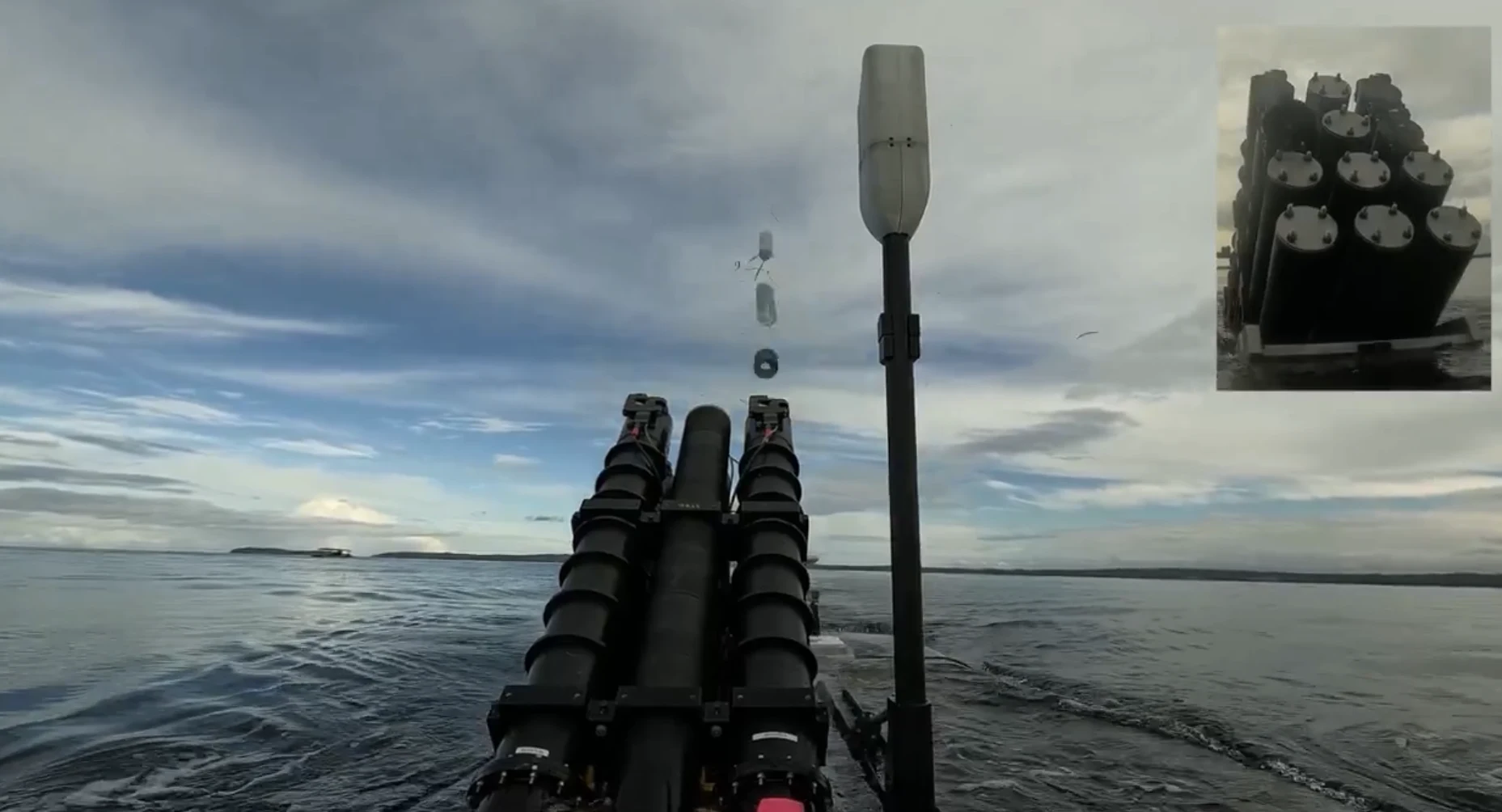
Anduril Industries has released the first public footage of its Ghost Shark extra-large autonomous undersea vehicle (XL-AUV) launching an Altius uncrewed aircraft at sea, days after Australia’s Minister for Defence Industry Pat Conroy declassified the platform’s payloads in Sydney on October 19, 2026. The 34-second video shows a surfaced Ghost Shark opening its upper hull doors, raising a multi-tube launcher and firing an Altius drone, part of what the company calls active payload testing.
Conroy confirmed three payloads approved for Ghost Shark after closed trials: up to 12 sea mines per mission, seabed logistics caches carrying equipment developed by the Defence Science and Technology Group, and swarms of Altius drones for reconnaissance and strike. The same announcement covered payload integration for the Speartooth uncrewed underwater vehicle and the Bluebottle uncrewed surface vessel, which will carry a thin-line towed array sonar to detect submarines.
Canberra is spending A$1.7 billion on a Ghost Shark fleet for the Royal Australian Navy (RAN) under a five-year contract signed with Anduril Australia on September 10, 2025, within up to A$5.8 billion earmarked over the decade for autonomous and uncrewed undersea warfare. The first vehicle reached the Navy in January 2026, and Anduril states that Ghost Sharks are now rolling off the production line. Defence is marking the payload milestone this week at Exercise Maritime Big Play Pacific, an AUKUS Pillar II event in San Diego.
Inside the Ghost Shark Altius Launch Sequence
The footage shows the vehicle holding on the surface while doors on top of the hull slide open and a launcher rises from the upper payload bay. The War Zone (TWZ), which analyzed the video, counted 12 angled tubes on that launcher and identified a second launcher, apparently of the same type, stowed in the other upper bay and not raised in the clip. One drone is shown leaving a tube while Ghost Shark stays surfaced. If both launchers carry 12 rounds, a single sortie could release two dozen Altius, according to TWZ’s estimate; Defence has not confirmed the number.
That surface window is the most exposed phase of the mission, although TWZ judged the vehicle’s above-water signature small enough to complicate radar and electro-optical detection. Neither Defence nor Anduril has disclosed how long Ghost Shark must remain on the surface to complete a launch, or whether a submerged launch is planned. Conroy withheld the number of drones per swarm for operational reasons.
The video also shows two deployable masts that TWZ noted had not been seen on the platform before: a longer arm that unfolds from the hull centerline between the payload bays and carries an antenna, and a shorter mast rising vertically farther aft. Altius is designed to fly in networked swarms and needs a datalink once airborne. TWZ assessed that the tall mast could provide a line-of-sight link to the drones and the aft mast a satellite communications array relaying their feeds to distant operators. Defence and Anduril have not described either mast’s function.
Which Altius Variant Ghost Shark Is Likely to Carry
Defence has not confirmed which Altius model is integrated, and the video does not identify it. The rounds displayed at the Sydney factory belonged to the Altius-600 family, a tube-launched fixed-wing aircraft whose wings deploy after leaving the tube, and, as TWZ notes, Ghost Shark has previously been shown alongside both the Altius-600 ISR model and the Altius-600M strike variant. Anduril credits the Altius-600 with a maximum range of about 275 miles (roughly 440 kilometers) and at least four hours of endurance.
The pairing pushes an undersea platform’s reach well beyond the horizon. Conroy has said Ghost Shark could potentially operate thousands of kilometers from the Australian continent; Altius then supplies either an organic intelligence, surveillance and reconnaissance (ISR) picture or a strike option. Modular hull sections let the RAN swap the Altius launchers for the mine-laying or seabed logistics payloads.
Analysis: The footage matters as much as a deterrence signal as a technical test. Tube-launched Altius has flown from helicopters, uncrewed aircraft and ground vehicles; launching it from an uncrewed undersea vehicle is new. Combined with Conroy’s argument that any shipping container on an Australian wharf could now hold an armed Ghost Shark, the video presents a containerized strike node that complicates an adversary’s targeting and force-protection planning. Surface exposure time and datalink architecture will decide whether that deterrent holds in a contested electromagnetic environment.
Payload testing continues alongside production at Anduril Australia’s Sydney factory. The next markers are the results from Maritime Big Play Pacific, confirmation of the Altius variant and loadout per launcher, and any decision on producing Altius in Australia, which Anduril Australia says it is pursuing at scale subject to government approval. Export also remains in play: Conroy said Canberra has not abandoned a Ghost Shark sale to the United States and that a range of other countries have expressed interest.