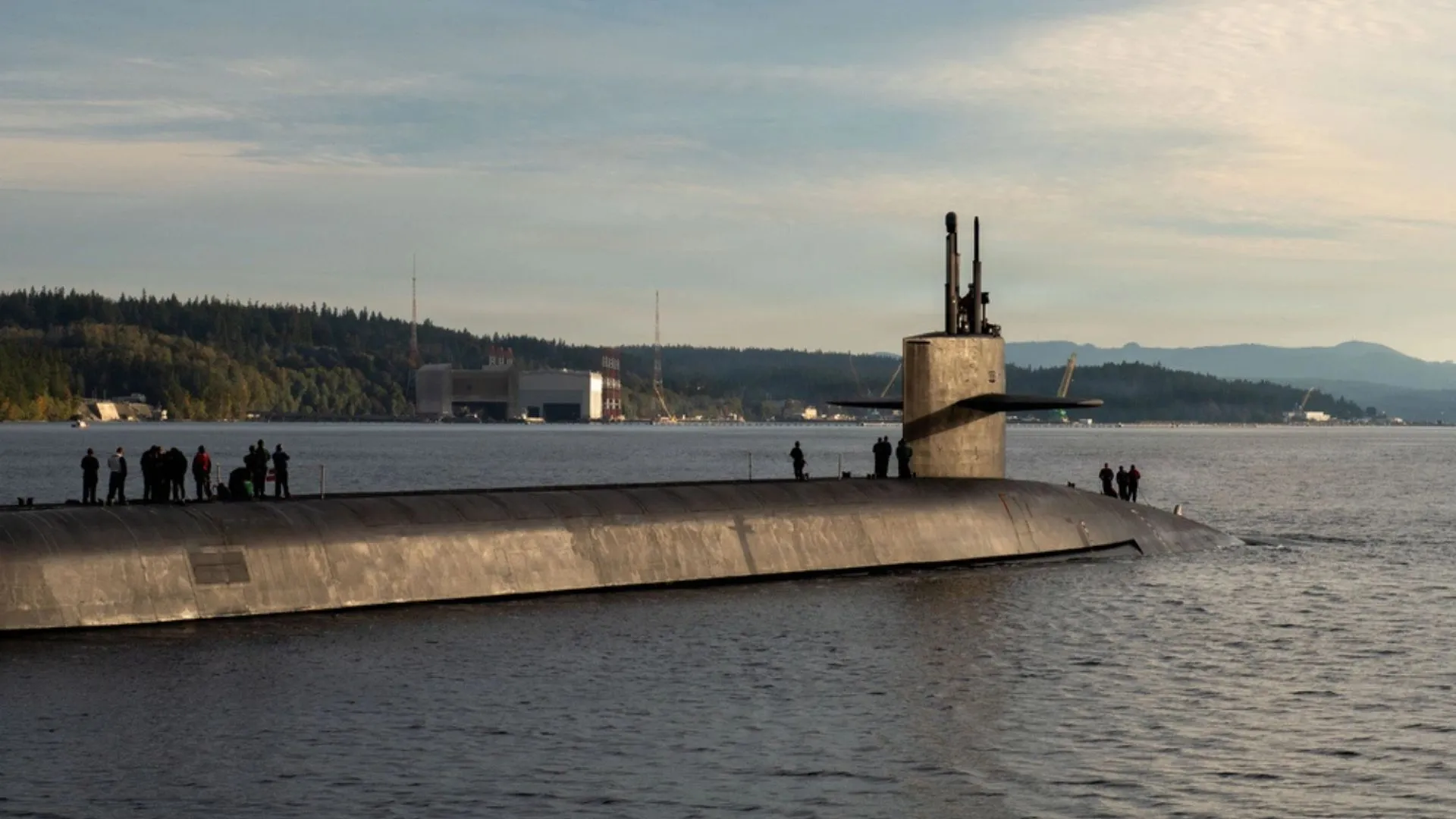
The U.S. Navy has awarded the Johns Hopkins University Applied Physics Laboratory (APL) a $47,738,983 contract to investigate present and future technological and operational vulnerabilities affecting submarines and other assets used in subsea and seabed warfare, the Pentagon announced October 21, 2026. The hybrid cost-plus-fixed-fee and cost-no-fee award, N00030-27-C-3002, supports the Navy’s Undersea Security Program and runs through October 20, 2031.
The timing matters. The contracting activity, Portfolio Acquisition Executive Strategic Systems Programs (PAE SSP), manages the Trident II D5 strategic weapon system carried by the Navy’s ballistic missile submarines (SSBNs), which open-source estimates credit with the majority of deployed U.S. strategic warheads. That fleet is entering a decade-long handover from 14 Ohio-class to 12 Columbia-class boats, while Russian seabed operations and a sharpening debate over so-called transparent oceans have put SSBN survivability under renewed scrutiny.
Inside the APL Contract on Submarine Vulnerabilities and Seabed Warfare
The scope language is the most revealing element of the award. It funds research and development support for a program investigating vulnerabilities that affect “submarines and other assets used in Subsea and Seabed Warfare,” wording that reaches beyond the effort’s original focus on ballistic missile submarines. The Navy has not disclosed which technologies, threat vectors, or platforms the work will examine.
The financial structure is modest. The Navy obligated only $50,000 in fiscal 2026 research, development, test, and evaluation (RDT&E) funds at award, money that expires on September 30, 2027, the end of the current fiscal year. The $47.7 million ceiling averages about $9.5 million per year over five years, with further funding likely to follow through modifications. The cost-no-fee element is a structure commonly used for research by nonprofit institutions such as APL. Work will be split between Laurel, Maryland (80 percent), and Washington, D.C. (20 percent).
The Navy competed the work under full and open competition through a Broad Agency Announcement (BAA) pursuant to 10 U.S. Code 4001(c)(1),. PAE SSP itself is new: it is one of five Portfolio Acquisition Executive organizations the Navy announced on March 16, 2026, and Vice Adm. Douglas L. Williams took command of it on June 12, 2026.
From SSBN Security to the Undersea Security Program
The program descends from one of the Navy’s oldest research efforts. Its origin is an October 1968 directive from the Director of Defense Research and Engineering requiring an investigation of SSBN vulnerability and survivability; the same year, the Navy’s Polaris program office asked APL to evaluate the prelaunch survivability of the SSBN fleet. Its charter has remained consistent: assess whether an adversary could locate, track, or destroy a U.S. ballistic missile submarine at sea, then develop systems and tactics to counter those threats.
The program was organized in three divisions: acoustics, non-acoustics, and operations security. Non-acoustic work covers detection phenomena other than radiated noise, such as magnetic, hydrodynamic, and optical signatures. The operations security line supported the SSBN Tactical Development Program, which Submarine Development Squadron 12 manages with APL. The laboratory has described SSBN security as its largest and longest-running undersea warfare program.
Procurement records show SSP solicits long-range science and technology proposals under the Undersea Security Program name through BAA N00030-23-S-7002. APL has said the program was expanded in 2004 to cover attack and guided-missile submarines (SSNs and SSGNs); when and why it took on the broader seabed mission has not been publicly explained.
Transparent Oceans, GUGI, and the Columbia-Class Transition
Two developments frame the broader mandate. The first is technological. Proponents of the transparent oceans thesis argue that quantum sensors, space-based sensing, dense acoustic networks, and artificial intelligence (AI) could eventually strip SSBNs of their stealth. A peer-reviewed study in the summer 2026 issue of International Security found that, of the technologies in that debate, only AI applied to passive sonar signal processing improves SSBN detection, and only in evolutionary fashion. A separate assessment published in August 2026 by the Council on Strategic Risks found that AI-enabled detection gains are concentrated in shallow water and that ocean physics still limits what any sensor can detect.
The second is operational. Two Western officials told Reuters in September 2026 that British, Norwegian, and U.S. forces disrupted an exercise near Svalbard in which Russia’s Main Directorate of Deep-Sea Research (GUGI) used deep-sea submersibles to simulate deploying technology designed to disable undersea cables. At least 11 Baltic Sea cables were damaged in the 15 months from October 2023 to January 2025. The same seabed hosts the fixed sensors and cables on which allied antisubmarine warfare depends.
The contract’s 2031 end date also overlaps the most sensitive stretch of the SSBN handover. Program Executive Officer Strategic Submarines Rear Adm. Todd Weeks said in February 2026 that the future USS District of Columbia (SSBN-826) was about 65 percent complete, with water entry planned for 2027 and delivery targeted for 2028. The boat was originally slated to begin its first patrol in 2030, replacing USS Henry M. Jackson (SSBN-730).
Analysis: The dollar figure is small; the scope language is not. By folding “other assets used in Subsea and Seabed Warfare” into a program built to protect SSBNs, the Navy treats deterrent survivability as inseparable from the wider contest over the ocean floor, where cables, fixed sensors, and unmanned systems can serve either side. Academic evidence suggests the oceans are not becoming transparent soon, but an undetected erosion of SSBN stealth would weaken the most survivable leg of the triad during an Ohio-to-Columbia handover with little schedule margin. Competing the work through a standing BAA preserves APL’s institutional memory while leaving room for new performers and new detection science.
Watch for incremental obligations on the APL contract, further awards under the Undersea Security Program BAA, and undersea security funding in the fiscal 2028 budget request. District of Columbia’s water entry in 2027 will test whether the Columbia schedule holds. The findings will stay classified; the public record will show only how much the Navy spends on asking the question.