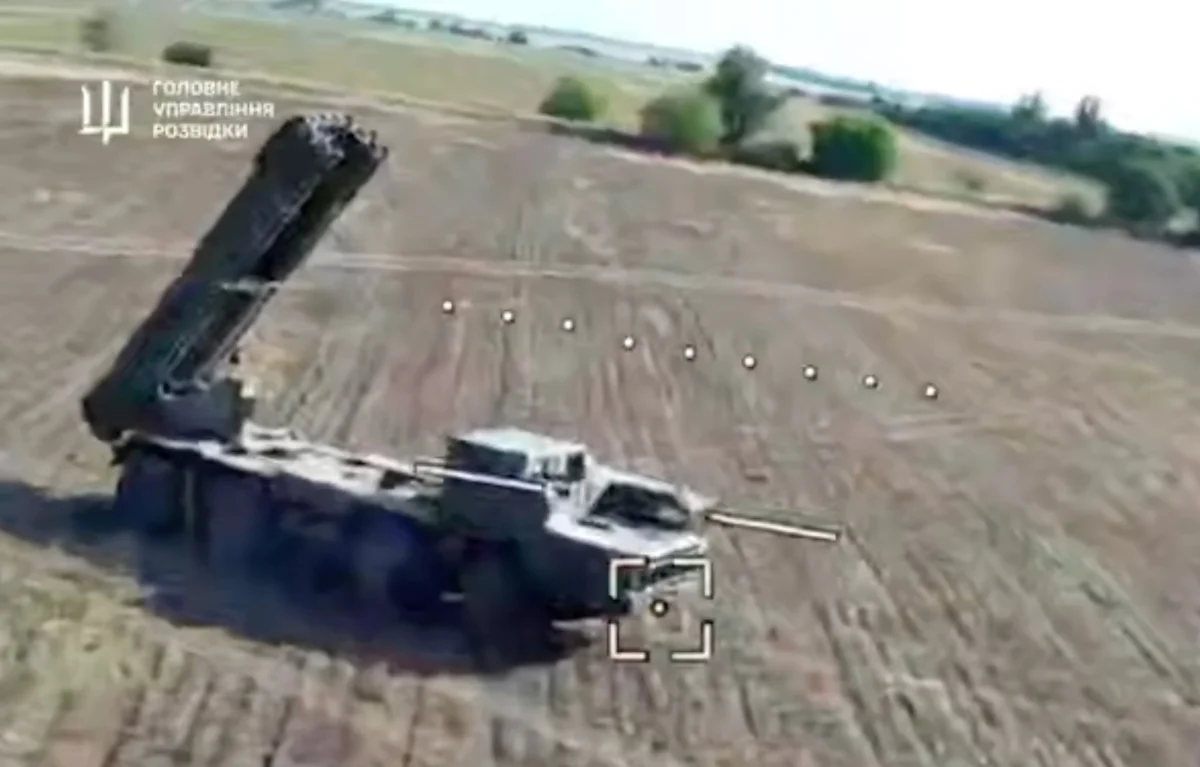
Ukraine’s Defense Intelligence Directorate (HUR) has struck a Russian 9K515 Tornado-S heavy multiple launch rocket system (MLRS) in occupied Kherson Oblast, according to footage released by the directorate’s Prymary unit on October 20, 2026. The video shows the launcher hit in succession by several kamikaze drones of different types near Skadovsk, a port town on the Black Sea coast.
Open-source analysts geolocated the strike to the village of Ulyanivka on the outskirts of Skadovsk, placing the launcher well behind the Dnipro River front line. HUR did not give an exact date, stating only that the strike took place over the past month. In southern Ukraine, the Tornado-S has repeatedly shelled Kherson and other towns along the Dnipro from positions inside occupied territory.
Tornado-S Rocket Launcher Specifications and Strike Range
The 9K515 Tornado-S is a deep modernization of the Soviet-era 9K58 Smerch. Developed by NPO Splav in Tula, now part of the state-owned Rostec group, it was approved for Russian service in mid-2016. The 9A54 combat vehicle carries a 12-tube launcher for 300 mm rockets. Publicly available specifications indicate it rides on the MAZ-543M 8×8 cross-country chassis, powered by a V-12 diesel engine, with a road speed of 60 km/h and an operational range of about 850 km.
The upgrade centers on fire control. An automated fire control system integrated with GLONASS satellite navigation lets the three-person crew prepare and fire a full salvo without leaving the cab, and passes individual flight-profile data to each rocket. The 9M542 guided high-explosive fragmentation rocket reaches 120 km, while 9M544 and 9M549 rounds carry cluster payloads. Russian claims of 200 km extended-range rounds remain unconfirmed. Each launcher is paired with a transloader carrying 12 reload rounds.
Range is the system’s defining operational advantage. At 120 km, a Tornado-S positioned near Skadovsk can reach Kherson city and the right bank of the Dnipro while sitting outside the reach of most Ukrainian tube and rocket artillery. That standoff makes it a priority target.
Tornado-S Losses Mount as Ukrainian Drones Reach Deeper South
The Prymary footage shows a tactic now standard against high-value vehicles: drones of different types hit the launcher one after another, so a follow-up drone can finish a target that survives the first impact before the crew drives it away. After a July drone strike on a Tornado-S near Huliaipole, the Pomsta Border Guard Brigade valued the vehicle at more than $15 million.
The Skadovsk strike extends a series of Ukrainian claims against the system this year. In February, the Unmanned Systems Forces’ Ptakhy unit hit a launcher in occupied Zaporizhzhia Oblast with FP-2 strike drones cued by reconnaissance drones. In March, a long-range Fire Point drone struck three launchers and a transloader near Karakul in occupied Crimea. Two more were hit near Melitopol in late April.
The Tornado-S led a wider monthly report in which HUR said Prymary also hit a Buk-M3 medium-range air defense system, an Orion reconnaissance and strike drone, a Kasta-2E low-altitude radar, a Nebo-U long-range surveillance radar and two P-18 early warning radars, as well as a drone assembly site and a building housing personnel of the 4th Air Assault Battalion, 108th Air Assault Regiment. HUR gave no dates or locations for these strikes and did not specify which targets were destroyed rather than damaged.
Analysis: The Tornado-S was designed to fight from depth, trading proximity for a 120 km reach that keeps it beyond conventional counter-battery fire. Persistent drone reconnaissance paired with layered one-way attack drones erodes that model, since an observation drone can hold a target until a strike package arrives. For NATO armies investing in long-range fires such as HIMARS and the Precision Strike Missile, the lesson is direct: range alone does not protect a launcher, and dispersal, concealment, decoys and organic short-range air defense for fires units carry equal weight.
Russia has not acknowledged the loss, and HUR’s account remains the only official source on the strike’s timing and outcome. Indicators to watch include whether Russian forces pull remaining Tornado-S batteries back from the coast, which would reduce their coverage of Kherson, and whether imagery confirms the status of the Buk-M3 and the radars listed in the report.