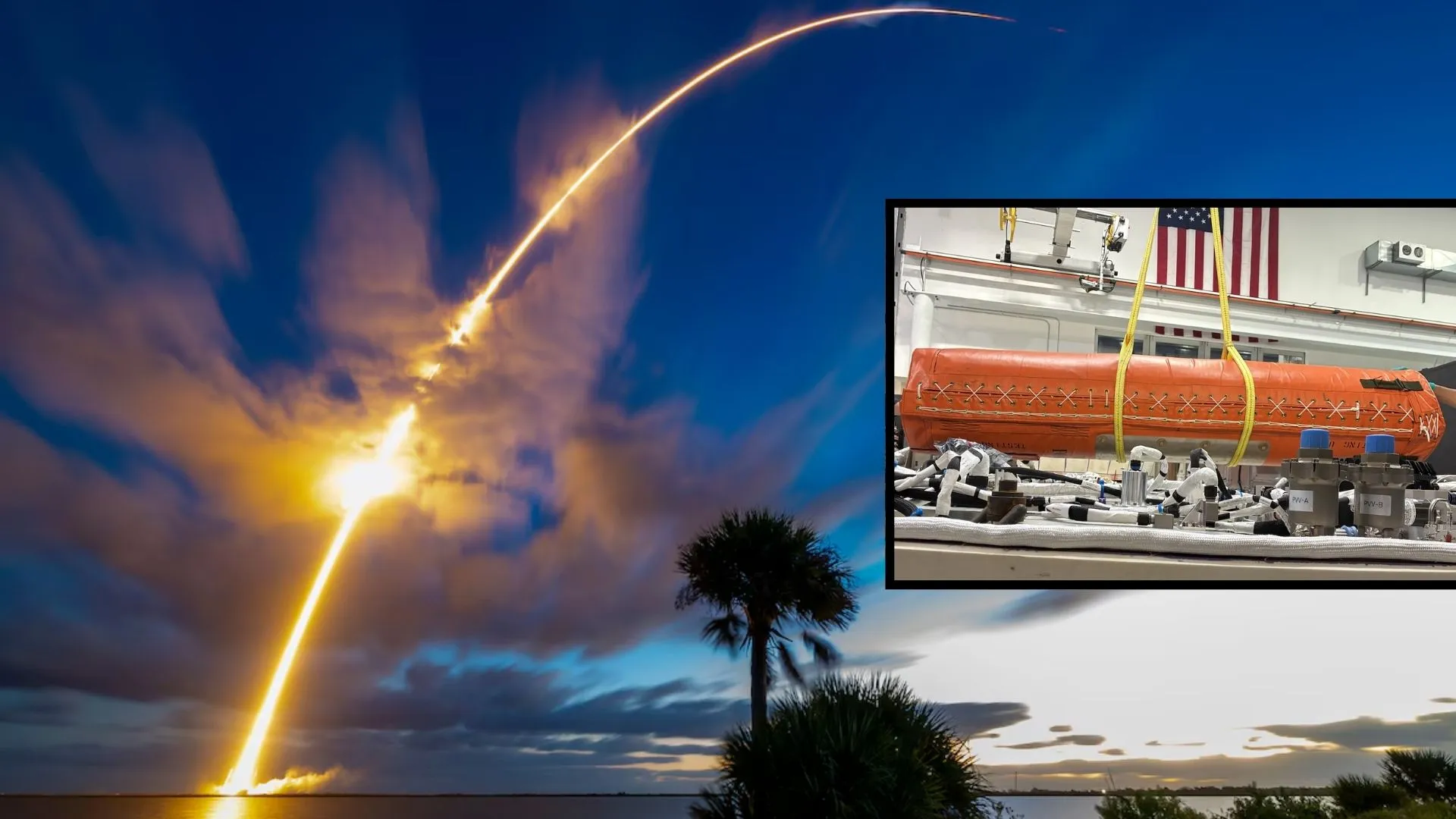
The Air Force Research Laboratory (AFRL) launched instrumented cargo pods inside a SpaceX Starfall reentry capsule on October 20, 2026, aboard a Falcon 9 rideshare mission from Cape Canaveral Space Force Station, Florida. The flight is the latest experiment under Rocket Cargo, the lab’s effort to determine whether large commercial liquid-propellant rockets can deliver materiel anywhere on Earth on tactical timelines.
Rocket Cargo dates to 2021, when AFRL designated it the fourth of its Vanguard programs, which push transformational technologies toward operational use. Fiscal 2022 budget documents set the long-range goal at 100 tons of materiel delivered anywhere on the planet in 60 minutes or less, using commercial rockets rather than Air Force-built vehicles. Five years on, it remains an experimentation effort, and the Starfall flight is a payload survivability test, not an operational delivery.
Rocket Cargo Pods Ride the Second SpaceX Starfall Flight
The capsule flew on SpaceX’s Bandwagon-5 mission, which lifted off from Space Launch Complex 40 at 7:04 a.m. EDT after a one-day weather delay, carrying 32 payloads. Starfall rode atop the stack, scheduled to separate last, about two hours and 48 minutes after liftoff. It was the vehicle’s second flight, following a debut demonstration on June 23, 2026.
Publicly available Federal Aviation Administration (FAA) environmental documents describe Starfall as an uncrewed, disk-shaped capsule about 3.1 meters (10.2 feet) in diameter and 0.75 meters tall, with an empty mass of roughly 2,100 kilograms and a payload capacity of up to 1,000 kilograms. It has no deorbit engine. The launch vehicle sets the reentry trajectory, while cold-gas nitrogen thrusters orient a jettisonable carbon-fiber heat shield. Pilot, drogue and main parachutes slow the capsule for splashdown in the Pacific Ocean, about 1,300 kilometers off the coasts of California and Mexico.
Inside, AFRL integrated lab-developed agile cargo pods designed to host varied loads. Each pod carried representative mission equipment and environmental sensors recording temperature, shock and vibration. The manifest centered on what an isolated unit would need: a SATCOM-enabled tracker, batteries, a reverse osmosis desalinator, survival gear and emergency medical equipment. Engineers also fit-checked a UNI-PAC III life raft inside the capsule for future tests, pointing to interest in personnel recovery and maritime rescue resupply.
Tens of Tons per Launch: Rocket Cargo Missions and Commercial Partners
AFRL points to tonnage as the feature that separates Rocket Cargo from other rapid-delivery efforts: a large rocket could carry tens of tons per launch to sites with no runways or roads. Candidate missions include contested logistics, expeditionary operations, rescue, disaster relief and response to chemical, biological, radiological and nuclear (CBRN) hazards.
“This was a critical achievement to demonstrate the potential of Rocket Cargo delivery for point-to-point rapid global mobility for the Future Force,” said Adam Remaly, director of the AFRL Technology Transition Office.
“Today’s launch was another demonstration of how AFRL is partnering with industry to burn down risk, collect hard data and deliver war-winning technologies for the operational force,” said Brig. Gen. Douglas P. Wickert, Department of the Air Force Technology Executive Officer and AFRL commander.
Industry work runs largely through the Rocket Experimentation for Global Agile Logistics (REGAL) solicitation. AFRL lists SpaceX, Blue Origin, Rocket Lab, Sierra Space, Anduril, Inversion Space and Outpost Space among its commercial partners. SpaceX received a potential five-year, $102 million contract in January 2022 to study how Starship could support the mission. This summer, AFRL added $11.7 million to Blue Origin’s study contract, bringing it to $13.07 million, with work on New Glenn applications running through October 29, 2027. Rocket Lab holds a contract, announced May 8, 2025, to fly an AFRL reentry survivability experiment on its Neutron rocket. In June 2026, Geneva Technologies of Monument, Colorado, received $4.28 million under a REGAL call on payload reentry.
Analysis: The Starfall flight shows AFRL running Rocket Cargo on two tracks: heavy-lift studies tied to Starship and New Glenn, and near-term rides on small capsules built for in-space manufacturing. The second track is cheap and available now, letting the lab qualify pod structures, batteries and SATCOM electronics against real reentry loads years before a tens-of-tons vehicle exists. The 1,000-kilogram ceiling, however, means none of this validates the program’s core logistics case. Cost per kilogram, landing precision at austere sites and safe handling of military cargo remain the variables that decide whether rocket delivery complements strategic airlift or stays a niche rescue and special operations tool.
Neither AFRL nor SpaceX had publicly confirmed Starfall’s reentry or recovery as of October 22, 2026, and the test’s value depends on retrieving the pods and their sensor data. AFRL says iterative testing across commercial rockets and reentry capsules will continue. The next markers are the Neutron survivability flight, the outcome of the SpaceX and Blue Origin heavy-lift studies, and whether future budget requests move Rocket Cargo beyond experimentation.