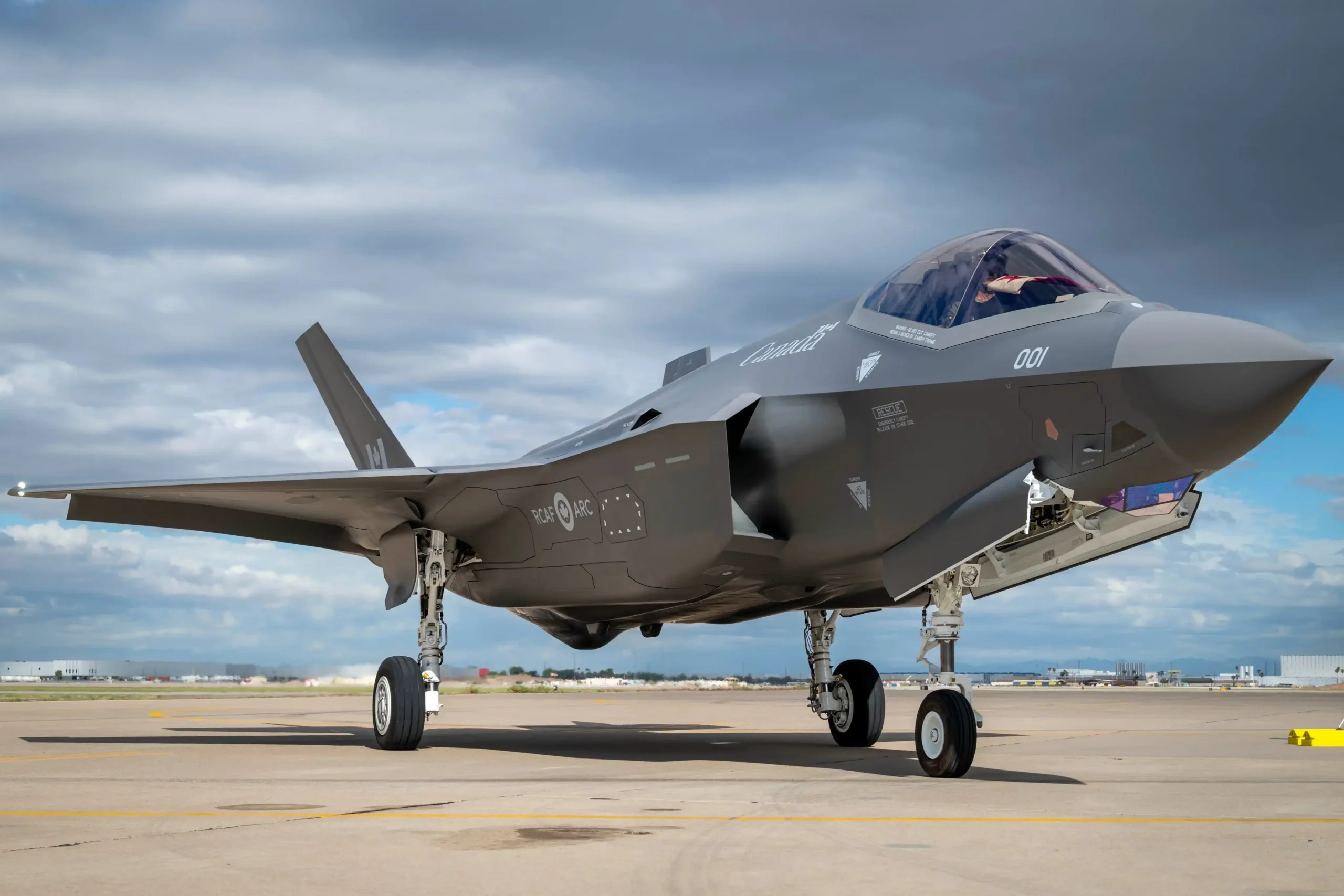
The Royal Canadian Air Force (RCAF) has accepted its first two CF-35A fighters, the Canadian designation for the Lockheed Martin F-35A Lightning II, at Luke Air Force Base, Arizona. The RCAF announced on October 23, 2026, that the handover took place the previous day, opening deliveries under the Future Fighter Capability Project (FFCP) and bringing the first new fighter type into Canadian service since the CF-18 Hornet arrived in 1982.
The aircraft arrive while the program’s final size remains undecided. Ottawa confirmed the F-35A selection on January 9, 2023, under a C$19 billion plan for 88 aircraft, but Prime Minister Mark Carney ordered a review of the purchase in March 2025 as relations with Washington deteriorated. That review missed the end-of-summer 2025 deadline the government had set for itself and has no public deadline. Canada is legally committed to 16 aircraft, and Carney confirmed in February 2026 that Ottawa is paying for long-lead components tied to 14 more; the 72 aircraft beyond the first 16 remain under review. Canadian press reports in late May 2026 said the government was weighing a mixed fleet of roughly 30 F-35As and 60 Saab Gripen E fighters; Ottawa has not confirmed that option.
Canada F-35 Training Pipeline Starts at Luke Ahead of 2028 Arrival
Under the Department of National Defence (DND) schedule, the first eight CF-35As will remain at Luke through 2026 and 2027, where the U.S. Air Force’s 56th Fighter Wing runs the F-35A pilot training center for American and partner-nation aircrews. The RCAF has stood up its first CF-35A training squadron at the base, while Canadian maintenance technicians are set to train at Eglin Air Force Base, Florida. This lets the RCAF generate instructors and qualified pilots before its own facilities exist.
Those facilities sit on the program’s critical path. The first aircraft are due at 4 Wing Cold Lake, Alberta, in 2028, with 3 Wing Bagotville, Quebec, as the second main operating base. In a June 10, 2025, audit, Canada’s Auditor General found the new squadron facilities at both bases more than three years behind schedule and not ready until at least 2031, after DND had to rework designs begun in 2020, before the F-35 and its security requirements were selected. The audit also found DND’s contingency plan for operating from interim facilities incomplete, with no proposed actions or cost estimate.
The same audit put the acquisition estimate at C$27.7 billion, excluding at least C$5.5 billion in infrastructure upgrades and advanced weapons, and flagged a shortage of qualified pilots. DND targets initial operational capability, one squadron at one main operating base ready for North American Aerospace Defense Command (NORAD) missions, in 2029 to 2030, and full operational capability in 2032 to 2034. The RCAF framed the delivery accordingly, saying it is developing “the skilled people, integrated capabilities, and modern tools” needed for future challenges.
CF-35A Sensors, Weapons, and Range Compared With the CF-18
The first Canadian airframe, production number AR-1, flew on September 23, 2026, from Naval Air Station Joint Reserve Base Fort Worth, Texas, in Canadian markings. Publicly available specifications indicate the conventional takeoff and landing F-35A is powered by a single Pratt & Whitney F135-PW-100 rated at roughly 43,000 lbf in afterburner, carries about 18,250 lb of internal fuel, and offers a combat radius above 590 nautical miles, with a top speed of Mach 1.6 and a 9 g limit.
The sensor suite separates the CF-35A from the jet it replaces. The Northrop Grumman AN/APG-81 active electronically scanned array radar, the AN/AAQ-37 Distributed Aperture System, the AN/AAQ-40 Electro-Optical Targeting System, and the BAE Systems AN/ASQ-239 electronic warfare suite feed a fused track picture shared over the Multifunction Advanced Data Link and Link 16. Two internal bays carry four weapons in low-observable configuration, typically AIM-120 AMRAAM missiles and 2,000 lb-class guided bombs, alongside an internal 25 mm GAU-22/A cannon. Current-production F-35As are built with Technology Refresh 3 hardware, the computing backbone of Block 4.
The CF-18A/B, even after Hornet Extension Project upgrades meant to keep it relevant into the early 2030s, remains a fourth-generation design that carries fuel and weapons externally; publicly available figures put the legacy Hornet’s internal fuel near 10,860 lb. For NORAD’s Arctic mission, where intercepts can occur far from forward operating locations, the F-35A’s larger internal fuel load and passive sensors mean longer unrefueled patrols and earlier detection without emitting.
Analysis: Every CF-35A delivered narrows Ottawa’s practical options. The Luke squadron, the Eglin maintenance pipeline, infrastructure redesigned around F-35 security standards, and NORAD integration with U.S. F-35 units anchor the RCAF to the type whatever the review concludes. A mixed fleet would add a second training pipeline, sustainment chain, and weapons inventory to a force already short of pilots. Ottawa’s leverage lies in industrial policy: its May 27, 2026, selection of the Saab GlobalEye as preferred supplier for six airborne early warning and control aircraft, built on the Toronto-made Bombardier Global 6500, shows it will steer major programs toward domestic production. The live question is no longer whether the RCAF flies the F-35, but how large its F-35 core will be.
The RCAF expects the remaining six Luke-based aircraft through 2027, with the first CF-35A arrival at Cold Lake planned for 2028. The key unknowns are when the review concludes, whether the 14 long-lead airframes convert into firm orders, and whether interim facilities can sustain operations until permanent squadron buildings open around 2031. GlobalEye negotiations, framed by a non-binding term sheet signed on September 25, 2026, will run in parallel.