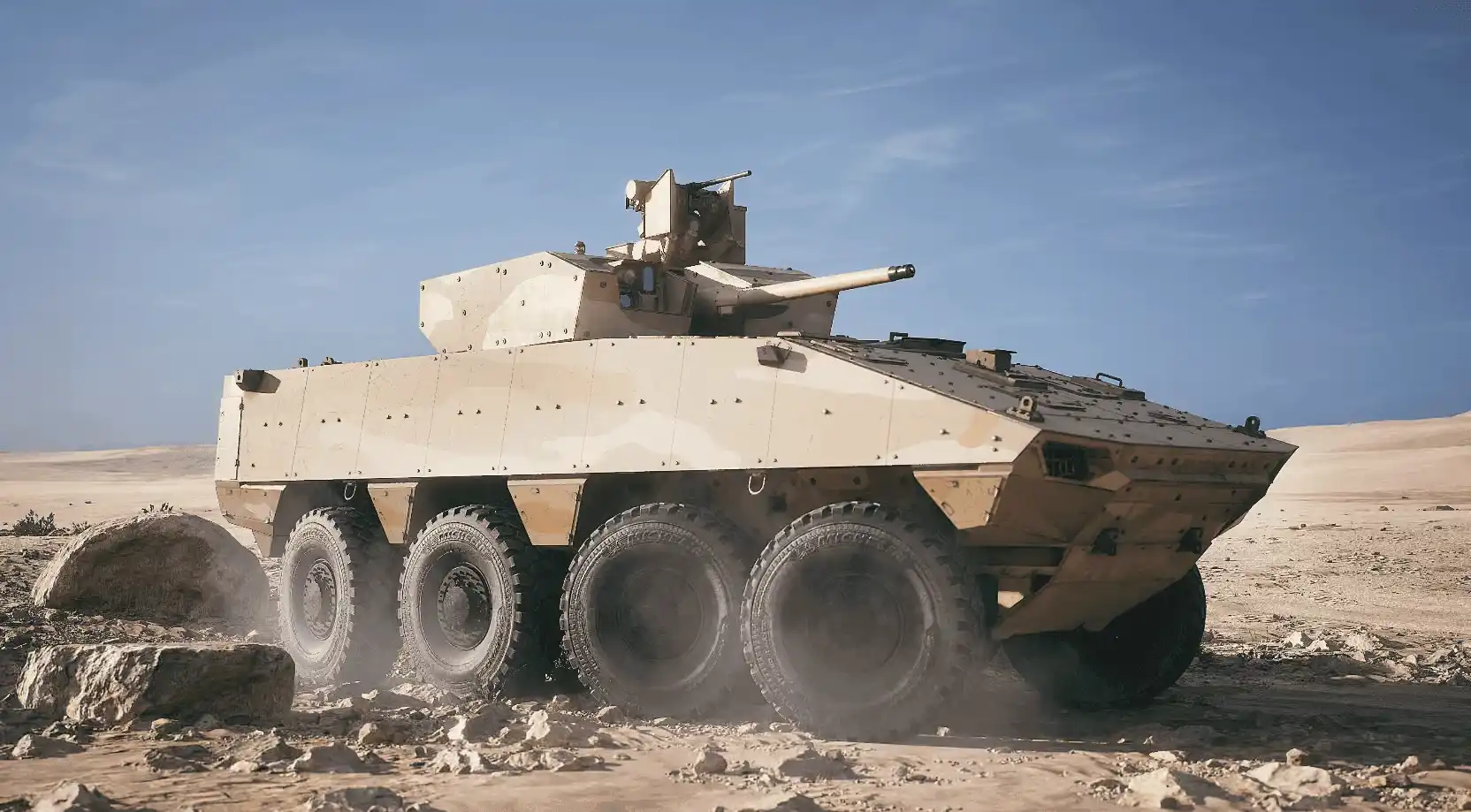
Qatar has selected KNDS France and John Cockerill Defense to modernize the Qatar Amiri Land Forces, signing a letter of intent (LoI) in Doha on October 21, 2026, during French President Emmanuel Macron’s state visit. According to French press reporting, the platform at the center of Qatar’s choice is the VBCI Mk2 8×8 infantry fighting vehicle, with a KNDS France hull and a turret from Belgium’s John Cockerill, in a quantity of several hundred vehicles across two tranches. The joint statement released by the Élysée says both sides aim “to conclude the remaining negotiations soon.”
The signature reverses an outcome that looked settled a year ago. Doha first signed an LoI for 490 VBCI on December 7, 2017, also in Macron’s presence, a package reportedly valued at about €1.5 billion and tied to a local industrial partnership with state-owned Barzan Holdings. No firm contract followed. In October 2025, reports indicated the French vehicle had been eliminated, and Qatar received its first German-built Boxer vehicles two months later under a package linked to the return of Qatari PzH 2000 howitzers for transfer to Ukraine. The new LoI reportedly opens a three-month exclusive negotiation period.
Qatar VBCI Deal: Two Tranches and a Reported Three-Month Exclusivity Window
The joint statement discloses no contract value, vehicle count, or delivery schedule. A second LoI signed the same day covers defense security guarantees whose terms also remain undisclosed. French press reporting puts the requirement at 489 vehicles, split into 389 units and a further 100, a figure neither government has confirmed. The nature of the 100-vehicle batch is unknown; it could be an option or a separate configuration.
KNDS France reached the final round against Singapore’s ST Engineering, which reportedly paired its offer with a John Cockerill turret. The Singaporean group already has a foothold in Doha: on February 27, 2026, it announced a €315 million, five-year maintenance, repair, and overhaul contract with Barzan Maintenance Shield covering Qatari land platforms.
Speaking in Doha on October 21, Macron linked the armored vehicle program to Qatar’s planned move to a new generation of Rafale fighters. The joint statement adds a commitment to capacity-building and integration between the Qatar Amiri Land Forces and the French Army. The VBCI would replace legacy AMX-10P infantry fighting vehicles and VAB carriers that open sources list in Qatari service.
VBCI Mk2 Protection, Mobility, and Payload Against the French Army Baseline
Nexter, now KNDS France, unveiled the VBCI Mk2 at DSEI in September 2015 as an export derivative of the vehicle the French Army fielded from 2008, incorporating lessons from Mali, Afghanistan, Lebanon, and the Central African Republic. Manufacturer data list an empty weight of 19 tonnes, a payload of up to 13 tonnes, and a gross vehicle weight of up to 32 tonnes. The chassis measures under 8 m long and under 3 m wide, with more than 13 m³ of usable interior volume and seating for up to 11 personnel.
A 600 hp diesel, identified in publicly available specifications as the Volvo D13, drives through a 7+2 automatic gearbox; the French Army’s 630 VBCI, delivered between 2008 and 2015, use a 550 hp Renault engine. Open-source figures give a road speed of 100 km/h and a range of 750 km. Upgraded air conditioning reflects Mali operations, where daytime temperatures reached 55°C, a margin that matters for Gulf summer operations.
Protection combines a light-alloy hull, internal spall liners, and modular appliqué armor rated against 30 mm armor-piercing fin-stabilized discarding sabot (APFSDS) rounds, according to manufacturer data. Mine and improvised explosive device (IED) protection exceeds STANAG 4569 Level 4, with blast-absorbing seats and fire suppression in the engine and crew compartments. The 13-tonne payload margin is the operationally decisive figure: it lets Qatar add armor kits and a medium-caliber turret without breaking the 32-tonne ceiling.
Cockerill 1030 Turret and the Shift to 30×173 mm Firepower
Neither government has named the turret. Open-source reporting identifies it as the Cockerill 1030, which would replace the two-man 40 mm CTA cased-telescoped turret Qatar evaluated on the VBCI in 2016 and 2017. Publicly available specifications describe a remotely operated, welded-aluminum turret with a stabilized Northrop Grumman Mk44(S) 30×173 mm dual-feed chain gun, 150 to 200 ready rounds, and a coaxial 7.62 mm machine gun. Baseline mass is about 1,500 kg on a 1.5 m turret ring, with appliqué armor up to STANAG 4569 Level 4 and a Safran stabilized panoramic sight. Options include anti-tank guided missiles, rockets, laser warning, and an active protection system.
Three implications follow. Elevation from -10 to +70 degrees gives the gun a counter-drone envelope, relevant after the Iranian strikes on regional states that the joint statement condemns. The 30×173 mm caliber matches the MK30-2 cannon on the Boxer RCT30 already delivered to Qatar, pointing toward common ammunition across two fleets. An uncrewed turret also frees hull volume for dismounts. The trade-off is lethality, since the 40 mm CTA offered greater penetration against heavier armor.
Analysis: The LoI is a political instrument before it is a procurement decision. It reportedly secures exclusivity for KNDS France and John Cockerill but binds Qatar to nothing, the same status the 2017 document held for eight years without conversion. Multiple sources cited in French reporting see limited odds of a signed contract, pointing to Qatari unease over France’s 2027 presidential election. A firm order would give the VBCI its first export customer and new-build volume a decade after French Army deliveries ended. John Cockerill holds the stronger hand: its turret reportedly featured in both finalist offers.
If the reported three-month window runs from the October 21 signature, it closes in late January 2027. The open questions are the firm quantity and tranche structure, the variant mix, the contract value, the share of final assembly, maintenance, and ammunition production assigned to Barzan, and the delivery schedule. Parallel work on security guarantees and enhanced Rafale capabilities for the Qatar Amiri Air Force will show whether the land deal moves with the wider partnership or stalls on its own.