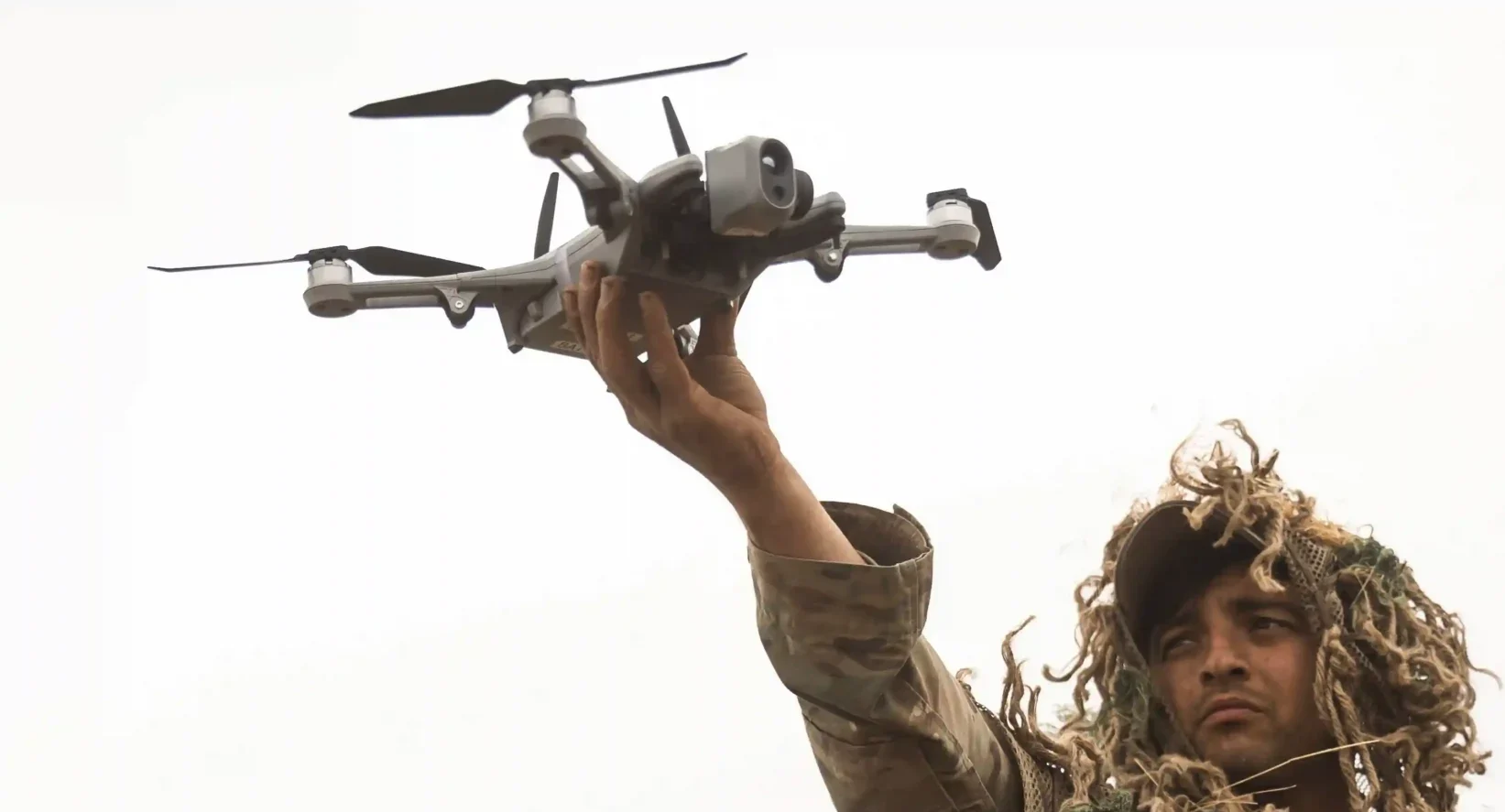
The U.S. Department of War is moving to buy 60,000 small one-way attack drones from nine companies after Gauntlet II of its Drone Dominance Program, with Perennial Autonomy and Neros each allocated the maximum initial order of 8,000 units for winning the Deep Strike and Close Quarters Battle mission areas. Final quantities will be set at contract award, according to the program’s published leaderboard.
The allocation doubles the roughly 30,000 drones, worth about $150 million, ordered in March 2026 after Gauntlet I at Fort Benning, Georgia. The program is run by the Defense Innovation Unit (DIU) and the Test Resource Management Center (TRMC) and traces back to Secretary of War Pete Hegseth’s July 10, 2025, memo on military drone dominance, which directed that every U.S. Army squad be equipped with small one-way attack drones by the end of fiscal 2026. The department plans to spend about $1.1 billion across four phases, with a stated goal of fielding more than 200,000 drones by 2027.
How the Drone Dominance Program Scored Gauntlet II at Fort Carson
Gauntlet II ran in August 2026 at Fort Carson, Colorado. It followed a qualifier held June 8 to 19, 2026, at Camp Grayling, Michigan, where 49 companies flew day and night missions. To reach the final event, each invited company had to deliver 120 drones fitted with lethality payloads in about five weeks, working with one or more warhead suppliers. Nineteen companies appear on the Gauntlet II leaderboard across the two mission areas.
Both mission areas were built around the find-fix-finish kill chain: locate a target, confirm it and strike it. Deep Strike lanes demanded engagements from a 15 km (9.3 mi) stand-off, while Close Quarters Battle lanes tested flight in confined spaces, defined in the Phase II solicitation as building interiors, trenches and tunnels at ranges under 2 km, with part of the testing repeated at night. Separate lanes evaluated controlled kinetic engagement and electronic warfare (EW) resilience, with the drones flown against counter-UAS systems.
The 15 km requirement marks a sharp step up. Gauntlet I strikes were set at about 10 km, and DIU said only 24% of drones in that round reached that distance. At 15 km, a squad-launched drone can hold mortar positions, command posts and supply nodes at risk well beyond the launching unit’s line of sight, which puts a premium on datalink robustness and terminal guidance under jamming. Final scores combined lane results with evaluations from the military operators who flew the systems and an assessment of each vendor’s production and supply chain capacity.
How Neros and Perennial Autonomy Topped the Gauntlet II Leaderboards
In Deep Strike, Perennial Autonomy scored 80.1 points, 9.2 points ahead of Hyperscale at 70.9. Neros placed third with 69.8, followed by Skycutter at 66.6 and Swarm Defense Technologies at 66.0. Orders scale with rank at 8,000, 7,000, 6,000, 5,000 and 4,000 drones, for 30,000 units in the mission area.
Close Quarters Battle used the same 30,000-unit ladder. Neros led with 88.1 points, ahead of ORQA US at 82.8, XTEND Reality at 80.2, Vector at 78.2 and ModalAI at 74.3. Neros is the only company to place in both mission areas, bringing its combined allocation to 14,000 drones. The Torrance, California, firm announced on September 30, 2026, that the department had ordered 14,000 drones and explosive payloads, a package it values at more than $100 million. According to the company, the order covers the Archer AI, a 10-inch airframe with terminal guidance, and the 5-inch Archer optimized for urban and indoor fighting.
Vector said its award covers up to 5,000 systems along with its high-voltage electronic safe and arm device, which lets operators fit different munitions. London-based Skycutter, the Gauntlet I winner, fell to fourth in Deep Strike and missed the Close Quarters Battle top five. “Congratulations to all the winners. Now, it’s time to deliver,” DIU said when it announced the results.
Pricing and Supply Chain Rules Behind the 60,000-Drone Buy
Phase II fixed unit prices at $4,500 per Deep Strike drone and $3,500 per Close Quarters Battle drone, with munitions priced separately at $3,250, according to the solicitation. At those rates, the 60,000 airframes represent about $240 million before warheads, against a Phase II floor of $300 million in prototype delivery orders. Neros’s figure shows the split: its 14,000 airframes total roughly $55 million at list price, so at least $45 million of its announced value sits outside the drones themselves.
Starting with Phase II, the department also said it would exclude systems using motors or battery systems from covered countries, a requirement aimed primarily at the Chinese components that dominate the commercial FPV market. Gauntlet I orders averaged about $5,000 per drone under baseline National Defense Authorization Act (NDAA) sourcing rules.
Analysis: Because the score weights production capacity and supply chain alongside lane performance, the Gauntlet II order book is as much an industrial-base selection as a capability ranking. Skycutter’s drop from first to fourth shows a leaderboard position carries no guarantee into the next round, and delivery has become the binding constraint: Neros says it is the only manufacturer whose Gauntlet I commitments were fully shipped and accepted. For the Army, the outcome is a two-tier small-drone inventory, with short-range FPVs for room and trench clearing and 15 km strike drones that give squads and platoons an organic deep-fires option. The open question is whether vendors cut off from Chinese motors and batteries can hold $3,500 to $4,500 price points at these volumes.
The program states that contract awards are not guaranteed. Gauntlet 2.5, a separate competition for reusable bomber and dropper drones worth $32 million for up to 1,200 aircraft, has been pushed to early November at Camp Grayling. Phase III opened on September 28, 2026, with about $450 million for roughly 60,000 drones, raising the Deep Strike price to $5,000 excluding weaponization and cutting Close Quarters Battle to $3,000, according to the program. Gauntlet III is expected about six months after Gauntlet II, with Gauntlet IV closing out the program.