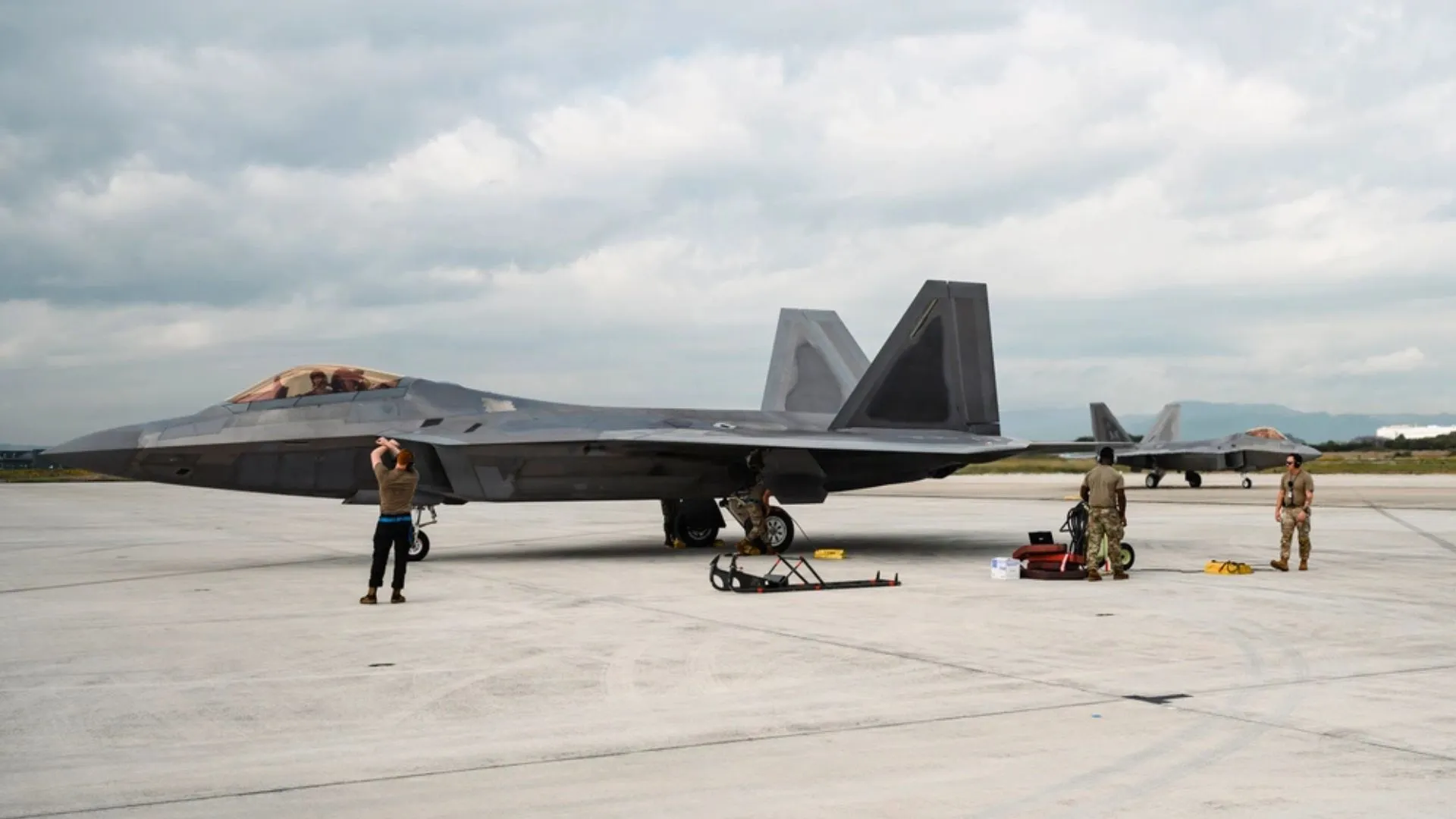
U.S. Air Force F-22 Raptors from the 525th Expeditionary Fighter Squadron arrived at Tsuiki Air Base, Japan, on October 19, 2026, to fly in Exercise Keen Sword 27, the biennial joint and bilateral field training exercise between U.S. forces and the Japan Self-Defense Forces (JSDF). The squadron deployed from Joint Base Elmendorf-Richardson, Alaska, and is operating from a Japan Air Self-Defense Force (JASDF) fighter base on Kyushu rather than a U.S.-run installation. The Air Force has not disclosed how many Raptors made the trip.
Keen Sword 27 runs through October 29 across JSDF and U.S. facilities, civilian airports and ports, and the sea and airspace around Japan. Japan’s Joint Staff committed about 45,000 personnel, 6,100 vehicles, 40 vessels and 260 aircraft, up from roughly 33,000 personnel, 30 ships and 250 aircraft in 2024. About 11,000 U.S. service members are taking part, according to the exercise spokesman. The 18th iteration of a series that began in fiscal 1985 is directed by Adm. Tateki Tawara, commander of the JSDF Joint Operations Command, and Adm. Stephen Koehler, commander of U.S. Pacific Fleet. Much of the activity centers on the southwestern islands, where Japan’s Type 25 surface-to-ship missile is participating for the first time. Australia, Canada, France, Germany, the Netherlands, New Zealand and the Philippines are also taking part.
Keen Sword 27 Brings F-22 Raptors to a JASDF Fighter Base
Tsuiki, in Fukuoka Prefecture, hosts the JASDF 8th Air Wing, whose 6th and 8th Tactical Fighter Squadrons fly the Mitsubishi F-2, along with a fire unit of the 2nd Air Defense Missile Group. The base operates a single 2,400-meter runway.
The choice of airfield tracks long-standing alliance planning. Under the May 2006 U.S.-Japan realignment roadmap, Tokyo agreed to improve Tsuiki and Nyutabaru air bases for contingency use by U.S. forces as capabilities move out of Marine Corps Air Station Futenma. In May 2023, the Ministry of Defense’s Kyushu Defense Bureau finalized an environmental impact statement for a 300-meter runway extension, to 2,700 meters, intended to let Tsuiki receive U.S. military aircraft in an emergency. The current construction status could not be independently confirmed.
U.S. fighters have used Tsuiki in this series before: F-16s of the 77th Expeditionary Fighter Squadron operated there during Keen Sword 25 in 2024, and the 525th flew Keen Sword from Kadena Air Base, Okinawa, as early as November 2014. Basing a fifth-generation squadron at a JASDF main operating base exercises the fuel, munitions, maintenance and command arrangements that agile combat employment depends on. The Air Force has not specified which events the Raptors will fly; the Joint Staff’s published plan includes integrated air and missile defense, bilateral offensive anti-ship operations and joint electromagnetic warfare.
F-22 Raptor Sensors, Weapons, and Fleet Limits in the Pacific
The F-22 is a fifth-generation air dominance fighter powered by two Pratt & Whitney F119-PW-100 afterburning turbofans in the 35,000-pound-thrust class, fitted with two-dimensional thrust-vectoring nozzles. The engines allow supercruise, sustained supersonic flight without afterburner, which widens the jet’s speed and range envelope and compresses an adversary’s reaction time. In the air-to-air configuration, the Raptor carries six AIM-120 AMRAAMs and two AIM-9 Sidewinders internally, preserving its low-observable signature, plus an M61A2 20mm cannon with 480 rounds. Publicly available specifications identify the Northrop Grumman AN/APG-77 active electronically scanned array radar as its primary sensor. For JASDF F-2 crews and air defense units, that combination offers training against a low-observable shooter that fourth-generation aggressors cannot replicate.
The fleet behind that capability is small. The Air Force operates roughly 185 F-22s, about 33 of them Block 20 aircraft used mainly for training. Demand in Japan is high: F-22s of the 90th Expeditionary Fighter Squadron, the 525th’s sister unit at Elmendorf-Richardson, and the 27th Expeditionary Fighter Squadron from Joint Base Langley-Eustis, Virginia, began a six-month rotation at Kadena in May that was scheduled to end in November. Those rotations fill the gap left by Kadena’s 48 retired F-15C/D Eagles. Air Force Secretary Troy Meink has said the first permanently assigned F-15EX Eagle IIs will reach Kadena in 2027, with the full complement in 2028. The F-15EX brings payload and modern electronic warfare, but not stealth.
Analysis: If the Kadena rotation holds to schedule, both of Elmendorf-Richardson’s active-duty F-22 squadrons are operating from Japan at the same time. That concentration shows how much of the Air Force’s fifth-generation air dominance presence in southern Japan rests on a rotational Raptor force until the F-15EX arrives. Tsuiki points to a second trend: the alliance is rehearsing the dispersal the 2006 roadmap anticipated, spreading high-value fighters beyond Kadena, long assessed as the only major U.S. air base within unrefueled fighter range of the Taiwan Strait and widely viewed as exposed to Chinese theater missiles. Dispersal improves survivability, but it multiplies the support burden on a small, maintenance-intensive fleet already absorbing back-to-back deployments.
The Raptors are scheduled to train with Japanese forces at Tsuiki through October 29. Open questions include the size of the detachment, whether the jets will integrate with the anti-ship and missile defense events, and whether the Air Force will release sortie data. Beyond the exercise, the next markers are the end of the Kadena F-22 rotation in November, progress on Tsuiki’s runway extension and the first F-15EX arrivals at Kadena in 2027. The Raptor’s role is also evolving: earlier in October 2026, an F-22 pilot controlled a YFQ-44A Fury Collaborative Combat Aircraft in flight, a capability that could change what future F-22 detachments bring to allied exercises.