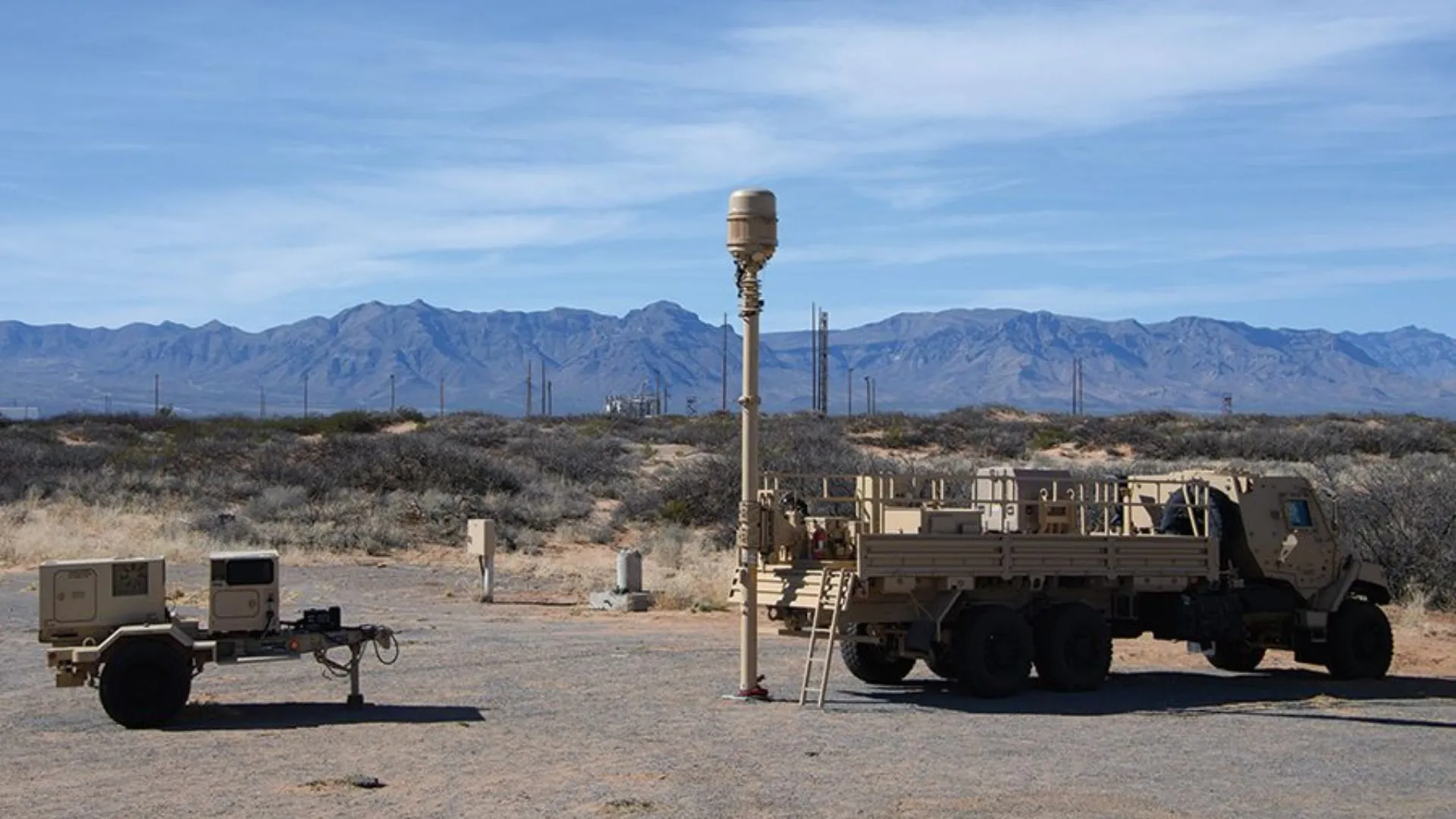
Lockheed Martin’s Remote Interceptor Guidance 360 (RIG-360) datalink has completed a critical design review, three captive-carry tests and its first developmental flight test with a Patriot Advanced Capability-3 (PAC-3) missile in less than two months, the company said on October 20, 2026. During the live-fire flight, the RIG-360 ground hardware and the PAC-3 interceptor exchanged communications, according to Lockheed Martin.
The milestones arrive roughly a year after the US Army funded the first phase of RIG-360 engineering and manufacturing development (EMD). The device targets a constraint inherited from Patriot’s original architecture: the interceptor’s in-flight uplink runs through the battery’s own fire control radar, which covers a fixed sector. RIG-360 takes over that uplink, letting the Army’s Integrated Battle Command System (IBCS) pair any networked sensor with a PAC-3 round flying in any direction. Jason Reynolds, vice president and general manager of Lockheed Martin Integrated Air and Missile Defense, called the program “critical for PAC-3 operation and in-flight success.” The company did not disclose the test dates, the range used, or whether the flight included a target intercept.
How the RIG-360 Datalink Removes Patriot’s Radar Sector Limit
Lockheed Martin describes RIG-360 as a software-defined, hemispherical PAC-3 missile communications device built around two main elements. A mast-mounted antenna array transmits and receives the radio frequency waveforms PAC-3 missiles use in flight. A control assembly drives the array and serves as the integration point to the IBCS Integrated Fire Control Network (IFCN). Army documents add a support laptop to the integrated assembly and list the antenna mast as a separate adapted component. The company says the system can operate from a truck, trailer, pallet or tower and can support multiple PAC-3 missiles in flight simultaneously.
That design targets a specific operational weakness. Publicly available specifications indicate the AN/MPQ-65 radar fielded with US Army Patriot batteries searches and tracks within a sector of roughly 120 degrees, and the battery’s interceptor uplink is bound to that radar. That battery cannot engage a threat outside the sector without repositioning the radar. RIG-360 separates the two functions: a 360-degree sensor feeding IBCS supplies the track, and RIG-360 relays guidance updates to the interceptor regardless of where the primary radar points.
Lockheed Martin says the captive-carry series produced evidence of 360-degree communications with the PAC-3 radio and demonstrated the program’s maximum-range requirement. The company has not released that range figure, the operating frequency band, or the array’s dimensions and weight.
From $114.6 Million EMD Award to Containerized Launcher Phase 2
RIG-360 began as a Lockheed Martin prototype. During the Army’s Integrated Flight Test-2 at White Sands Missile Range, New Mexico, in November 2022, IBCS used a RIG-360 prototype as the datalink to a PAC-3 missile that intercepted a cruise missile target, removing the Patriot radar from the uplink chain.
The Army then made it a formal program under Program Executive Office Missiles and Space, Integrated Fires and Mission Command (IFMC). On May 9, 2025, IFMC definitized a $114.6 million EMD contract, with work in Grand Prairie, Texas, running through September 30, 2027. In August 2025, Lockheed Martin announced completion of the first EMD phase, marked by the first array assembly, the most complex of the system’s three core EMD subsystems. The company is also building a dedicated EMD production facility in Grand Prairie.
A parallel effort now pairs RIG-360 with a new launcher. In May 2026, the Army awarded Lockheed Martin a $61 million cost-plus-incentive-fee contract to develop and demonstrate the PAC-3 Missile Segment Enhancement (MSE) Containerized Launcher and a containerized RIG-360 system, including three RIG-360 integrated assemblies. A Phase 2 follow-on awarded on July 1, 2026, carries a ceiling of $347.5 million and covers eight development increments: five for the containerized launcher and three for the RIG-360 containerized system.
Analysis: RIG-360 moves a Patriot battery’s engagement geometry from the radar to the network. The Lower Tier Air and Missile Defense Sensor (LTAMDS), which is replacing the AN/MPQ-65, adds two rear-facing secondary arrays to engage threats from any direction. Lockheed Martin presents RIG-360 as a way to reduce single points of failure in missile communications. A standalone datalink lets IBCS cue PAC-3 rounds from any fire-control-quality sensor on the IFCN. Paired with a containerized launcher, it points toward dispersed launch sites with no organic radar nearby, useful against cruise missiles and one-way attack drones arriving on multiple axes.
Lockheed Martin says the program is ahead of schedule for deliveries and fielding dates but has not published them. An Army market research notice sought the ability to deliver first hardware in the third quarter of fiscal 2028, and the government expects to acquire the RIG-360 technical data package only at the end of EMD. Next come further developmental flights, containerized-system live fires and a production decision.