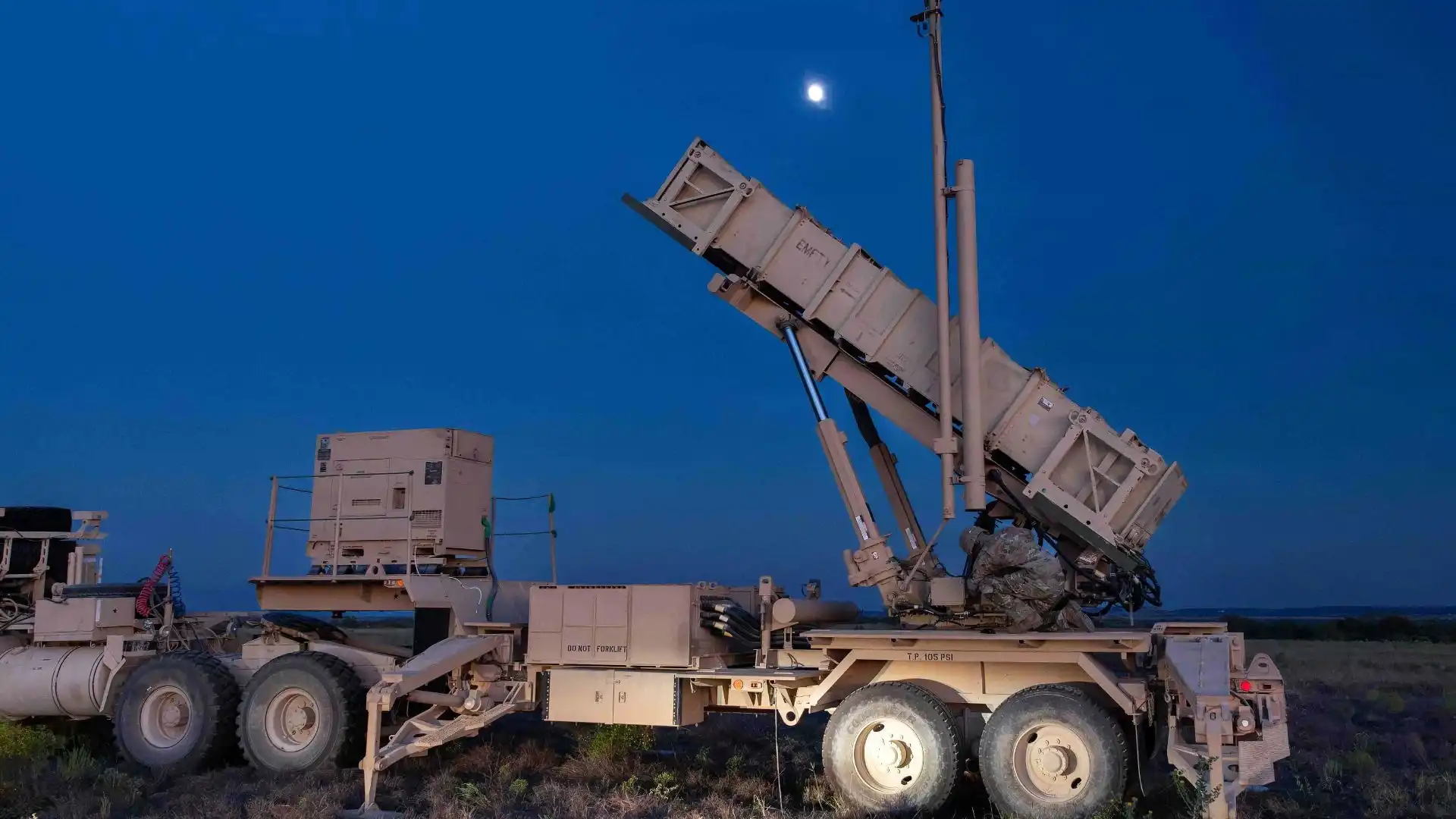
Soldiers from Delta Battery, 1st Battalion, 62nd Air Defense Artillery Regiment (1-62 ADA), 69th Air Defense Artillery Brigade, reloaded MIM-104 Patriot M903 launching stations in darkness at Fort Hood, Texas, on October 23, 2026, during the battalion’s mission readiness exercise. Working under headlamps, crews used a modified M985 Heavy Expanded Mobility Tactical Truck (HEMTT) fitted with a heavy-duty crane to lift, position and secure training missile canisters, according to the Army.
The drill comes as Army leaders describe the Patriot force as the service’s most stressed element. The Army fields 15 active Patriot battalions and plans to grow to 18, plus a composite battalion for the Guam Defense System. The 1-62 ADA deployed to Poland from October 2023 to June 2024 to reinforce NATO’s eastern flank. Interceptor supply is expanding: a seven-year framework agreement announced January 6, 2026, between the Pentagon and Lockheed Martin aims to raise Patriot Advanced Capability-3 Missile Segment Enhancement (PAC-3 MSE) output from roughly 600 to 2,000 rounds per year, followed by a $4.7 billion contract action in April 2026.
How the Patriot Missile Reload Works on the M903 Launcher
The M903 launching station rides on an M860A4 semitrailer towed by an M983A4 HEMTT tractor. Publicly available specifications indicate it can hold 16 PAC-3 Cost Reduction Initiative (CRI) interceptors in four four-round canisters, 12 PAC-3 MSE interceptors or four PAC-2 Guidance Enhanced Missile (GEM) canisters, and Lockheed Martin lists a mixed load of six MSE and eight CRI. The MSE uses a larger two-pulse solid rocket motor for added range and altitude and is packaged one missile per canister, which is why an MSE-only load tops out at 12 rounds. Both PAC-3 variants are hit-to-kill interceptors built to defeat tactical ballistic missiles, cruise missiles and aircraft.
Once a launcher fires out, it stays silent until a reload crew brings it back. That job falls to the guided missile transporter (GMT), an M985-series HEMTT whose crane removes spent canisters from the launcher and swings fresh ones into place. Reload crews are five-soldier teams built around a crane operator, a signal person who directs each lift, a safety noncommissioned officer and tag line handlers who steady the canister. In a certification described by U.S. Air Forces Central, a deployed crew had one hour to load all four canisters on a launcher and finished in 53 minutes.
At Fort Hood, Delta Battery ran that sequence with training canisters after dark. Sgt. Kolby Bagley served as the crew’s signal person, coordinating equipment movements. Headlamps lit the work areas, but limited visibility still demanded constant communication and vigilance around personnel and equipment. “One of the biggest things I took away from this reload [training] was learning to trust my safety more,” Bagley said. The Army did not release reload times, the number of launchers serviced or the interceptor mix the battery normally fields.
Mission Readiness Exercise Tests Patriot Battery Sustainment After Dark
Reload training was one of several events in the 1-62 ADA mission readiness exercise, which began October 19 and brought firing batteries, the battalion headquarters and supporting elements into the field. The Army said the exercise evaluates the battalion’s ability to establish, operate and sustain Patriot air defense systems, a scope that reaches beyond emplacement and radar operations into the logistics chain that keeps launchers loaded.
Delta Battery’s leadership pushed execution down to junior leaders. “Our junior leaders know what needs to get done, and we need to allow them to lead,” said 1st Sgt. Pattrick Harris, the battery’s first sergeant. “We set the standard, give them the resources and let them execute. That’s how they build confidence, and that’s how we find out what our crews are capable of.” Capt. Grace Ko, the battery commander, framed the drill around endurance rather than emplacement. “It’s not enough to get a Patriot system into position. Our soldiers must be able to keep it operational,” Ko said. “We need to be ready to sustain the fight.” She added that repeating reloads at night gives crews experience with challenges they could face during a real mission.
The exercise follows a year of battery-level field work at Fort Hood. Bravo Battery radar crews drilled emplacement and safety procedures in February 2026, and Alpha Battery ran a field training exercise focused on equipment maintenance and standards in April. Night reloads add their own layer of risk: a missile canister swinging from a crane boom while soldiers work tag lines around it, with visibility limited to the reach of a headlamp.
Analysis: Most debate over Patriot capacity centers on interceptor production. At the battery, however, the magazine is what a launcher holds, at most 16 CRI or 12 MSE rounds, and sustained defense against repeated salvos depends on how quickly a five-soldier crew can cycle canisters from the GMT to the launcher, at night, without dropping a load or injuring a soldier. With 15 battalions committed across Europe, the Middle East and the Indo-Pacific, including the June 23, 2025, defeat of an Iranian ballistic missile attack on Al Udeid Air Base in Qatar by U.S. and Qatari Patriot batteries, reload proficiency works as a capacity multiplier: a crew that beats the one-hour standard returns launchers to the fight faster without adding an interceptor or a soldier.
The Army said soldiers will train for 21 days but has not said how its batteries were assessed. Next markers include the battalion’s evaluation results, PAC-3 MSE delivery rates under the April 2026 contract and the stand-up of new Patriot battalions, each needing certified reload crews.