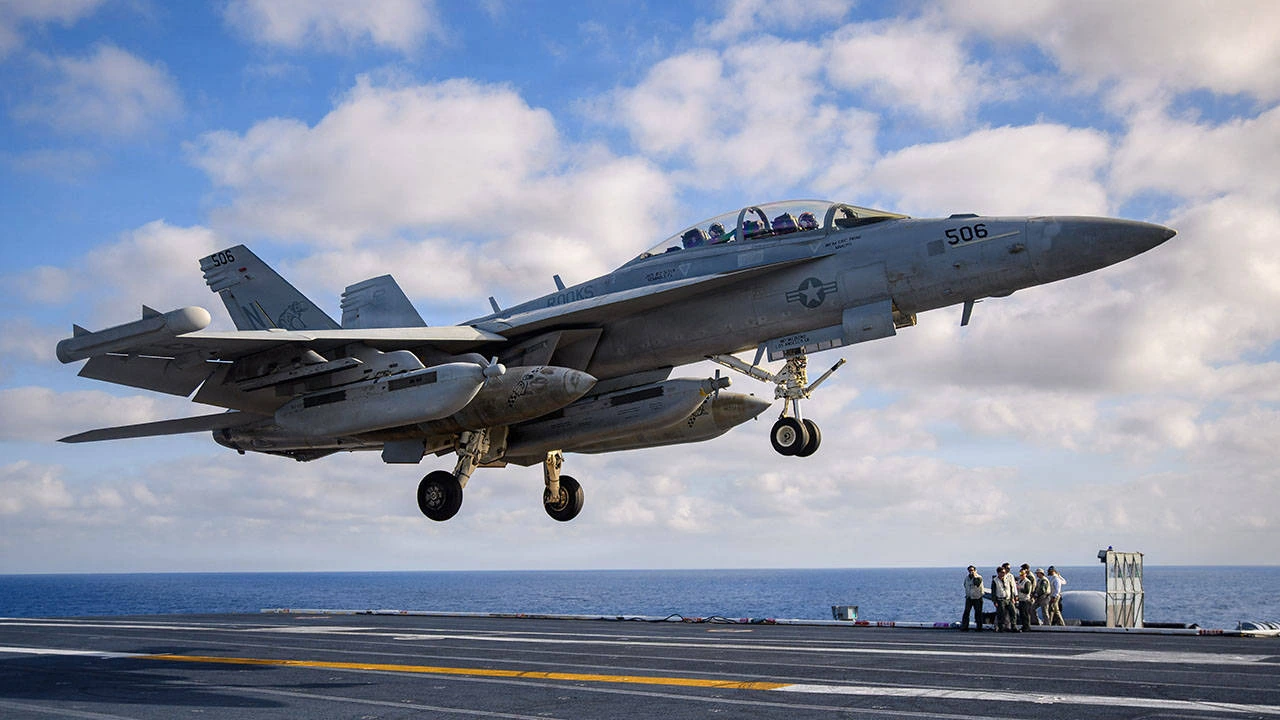
The US Navy has moved the Next Generation Electronic Attack Unit (NGEAU) for the EA-18G Growler into full-rate production, awarding General Dynamics Mission Systems an indefinite-delivery/indefinite-quantity (IDIQ) contract worth up to $184.25 million. The award, listed by the Department of Defense in September 2026 and later announced by the company, covers NGEAU production and sustainment at the firm’s Bloomington, Minnesota, facility through September 2032.
NGEAU replaces the Electronic Attack Unit, the processing element that manages the Growler’s airborne electronic attack (AEA) suite, and anchors Phase 1 of the Navy’s Growler Block II modernization. The timing reflects a fleet with no new airframes coming: Boeing delivered the last of 160 Navy Growlers in 2019, and the service plans to keep the aircraft operational into the mid-2040s. The legacy unit also faces diminishing manufacturing sources and material shortages (DMSMS), which makes the award a sustainment requirement as much as a capability upgrade.
NGEAU Production Contract: Funding, Terms and Scope
The contract splits into two pricing structures. Full-rate production falls under firm-fixed-price terms, while sustainment work is cost-plus-fixed-fee. Beyond NGEAU itself, the scope includes future sustainment support for the Growler’s Advanced Capability Mission Computer (ACMC), extending General Dynamics’ footprint across the aircraft’s core processing architecture.
The Navy obligated $40.06 million at award: $29.69 million in fiscal 2026 Aircraft Procurement, Navy (APN) funds and $10.37 million in fiscal 2025 APN funds. None of those funds expire at the end of the current fiscal year. Naval Surface Warfare Center (NSWC) Crane Division in Indiana, whose mission set includes electronic warfare, is the contracting activity. The Navy awarded the contract on a sole-source basis under 10 U.S. Code 3204(a)(1), which permits noncompetitive procurement when only one responsible source can meet the requirement.
Several key figures remain undisclosed. Neither the Navy nor the company has released the number of units covered, the per-unit cost, or the planned retrofit rate across Growler squadrons. Because the vehicle is an IDIQ, actual quantities will be set through individual delivery orders against the $184.25 million ceiling.
Inside Growler Block II Phase 1: Open Architecture and REAM
According to the Navy, NGEAU enhances the Growler’s ability to autonomously process and respond to unknown signals in an extremely dense electromagnetic spectrum environment. The unit is built on an Open Mission Systems (OMS) architecture with Multi-Level Security (MLS) and Multi-Tier Resource Management. In practical terms, MLS allows the processor to handle data at different classification levels on a single system, while resource management allocates receivers and jamming assets across simultaneous tasks as threat density rises.
Phase 1 pairs the hardware with Reactive Electronic Attack Measures (REAM), a separate capability that the Navy says uses cognitive electronic warfare machine-learning algorithms to detect and identify unknown complex emitters within advanced integrated air defense systems (IADS). NGEAU supplies the processing headroom that REAM requires. The operational intent is to move the Growler from library-based jamming, which depends on pre-loaded threat parameters, toward responses generated against radar modes that crews have never encountered. Processing throughput, latency, and frequency coverage figures for NGEAU have not been publicly released.
Boeing, as the Growler’s prime contractor, handles integration and testing. In September 2024, the Navy awarded Boeing a $95.9 million order supporting development and operational testing of Block II Phase 1, including 25 NGEAU A-kits, 15 B-kits, and nine B-kit spares. A-kits cover the permanent wiring and structural modifications to the airframe; B-kits are the removable mission hardware. Boeing received a further $60.1 million modification for the NGEAU effort in early 2026.
How NGEAU Connects the Next Generation Jammer and Beowulf
NGEAU is neither a jammer nor a sensor; it sits behind the Growler’s apertures and pods. The current suite combines the AN/ALQ-218(V)2 wideband receiver, housed in wingtip pods, with the AN/ALQ-227(V)1 Communications Countermeasures Set for intercepting, geolocating, and jamming communications. Legacy AN/ALQ-99 tactical jamming pods, which publicly available specifications credit with coverage from 64 MHz to 20 GHz, remain in service alongside the Raytheon AN/ALQ-249(V)1 Next Generation Jammer Mid-Band (NGJ-MB). The L3Harris Next Generation Jammer Low-Band (NGJ-LB) will add a single pod on the centerline station.
The NGJ pods, built around active electronically scanned arrays, can generate multiple jamming beams at once. The new NGEAU hardware is intended to expand frequency coverage and increase electronic attack bandwidth, which gives the aircraft the processing margin to exploit that multi-beam capacity rather than leaving it constrained by a legacy unit.
Block II Phase 2, known as Beowulf, adds the AN/ALQ-264(V) Multi-Function Array (MFA) in the inboard leading-edge flaps to augment the ALQ-218 receiver. Northrop Grumman developed the array. In March 2026, Boeing received a $34 million contract for Beowulf engineering and test assets, with a potential value of $489.3 million if all options are exercised and work scheduled through February 2030. More receive apertures will feed more data into NGEAU.
Analysis: The award confirms that the Navy now treats onboard processing, not pod hardware alone, as the decisive layer of airborne electronic attack. Adversary radars increasingly rely on digital, reprogrammable waveforms that defeat static threat libraries, and the time between detecting a new emitter mode and countering it has become the central competitive variable in suppression of enemy air defenses. An open architecture lets the Navy field new techniques as software rather than through hardware refresh cycles. The DMSMS dimension matters equally: without a production-ready replacement, the legacy unit would have constrained readiness across a fleet the Navy cannot recapitalize before a successor AEA platform is selected.
The next milestones are the first delivery orders under the IDIQ, which will reveal quantities and retrofit pace, and completion of Boeing’s Phase 1 operational testing. Beowulf development runs through February 2030, and the Navy has previously indicated a Growler service life extension in the mid-2030s. Neither the Navy nor the company has said whether the Royal Australian Air Force, the only other Growler operator, will adopt NGEAU.