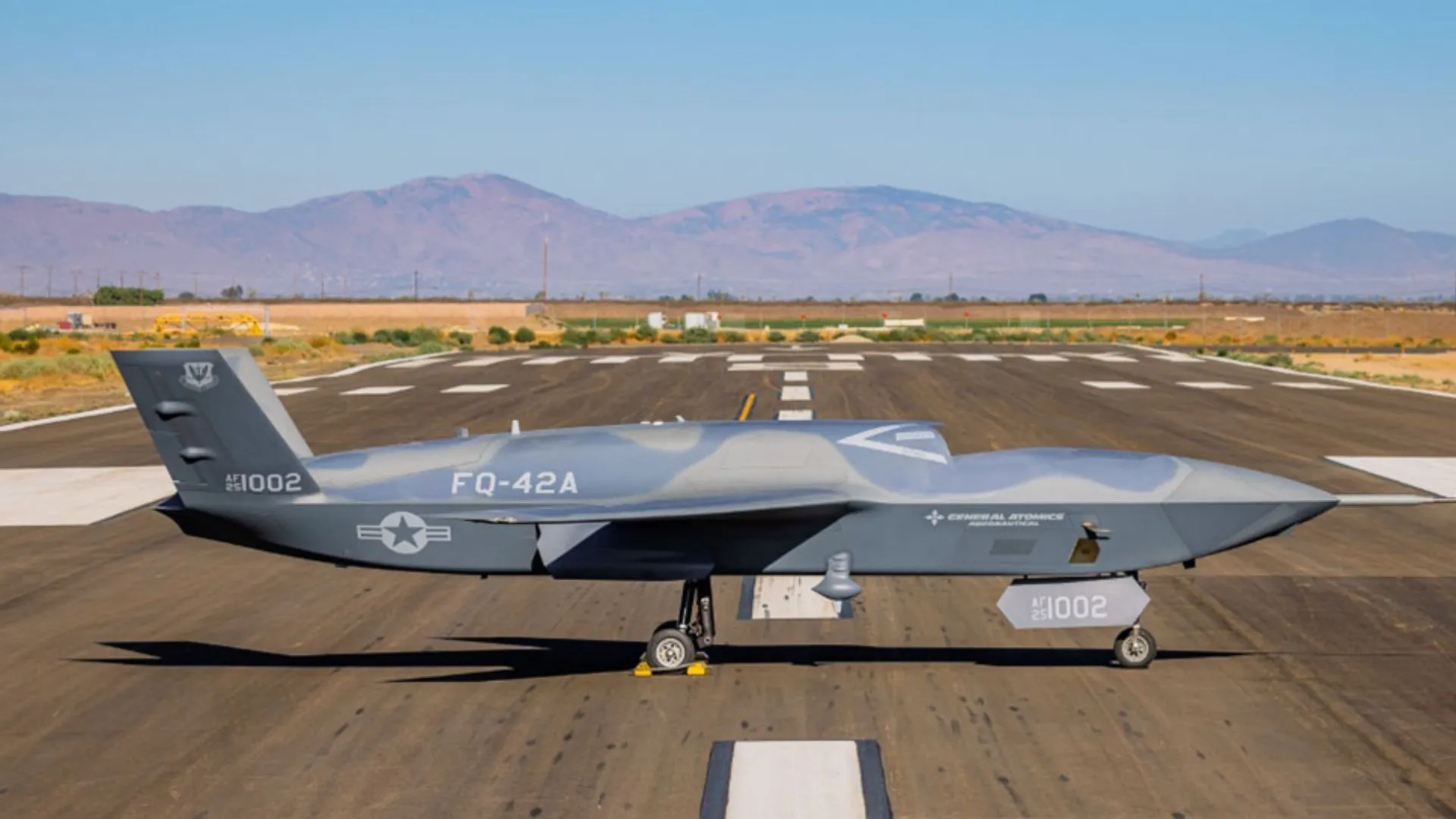
General Atomics Aeronautical Systems, Inc. (GA-ASI) announced on October 23, 2026, that Spirit Defense, a Boeing company headquartered in Wichita, Kansas, will serve as fuselage design-build partner for the FQ-42 Vengeance Collaborative Combat Aircraft (CCA). The agreement brings an outside structures supplier into the uncrewed fighter program four months after the U.S. Air Force (USAF) placed it under an initial production contract.
The partnership breaks with company practice. GA-ASI has built every aircraft in its uncrewed aircraft systems (UAS) line in-house since 1992, from the MQ-9A Reaper to the MQ-20 Avenger. The Air Force, however, is pressing industry for production depth as it prepares to field its first CCA fleet, and the FQ-42 is moving toward serial manufacture while Congress has yet to appropriate the money needed to buy it.
How Spirit Defense Fits Into FQ-42 Vengeance Production
Under the arrangement, Spirit Defense will apply its engineering and advanced manufacturing capabilities to the FQ-42 fuselage from design through production, according to GA-ASI. Neither company disclosed the contract value, shipset quantities, or production site.
“With Spirit Defense we add capacity, which is exactly the kind of production resilience our U.S. Air Force customer is looking for with its CCA ramp-up,” GA-ASI President David R. Alexander said. GA-ASI framed the deal as a way to scale output faster and remove single points of failure.
GA-ASI is not starting from zero. The company has completed a dedicated low-observable paint facility, says it is positioned to deliver six FQ-42s per month, and holds additional floor space for further orders. It is already building aircraft on company funds while government funding plans mature, and it delivered an FQ-42 to Air Force test and evaluation units at Creech Air Force Base, Nevada, on September 18, 2026.
Boeing closed its acquisition of Spirit AeroSystems, a deal with an equity value of about $4.7 billion, on December 8, 2025, absorbing Spirit’s commercial operations and establishing Spirit Defense as a non-integrated subsidiary of Boeing Defense, Space & Security that retains its own governance and operations. Spirit’s defense work includes structures for the Northrop Grumman B-21 Raider and the complete fuselage of the Sikorsky CH-53K King Stallion.
Gambit Core Architecture Behind the FQ-42 Uncrewed Fighter
The FQ-42 descends from the Gambit 2 concept within GA-ASI’s Gambit Series, a family of uncrewed combat jets built around a common core that shares landing gear, baseline avionics, and chassis across mission variants. The YFQ-42A prototype first flew on August 27, 2025; the Y prefix was dropped with the June 2026 production award, and the Air Force announced the popular name Vengeance on September 14, 2026.
Detailed performance data remains undisclosed. Publicly available imagery and open-source assessments indicate a single engine of undisclosed make and model, a dorsal inlet, a V-tail, and an internal weapons bay sized for two AIM-120 Advanced Medium-Range Air-to-Air Missiles (AMRAAM). Open-source estimates based on a full-scale model shown at the 2025 Paris Air Show put the bay at roughly 4 meters long and 0.8 meters wide.
That configuration makes the fuselage the most demanding structure to share. On a low-observable design, the fuselage carries the inlet duct, the weapons bay and its doors, and much of the signature-critical outer mold line, so tolerances held at that level directly shape radar cross-section. Assigning it to a design-build partner rather than a build-to-print supplier indicates GA-ASI expects Spirit to engineer for producibility at rate, not simply replicate drawings.
GA-ASI says the modular airframe allows rapid integration of mission systems and autonomy software, demonstrated in live flight tests on multiple aircraft. The Air Force plans to select a single primary mission autonomy provider for Increment 1 by summer 2027.
CCA Increment 1 Production Awaits FY2027 Appropriations
The Air Force awarded engineering and manufacturing development (EMD) and production contracts for CCA Increment 1 on June 17, 2026, four months ahead of schedule: GA-ASI for the FQ-42A and Anduril for the FQ-44A Fury. The awards cover the first three production lots, but the service has not disclosed contract values or per-vendor quantities. Air Force Secretary Troy Meink tied them at the time to fielding more than 150 combat-capable CCA by the end of the decade. On September 14, 2026, he raised the target to at least 500 in service by 2032, toward a long-term objective of about 1,000 across multiple increments.
Funding is now the binding constraint. The FY2027 budget request sought $996.5 million in procurement to begin Increment 1 production, plus $150 million in advance procurement for FY2028, the first time CCA appeared in an Air Force procurement request. The Pentagon instead entered FY2027 under a continuing resolution that holds spending at FY2026 levels through December 11, 2026, and does not authorize new starts such as CCA production. Brig. Gen. Timothy Helfrich, the Air Force’s portfolio acquisition executive for fighters and advanced aircraft, has said publicly that production cannot proceed without production funding.
GA-ASI also says it is in discussions with numerous international militaries over Gambit Series variants optimized for electronic warfare, suppression and destruction of enemy air defenses (SEAD/DEAD), and standoff strike, offering buyers indigenous manufacturing and integration of national sensors and weapons.
Analysis: The agreement moves GA-ASI from vertically integrated builder toward a prime managing a distributed supplier base, the model the Air Force needs to reach at least 500 CCA in service by 2032. It also creates an unusual alignment: a Boeing subsidiary will build primary structure for a General Atomics uncrewed fighter, although Boeing developed its own MQ-28 Ghost Bat with Australia and was not selected for Increment 1 in April 2024. Spirit’s independent governance makes that workable. The limiting factor remains fiscal rather than industrial; added capacity delivers little until Congress appropriates procurement dollars.
The next decision point is December 11, 2026, when Congress must enact full-year FY2027 appropriations or extend the stopgap; another continuing resolution would push funded CCA production deeper into 2027. Open questions include the scope of Spirit Defense’s work share, the site that will produce FQ-42 fuselages, and when the first Spirit-built structure enters final assembly.