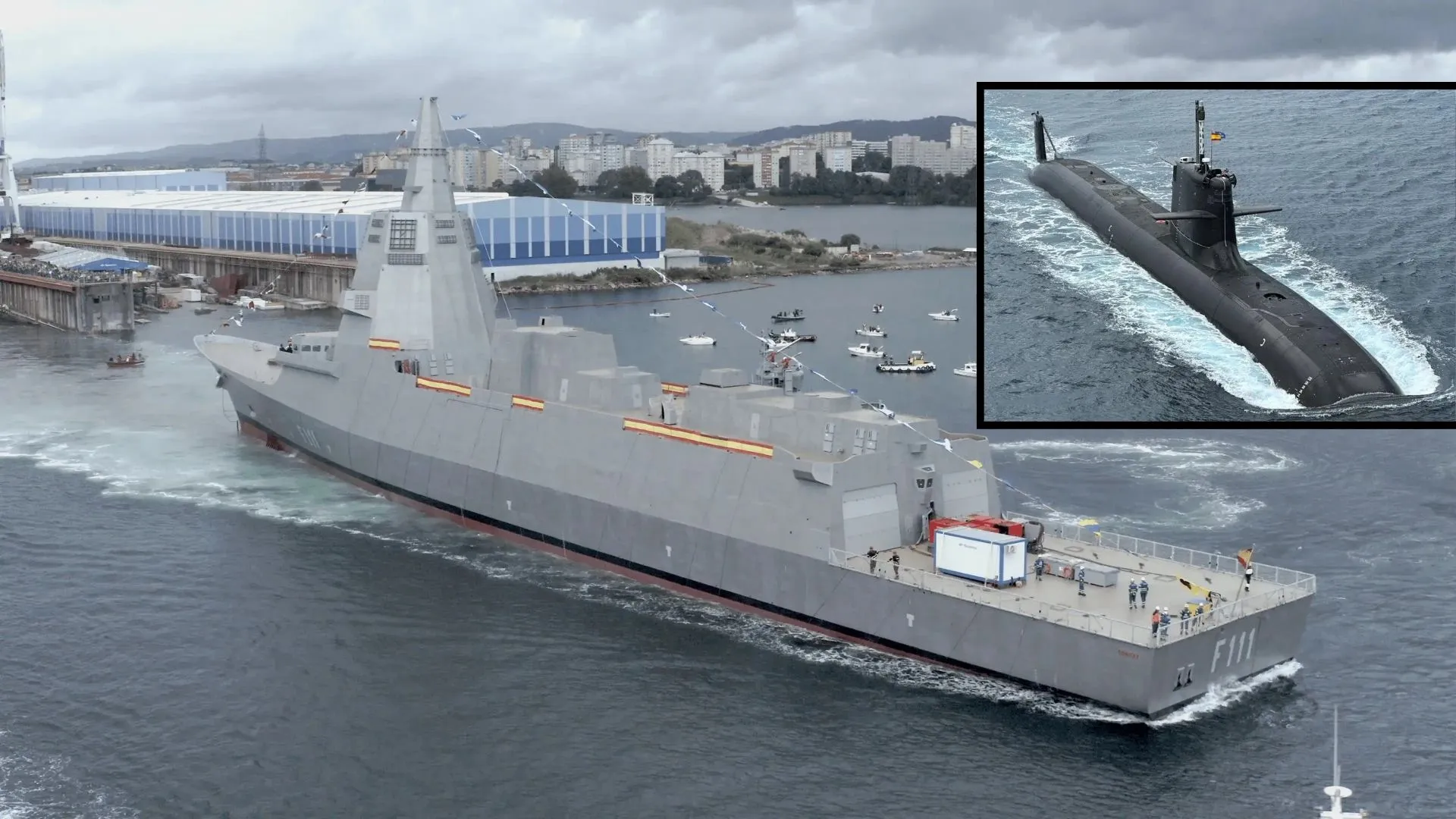
Navantia, Spain’s state-owned shipbuilder, has signed a Memorandum of Understanding (MoU) with San Sebastián-based Multiverse Computing to develop, validate and deploy artificial intelligence and quantum-inspired software for naval defense, the company announced on October 21, 2026. Gonzalo Mateo-Guerrero, Navantia’s Chief Operating Officer (COO), and Enrique Lizaso, Multiverse Computing’s co-founder and Chief Executive Officer (CEO), signed the framework, which targets embedded AI aboard surface combatants and submarines.
The agreement lands as Navantia works to fold AI into the combat systems it supplies to the Spanish Navy ahead of the first F110 frigate delivery in 2028, and as Madrid deepens its financial bet on Multiverse. The Spanish government, through the Spanish Society for Technological Transformation (SETT), invested €59.2 million in the company in June 2025 and authorized a further €107 million on June 23, 2026. A month later, Multiverse announced a $570 million (€500 million) Series C round at a $1.7 billion pre-money valuation. The MoU therefore pairs a shipyard owned by the State Industrial Holdings Company (SEPI) with an AI firm in which the Spanish state is a shareholder.
Four Lines of Work Under the Navantia AI Agreement
The framework sets out four areas of exploration: efficient AI for embedded systems and for surface and submarine platforms; signal processing and situational awareness; mission planning and logistics optimization; and Command, Control, Communications and Intelligence (C4I) systems. The two companies will also assess joint proposals for European defense and innovation programs.
The division of labor is explicit. Multiverse will contribute CompactifAI, its model compression technology, to shrink AI models for environments limited by computing capacity, power or connectivity. Navantia brings product knowledge, naval architecture, systems integration, operational requirements and life-cycle expertise. According to Navantia, the pairing is intended to move work from experimentation toward AI capabilities embedded in its naval products.
“The agreement will make it possible to apply artificial intelligence to Navantia’s products and accelerate their evolution towards more efficient and more advanced naval solutions,” Mateo-Guerrero said. Lizaso framed the challenge in integration terms: “In artificial intelligence applied to defence, the difficult step is not the demonstration but the integration: moving from a model that works in the laboratory to a capability that a naval system can sustain throughout its entire life cycle.”
The MoU does not name a platform, a program of record, a budget or a timeline. It is a framework for collaboration rather than a contract, and neither company disclosed financial terms.
How CompactifAI Shrinks Models for Shipboard and Submarine Use
CompactifAI applies tensor networks, a mathematical framework drawn from quantum physics, to restructure the weight matrices of neural networks into smaller factorized representations. The compressed model is then retrained, a step the company calls healing, to recover accuracy lost during compression. Multiverse states that the method can reduce the size of large language models by up to 95% with limited accuracy loss. In a 2024 research paper, the company reported that combining CompactifAI with quantization cut the memory footprint of the Llama 2 7B model by 93%, with a 2% to 3% drop in accuracy. These figures are company-reported and have not been independently validated in a naval environment.
The operational relevance is direct. A warship’s combat management system runs on hardened, power-budgeted processors qualified over long certification cycles, which cannot be refreshed at the pace of commercial AI hardware. A submarine such as the S-80 Plus (Isaac Peral class) operating submerged has little or no access to off-board networks, which rules out reliance on cloud inference. Multiverse positions its technology for deployments with no dependence on external services, a requirement that maps onto both cases. Compressed models could, in principle, run sensor fusion, acoustic classification or decision-support functions locally on existing shipboard compute, rather than demanding additional server racks with their space, weight, power and cooling (SWaP-C) penalties.
SCOMBA, the F110 Frigate and Spain’s Naval Combat Cloud
The most obvious integration path runs through the Sistema de Combate de los Buques de la Armada (SCOMBA), the combat management system developed by Navantia’s Systems division. On the five-ship F110 Bonifaz-class program, contracted in April 2019 for €4.317 billion, SCOMBA processes sensor, radar and weapons data in real time and integrates with the Lockheed Martin AN/SPY-7(V)2 solid-state S-band radar and the Aegis fire control loop. The 6,100-tonne lead ship, Bonifaz (F-111), was launched at Ferrol on September 11, 2025.
Navantia is also leading development of the Naval Combat Cloud, presented as the operating environment for the next generation of SCOMBA and combining communications, storage, cybersecurity, AI and big data. Neither company has said whether the Multiverse collaboration will feed that effort, but the MoU’s C4I and situational awareness work streams align closely with it.
The agreement also builds on existing ties. Navantia Australia and Multiverse announced a strategic alliance in November 2025 aimed at the Australian defense sector, and Multiverse signed a separate efficient-AI agreement with Indra Group in October 2025.
Analysis: The MoU is less about a single capability than about who controls the AI layer in Spain’s future fleet. By pairing a SEPI-owned prime contractor with a state-backed domestic AI firm, Madrid is assembling a sovereign stack in which combat-system software, the models running on it and the tooling that fits those models onto qualified hardware remain under national control. That also strengthens Navantia’s export pitch, since an AI-enabled combat system without foreign model dependencies is simpler to offer abroad. Lizaso’s own framing identifies the real test. Compression solves the compute problem, but shipboard AI must still clear safety certification, configuration control and sustainment across a hull life measured in decades, areas where neither company has yet published results.
Milestones to watch include the first joint bids for European defense and innovation programs or Spanish national initiatives, any announcement tying the collaboration to SCOMBA or the Naval Combat Cloud, and demonstrations on representative shipboard or submarine hardware. Navantia has not disclosed a schedule, budget or target platform, and those details will determine whether the MoU produces fielded capability or remains a research framework.