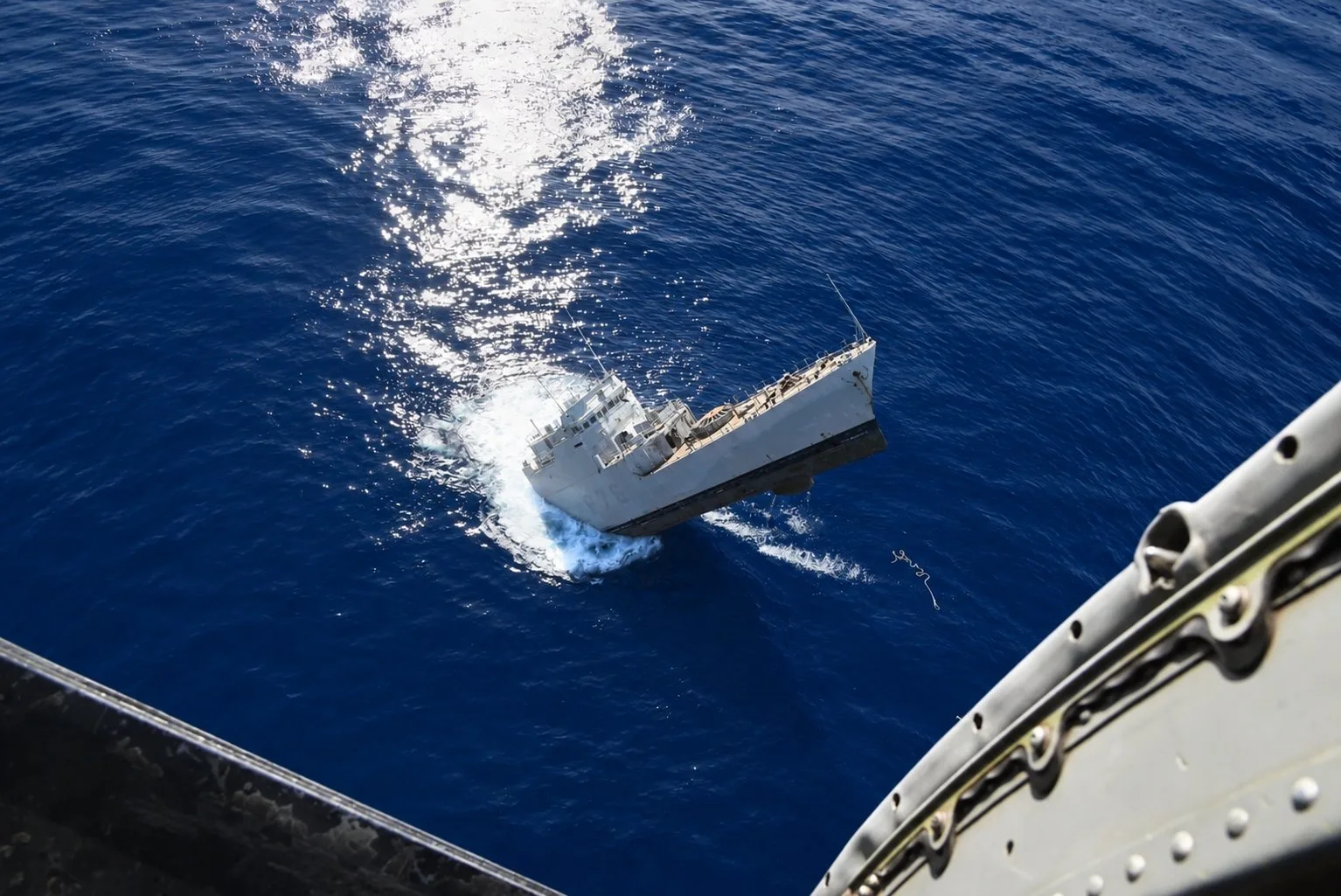
Spain’s submarine Isaac Peral (S-81) sank the decommissioned patrol vessel Infanta Elena (P-76) with a single heavyweight torpedo during the live-fire exercise SINKEX 26 in Atlantic waters south of the Canary Islands, the Spanish Navy announced on November 4, 2026. The firing tested the boat’s weapon systems and crew readiness in a joint scenario alongside frigates, combat aircraft and unmanned systems.
The engagement caps a steady qualification path. S-81, lead unit of the S-80 class built by Navantia in Cartagena, entered service on November 30, 2023, after a program set back by a 2013 weight problem that forced a hull extension of roughly 10 meters. It fired torpedoes for weapons evaluation during SINKEX 25 in June 2025. The second boat, S-82 Narciso Monturiol, is in the final stretch before handover.
How the Isaac Peral Submarine Executed the SINKEX 26 Shot
The target left the Cartagena naval base under tow and was moved south by the multipurpose vessel Carnota (A-61) to a high-seas area west of El Hierro, away from commercial shipping lanes, according to Spanish defense press reports. Built by the Bazán yard as the Descubierta-class corvette F33, Infanta Elena entered service in 1980, was reclassified as a patrol vessel in 2004 and was decommissioned on March 17, 2023, after more than 730,000 nautical miles under way, including counter-piracy patrols under the European Union’s Operation Atalanta and enforcement of the United Nations naval embargo during the Gulf War. Using a retired hull as a live target lets the Navy validate warhead effects against real steel rather than instrumented exercise shots.
The SINKEX force included the frigates Cristóbal Colón (F-105) and Navarra (F-85), the maritime action ship Relámpago (P-43), the Mine Countermeasures Diving Unit, three AV-8B Harrier II jets, a helicopter from the 10th Squadron, a ScanEagle unmanned aircraft from the 11th Squadron and a maritime patrol aircraft from the Spanish Air and Space Force. Captain Rafael Mira Calvo, commander of the 41st Escort Squadron, directed the activity from Navarra.
The official statement does not name the weapon, the launch range or the exact date of the firing. The Navy’s S-81 fact sheet lists the SeaHake mod 4, the export designation of Atlas Elektronik’s DM2A4, as the boat’s heavyweight torpedo. Before the sinking, the hull was stripped of fuels, oils and other pollutants, and a monitoring protocol for cetaceans and civilian traffic remained active throughout, according to the Navy.
Torpedo and Combat System: What the S-81 Firing Validates
Publicly available specifications indicate the DM2A4 is a 533 mm heavyweight torpedo about 6.6 meters long, weighing roughly 1,530 kg with a warhead of about 260 kg. Silver-zinc batteries give it a top speed of about 50 knots and a range of up to 50 km. Guidance combines a wire link with active and passive sonar homing and wake homing.
If the DM2A4 was the weapon used, that architecture suits a one-shot kill. The wire link lets the submarine’s fire control update the weapon after launch, while wake homing gives a robust terminal solution against a surface ship. Either way, the firing exercised the find, track and strike sequence SINKEX 26 was built to test, running through the combat system Navantia developed with Lockheed Martin.
S-81 displaces roughly 3,000 tonnes submerged on an 80.8-meter hull and is also armed with UGM-84 Sub-Harpoon Block II anti-ship missiles. It still lacks the BEST bioethanol-based air-independent propulsion system, which Navantia will fit first on S-83 Cosme García; S-81 and S-82 are due to receive it at their first major overhaul.
Analysis: A one-torpedo sinking does not erase two decades of S-80 delays, but it answers the central question: whether a Spanish-designed boat, its combat system and its heavyweight torpedo can close a kill chain together under realistic conditions. The ministry framed the payoff as deterrence, citing “the silent certainty of its presence.” That deterrent scales only with hull count. Until S-82 reaches full availability and air-independent propulsion arrives with S-83, Spain will spread a thin modern submarine force across Atlantic and Mediterranean commitments.
Navantia is targeting administrative delivery of S-82 in the last week of November 2026, while the formal ceremony could be held over until a new government takes office after the November 29 general election. S-81, meanwhile, has joined the Dédalo 26-02 Expeditionary Combat Group ahead of NATO’s Operation Sea Guardian in the Mediterranean. The Navy has not said whether it will release launch range or run data from SINKEX 26.