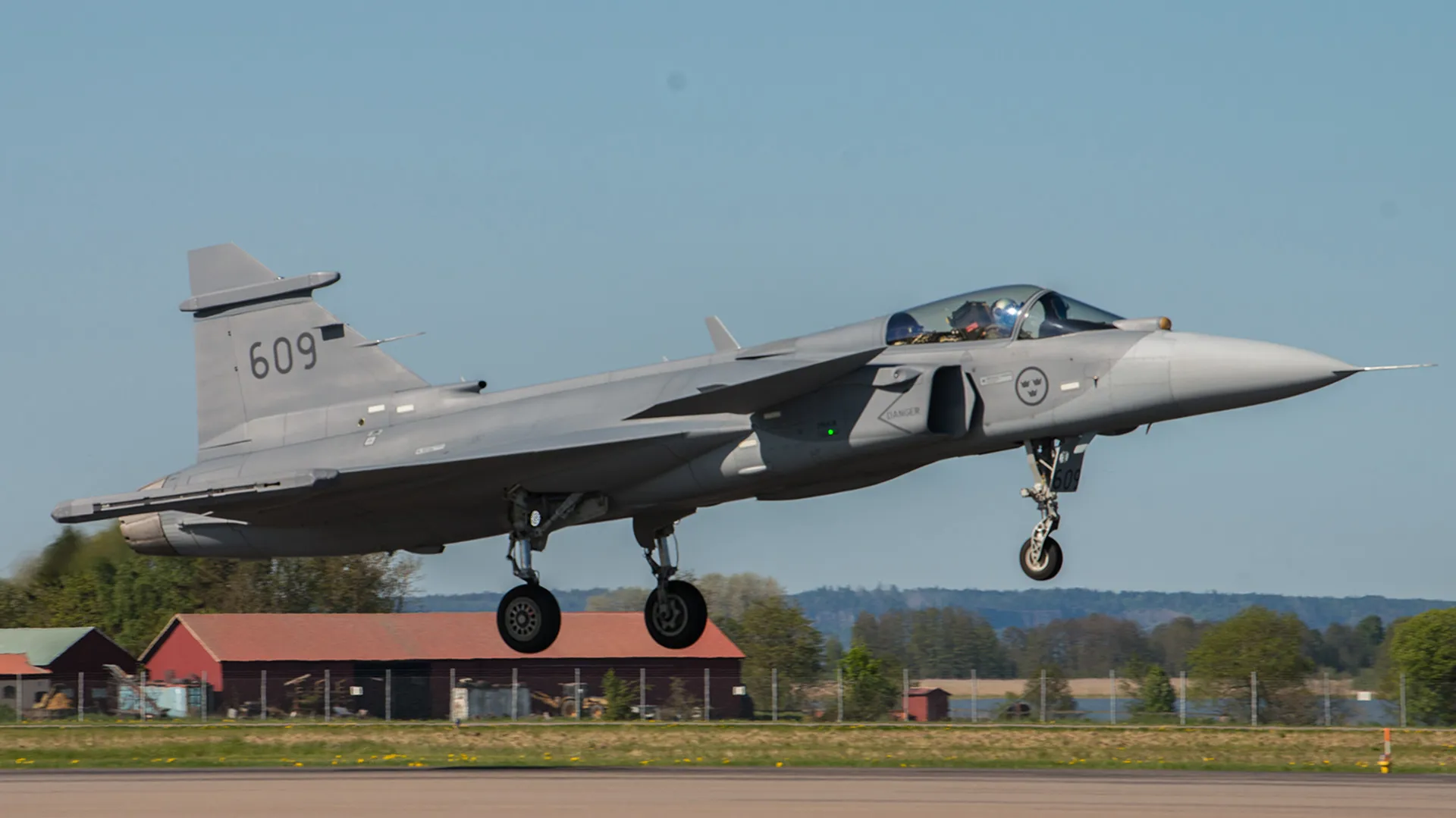
Two experienced fighter pilots from the Swedish Air Force’s Norrbotten Wing (F 21) have completed conversion to the JAS 39 Gripen E at Skaraborg Wing (F 7) in Såtenäs and will serve as the instructors who introduce the new fighter at Luleå. According to the Swedish Armed Forces, the pair are now flying as many Gripen E sorties as possible before F 21’s 212th Squadron receives its first aircraft in early 2027.
F 7 accepted the Swedish Air Force’s first operational Gripen E, serial 609, on October 20, 2025, the first of 60 Gripen E on order with Saab. The wing’s 72nd Squadron leads the type’s introduction. Extending the Gripen E to F 21, Sweden’s northernmost fighter wing, is the program’s first step beyond its lead unit. It comes as Stockholm prepares to transfer Gripen C/D fighters to Ukraine from 2027 and plans 12 additional Gripen E to backfill them, raising pressure to regenerate frontline squadrons quickly.
Gripen E Conversion at F 7: Building Instructors for 212th Squadron
The Swedish Armed Forces identify the two F 21 pilots only by initials. The first, K, is slated to take command of the 212th Squadron in spring 2027, coinciding with the type’s arrival in Luleå. The second, H, is a flight leader in the same squadron and will anchor the flying system itself while K concentrates on squadron leadership.
“The idea is to take as much experience as I can from 72 at F 7, which is first in line here,” K said, in remarks published in Swedish and translated here. H described his role as being the core of the system when it moves to F 21, including running the wing’s own conversion course.
The approach is a train-the-trainer cascade. With the formal syllabus complete, the focus is now on flight hours and knowledge transfer from the 72nd to the 212th. The commander of the 72nd, identified as C, called the two “experienced and very competent Gripen pilots” and said the arrangement lays the groundwork for close cooperation between the squadrons while giving F 21 the tools to retrain its own pilots during 2027.
The Armed Forces did not disclose how many Gripen E F 21 will receive in its first tranche, how many pilots the wing intends to convert in 2027, or when the 212th Squadron is expected to declare initial operational capability.
IRST, Sensor Fusion, and Pilot Workload: What Changes From Gripen C/D
Externally, the Gripen E closely resembles the C/D, but the Swedish Armed Forces treat it as a new aircraft. K said handling differences are modest; conversion has focused on systems, from aircraft setup to tactical systems. Publicly available specifications indicate the E is powered by a General Electric F414G turbofan producing about 98 kN of afterburning thrust, offers up to 40 percent more fuel capacity, and pairs a Leonardo ES-05 Raven active electronically scanned array (AESA) radar with the Skyward-G infrared search and track (IRST) sensor, the Arexis electronic warfare suite, and a single wide area display in the cockpit. Primary air-to-air armament remains the MBDA Meteor and IRIS-T.
The Armed Forces singled out the passive IRST, which detects heat signatures from other aircraft and other sources, including from the ground, without emitting. H said a defining feature of modern fighters is that “the sensors work more actively with each other,” both within a single aircraft that fuses all target data into one picture and across a formation that shares it to build situational awareness and deliver targeting data against threats such as incoming missiles.
That information density is the main training challenge. H warned that pilots with long C/D experience could fly “Erik like a Caesar,” Swedish phonetic shorthand for flying an E like a C, and leave half of its capabilities unused. “This aircraft has so many new possibilities that you have to let go of Gripen C and start thinking Gripen E,” he said. The cost is a heavier cognitive load: pilots choose which displays and data to present, and H said it is easy to absorb everything but harder to discern what matters in the moment, a skill he described as part of the training.
Analysis: The F 21 pipeline marks the point where Sweden’s Gripen E program shifts from introduction to force regeneration. Seeding the 212th Squadron with two deeply trained pilots rather than a larger cohort reflects how scarce lead-unit expertise and early airframes remain. More consequential is the doctrinal shift the pilots describe: the E’s value lies less in kinematics than in passive detection and networked fusion, which suit Sweden’s dispersed, emission-controlled operating concept and NATO’s Nordic air defense. If conversion produces pilots who fly the E like a C/D, that advantage erodes, which makes information management the program’s real readiness metric.
The next milestone is the first Gripen E delivery to F 21 in early 2027, followed by K’s assumption of command in the spring and an in-house conversion course led by H through the year. Open questions include Saab’s Gripen E delivery rate, as production also covers Brazil’s order and a 16-aircraft Ukrainian contract due for delivery in 2029 and 2030, the timeline for F 21’s second squadron, and how C/D transfers to Ukraine will affect training capacity across the force.