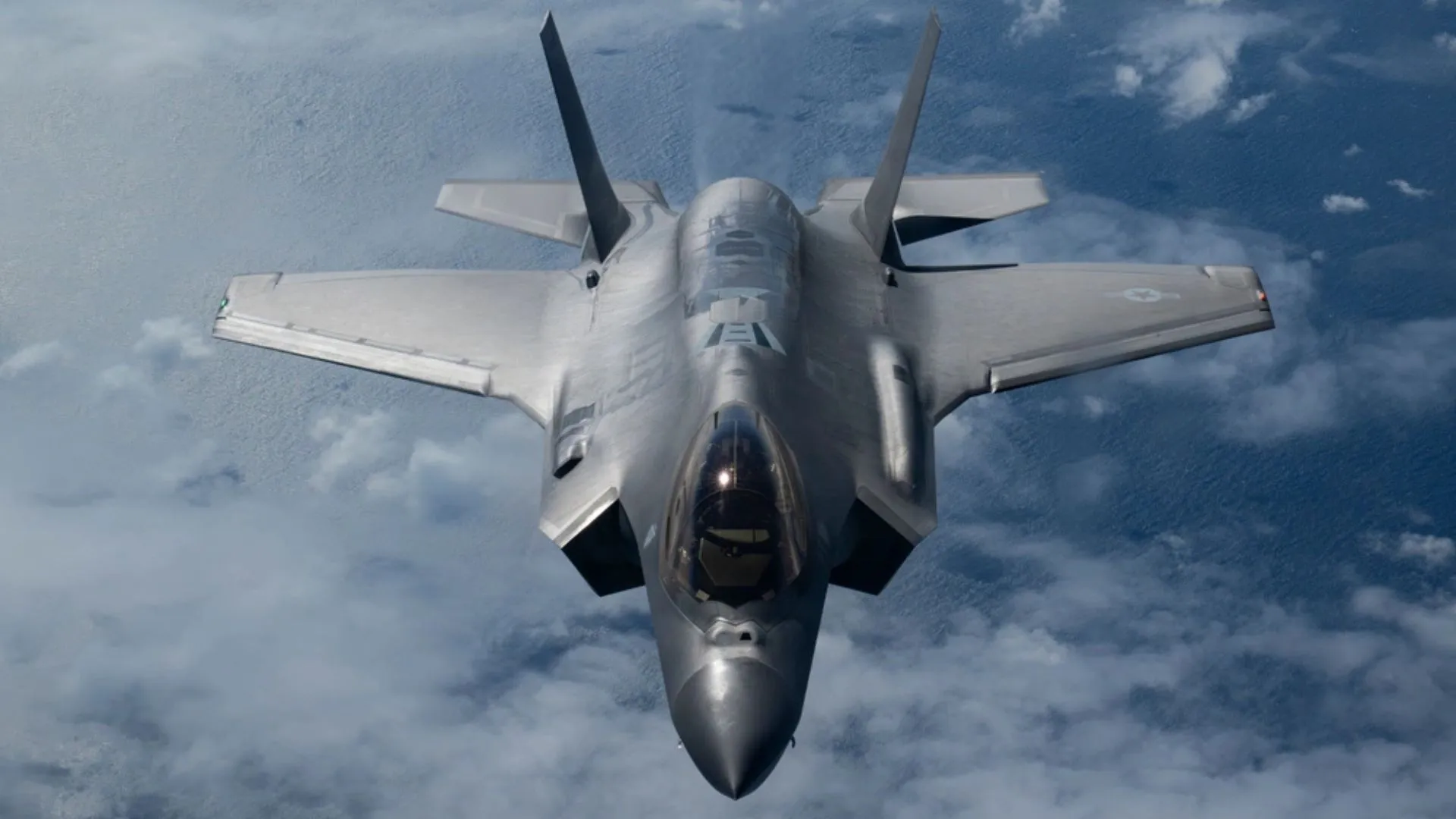
Lockheed Martin Aeronautics has received a $114,629,966 cost-plus-fixed-fee order to redesign two F-35 Lightning II navigation systems, the Global Positioning System (GPS) Electronic Unit and the NAV100 Inertial Navigation System (INS), the Pentagon announced on October 23, 2026. Naval Air Systems Command (NAVAIR) at Patuxent River, Maryland, placed the order (N0001927F1037) against basic ordering agreement N0001924G0010 to replace obsolete electronic components in both units.
The award targets a structural sustainment problem rather than a capability gap. The F-35 remains in production with avionics architectures defined in the 2000s, and suppliers keep retiring the processors, programmable logic and power components those designs depend on. According to the Pentagon, the redesigns are meant to prevent production disruptions, address diminishing manufacturing sources (DMS) and support continued production and sustainment for the Air Force, Navy, Marine Corps and the F-35 cooperative program partners.
What the F-35 Navigation Systems Redesign Covers Through 2030
The order funds nonrecurring engineering, redesign, integration, qualification and testing for both units. Its stated requirement is to replace obsolete parts while maintaining system performance and compatibility with existing aircraft systems. In practice, that defines a form, fit and function replacement: the new hardware must slot into the same installation, interfaces and mission software as the units it succeeds, without adding capability.
The two boxes play distinct roles. The GPS Electronic Unit handles satellite navigation processing for the jet’s mission systems. The INS computes attitude, heading, velocity and position from onboard sensors, independent of any external signal, which makes it the primary navigation reference when GPS is jammed or spoofed. Honeywell was selected in 2003 to supply the F-35’s ring-laser-gyro INS. The Pentagon notice does not identify which firms will perform the redesign.
Work will be split between El Segundo, California (70.1%); Fort Worth, Texas (27.5%); and Clearwater, Florida (2.4%), with completion expected in January 2030. That 39-month window reflects the weight of qualification: new navigation hardware on a fifth-generation fighter must clear environmental, electromagnetic and integration testing before entering production lots.
The effort is separate from the GPS Spatial Temporal Anti-Jam Receiver (GSTAR), placed on contract in 2019 to replace the F-35’s Antenna Electronics Unit under Block 4. The announcement does not state whether the redesigned GPS unit will add Military Code (M-code) processing, the jam-resistant military GPS signal the Defense Department is fielding across its fleets.
How the US and F-35 Partners Are Splitting the $114.6M Bill
All funds are obligated at award. Fiscal 2026 Air Force aircraft procurement accounts contribute $46,411,323 and Navy aircraft procurement accounts $46,411,322, the latter covering Navy and Marine Corps aircraft. Cooperative program partner funds add $21,807,321, roughly 19% of the total. Drawing on procurement dollars rather than research accounts ties the work directly to keeping the production line and spares pipeline running.
The order was not competitively procured. It runs against an existing basic ordering agreement with Lockheed Martin, which holds design authority for the air vehicle and must certify that any replacement hardware integrates cleanly with the aircraft.
The award also extends a long pattern. In July 2016, NAVAIR awarded Lockheed Martin a $241.8 million contract for DMS electronic components for the F-35. In May 2022, a separate $43.6 million order funded redesign of the panoramic cockpit display’s electronic unit video mixer. Each addresses the same exposure: commercial-derived electronics with life cycles far shorter than an airframe planned to remain in service into the 2080s.
Analysis: The order buys continuity, not combat edge, and that is why it matters. Navigation underpins weapons employment, sensor fusion and formation coordination, and the INS is the jet’s fallback in the GPS-contested airspace that planners in Europe and the Indo-Pacific now treat as the baseline. A supply break on either unit would stall deliveries regardless of Block 4 progress. Partner co-funding also keeps the global fleet on a common configuration, protecting interoperability and shared spares. The risk lies in timing: the redesign must qualify against an aircraft configuration still evolving through Technology Refresh 3 and Block 4, and the roughly year-long delivery pause tied to Technology Refresh 3 integration in 2023 and 2024 showed how quickly avionics changes on this aircraft can ripple into production.
The next milestones are qualification testing and a production cut-in point, neither of which the announcement specifies. Also unaddressed: whether fielded jets will be retrofitted or receive the new units only as spares are replaced, and whether M-code is in scope. Follow-on orders for production units would be the first signal of which lots receive the redesigned hardware ahead of the January 2030 completion date.