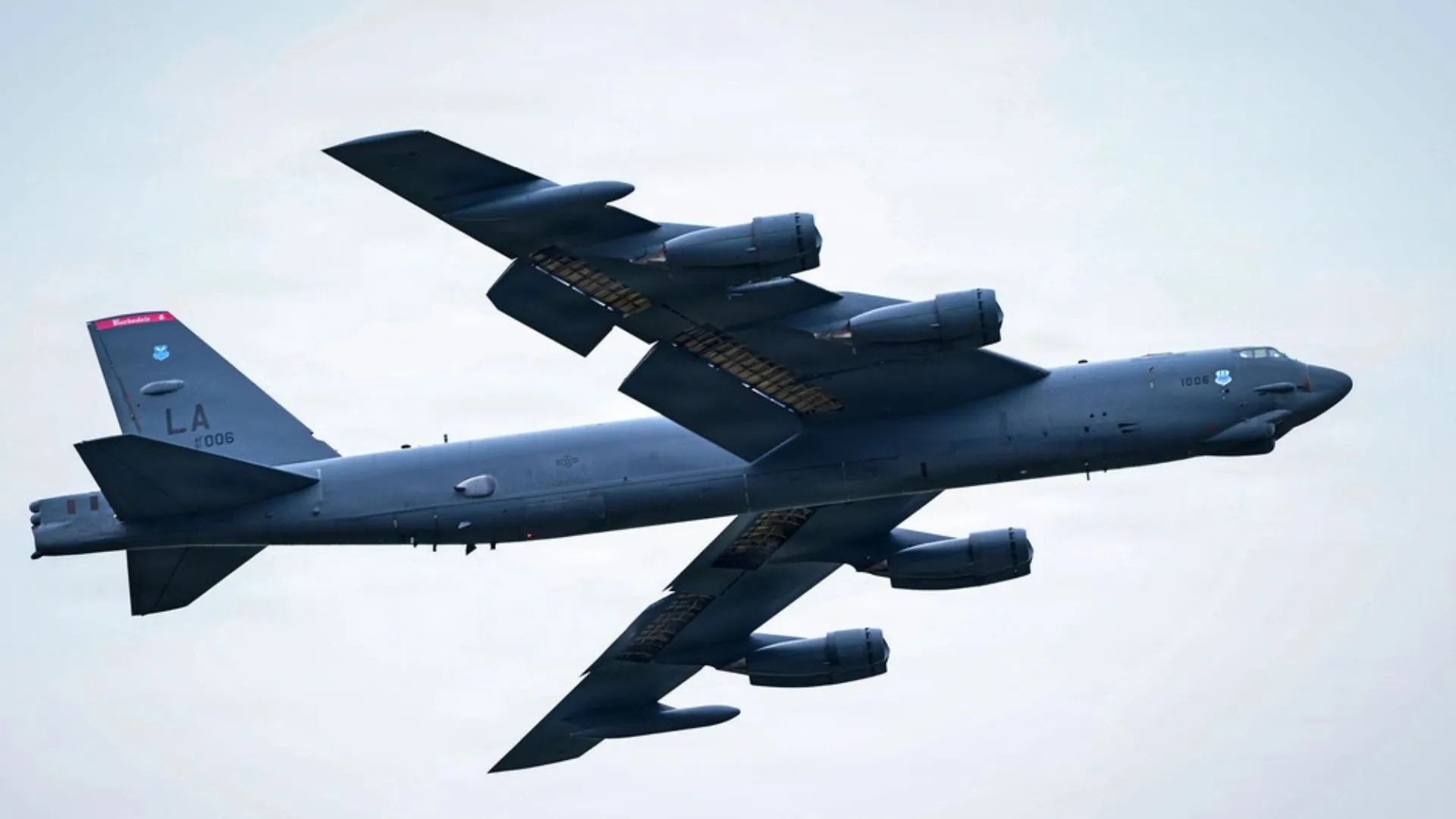
U.S. Strategic Command (USSTRATCOM) launched Global Thunder 27 (GT27), its annual nuclear command and control exercise, on October 22, 2026, the command announced from Offutt Air Force Base, Nebraska. Personnel throughout the strategic enterprise, including USSTRATCOM components and subordinate units, are taking part, and bomber and other aircraft flights may increase while it runs.
USSTRATCOM said GT27 aims to enhance nuclear readiness and ensure a safe, secure, effective and credible strategic deterrent force, and that the annual event responds to no nation or current world events. It is nonetheless the first Global Thunder since the New Strategic Arms Reduction Treaty (New START) expired on February 5, 2026, leaving the two largest strategic arsenals without legally binding limits. It follows NATO’s Steadfast Noon nuclear exercise, which opened in Italy on October 13 with 17 nations, and is the first edition under Adm. Richard Correll, who took command of USSTRATCOM on December 5, 2025.
How Global Thunder 27 Exercises the Nuclear Command and Control Chain
Global Thunder combines a command post exercise with field training, spanning combatant command planning down to execution by bomber wings, missile crews, and airborne command posts. The scenarios stress nuclear command, control and communications (NC3), the networks that carry orders from national leadership to the triad: Minuteman III intercontinental ballistic missiles (ICBMs), Ohio-class ballistic missile submarines armed with Trident II D5 missiles, and nuclear-capable B-52H Stratofortress and B-2A Spirit bombers.
The GT27 announcement discloses no duration, platforms, or operating locations. Global Thunder 26 opened on October 21, 2025. A B-52H from the 2nd Bomb Wing at Barksdale Air Force Base, Louisiana, was generated at Minot Air Force Base, North Dakota; a KC-135 Stratotanker from McConnell Air Force Base, Kansas, operated from Fairchild Air Force Base, Washington; and the 509th Bomb Wing documented participation at Whiteman Air Force Base, Missouri, on October 24 and 26. Exercise traffic typically includes the Navy’s E-6B Mercury, which flies the Take Charge and Move Out (TACAMO) mission to submerged submarines and the Looking Glass airborne command post mission, and the Air Force’s E-4B Nightwatch National Airborne Operations Center.
The airborne launch path received attention weeks before GT27. Airmen of the 625th Strategic Operations Squadron and sailors of Fleet Air Reconnaissance Squadron Four (VQ-4) completed a Simulated Electronic Launch-Minuteman (SELM) event at Malmstrom Air Force Base, Montana, from September 15 to 17, 2026. The GT27 release also departs from 2025 wording: the GT26 statement stressed assuring allies and demonstrating warfighting capacity, while this year’s text returns to deterrence language, says aircraft activity may rather than will increase, and names no allied participants.
Legacy NC3 Fleets and the Programs Lined Up to Replace Them
GT27 runs on aging platforms whose successors remain in development. On October 15, 2026, the Navy accepted the first C-130J-30 Super Hercules from Lockheed Martin in Marietta, Georgia, for conversion into the E-130J Phoenix II, with Northrop Grumman integrating TACAMO mission systems including a Collins Aerospace very low frequency (VLF) subsystem. The E-130J will assume only the TACAMO role from the Boeing 707-derived E-6B; it is not expected to carry the Looking Glass airborne command post mission, and no replacement host for that mission has been confirmed. A July 2026 Government Accountability Office (GAO) assessment found the program’s transition to production had slipped about one year.
The E-4B fleet faces a similar handover. Sierra Nevada Corporation holds a $13 billion contract, awarded April 26, 2024, and running through July 2036, for the Boeing 747-8-based E-4C Survivable Airborne Operations Center. The first E-4C flew on August 7, 2025, and remains in flight testing.
The Air Force expects its first operational B-21 Raider at Ellsworth Air Force Base, South Dakota, in 2027, after a $4.5 billion agreement with Northrop Grumman to expand production capacity by 25%. The LGM-35A Sentinel ICBM is still being restructured after its 2024 Nunn-McCurdy breach, with the Pentagon’s Cost Assessment and Program Evaluation office estimating a modified program at $141 billion. The Air Force targets a Milestone B decision by the end of 2026; GAO places the first flight test in March 2028. Until Sentinel fields in the early 2030s, Minuteman III holds the land-based leg at a sustainment cost the Air Force puts above $2 billion a year.
Analysis: Without New START’s data exchanges, inspections, and notifications, Washington and Moscow lack a verified picture of each other’s deployed forces. Publicly announced drills such as GT27 now carry more of the signaling burden, and the standard disclaimer that the exercise targets no nation works as a risk-reduction tool rather than boilerplate. One older mechanism survives: a 1989 U.S.-Soviet agreement of unlimited duration requires 14 days’ notice of one major strategic exercise involving heavy bombers each year. The GT27 release does not say whether Russia received such notice. The structural issue is industrial: USSTRATCOM certifies readiness on airframes and missiles whose replacements, for Sentinel and the E-130J, have already slipped, making legacy sustainment the operative variable for deterrence credibility into the early 2030s.
USSTRATCOM has not announced an end date for GT27; activity documented by participating wings during GT26 spanned roughly October 19 to 26, 2025. The next milestones are programmatic: the Sentinel Milestone B decision, the first E-130J conversion, continued E-4C testing, and the first B-21 delivery to Ellsworth. Whether Washington and Moscow open talks on a post-New START framework remains the largest unknown.