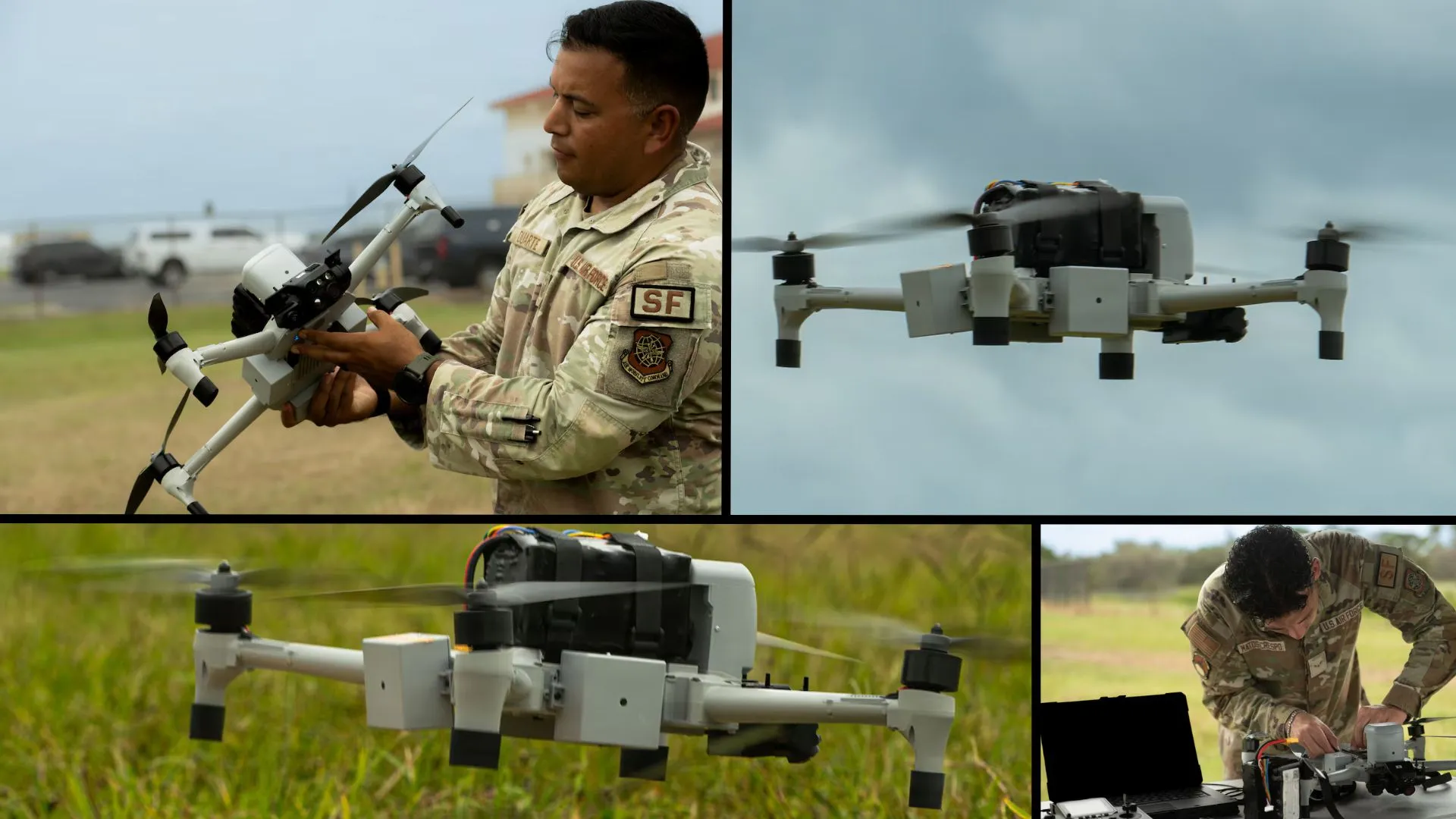
U.S. Air Force security forces at MacDill Air Force Base, Florida, have added the Bumblebee V2 drone interceptor to the installation’s defenses, training on the collision-kill quadcopter on October 8, 2026, in coordination with Joint Interagency Task Force 401 (JIATF 401). The 6th Air Refueling Wing disclosed the training on October 23, 2026, describing a system built to defeat hostile drones by flying directly into them.
The step carries a Pentagon counter-drone effort first assessed by Army rapid-response units into Air Force base security. MacDill hosts the wing’s KC-135 Stratotanker fleet, the headquarters of U.S. Central Command and U.S. Special Operations Command, and 33 mission partners on the edge of Tampa Bay and a dense urban area. Pressure on base defenders keeps rising: a U.S. Northern Command spokesperson put reported drone incursions over military installations at roughly 420 between September 2024 and September 2025, up 82 percent from the previous year.
How the Bumblebee V2 Interceptor Defeats Small Drones by Collision
Perennial Autonomy, a Menlo Park, California, company formerly known as Project Eagle, builds the Bumblebee V2, a first-person-view (FPV) quadcopter compliant with National Defense Authorization Act (NDAA) sourcing rules. It carries no warhead. The interceptor rams its target and disables both aircraft, avoiding the blast and fragmentation that missiles, guns or explosive interceptors would scatter across a flight line or neighboring city blocks.
Version 2 targets the weakness of its predecessor. Bumblebee V1 used a fixed camera and depended on a pilot manually steering one drone into another. V2 adds a gimballed three-camera array, artificial intelligence (AI) automated target recognition and automatic speed control, so the drone can track and close on a target while the operator retains oversight. The operator still triggers the final intercept, and JIATF 401 says Perennial Autonomy’s counter-UAS systems keep decisions on the use of lethal force with the warfighter. JIATF 401 has evaluated the system against Group 1 and Group 2 unmanned aircraft systems (UAS), the two smallest Defense Department categories.
That design matters for installation defense because a physical kill does not depend on a radio link. Drones flying preprogrammed routes or using hardened datalinks can keep going after jamming; an interceptor that strikes the airframe stops them regardless. No official figures have been released for speed, engagement range or unit cost. The Army says the V2 can fly for up to an hour on a single battery, although reporting from the spring trials put battery life at about 20 to 25 minutes depending on speed.
From Fort Bragg to MacDill: JIATF 401 Scales Collision Interceptors
JIATF 401 awarded Perennial Autonomy a $5.2 million agreement for the Bumblebee V2 on January 30, 2026, with deliveries beginning in March. In May, the task force added a three-year indefinite delivery/indefinite quantity contract worth up to $500 million covering the Bumblebee, the Merops interceptor and the Hornet midrange strike drone, systems it said forces in the U.S. Central Command region were already employing.
Army units ran the early assessments. Twenty 82nd Airborne Division paratroopers trained on V2 prototypes at Fort Bragg, North Carolina, on April 22, 2026. The 3rd Battalion, 75th Ranger Regiment followed with a five-day exercise at Fort Benning, Georgia, from July 6 to July 10, focused on defending installations and domestic critical infrastructure under Title 10, Section 130i of the U.S. Code.
At MacDill, Tech. Sgt. Nathan A. Duarte, the 6th Security Forces Squadron’s unmanned aircraft systems program manager, inspected a Bumblebee V2 during the October 8 training. The session also featured a Paladin counter-UAS system that defeats drones with a net round. The release does not say whether the two systems share sensors or a common command-and-control architecture.
Analysis: MacDill shows the JIATF 401 model working as designed: a commercial interceptor bought on a small agreement, validated by Army rapid-response units and handed to another service’s installation security force in roughly eight months. For an air base, a warheadless collision interceptor fills a real gap. Jamming remains the default domestic defeat option but fails against drones flying without an active link, while guns and missiles are impractical near parked aircraft and populated areas. The binding constraint is the kill chain behind the effector: detection, identification, deconfliction with KC-135 sorties and Tampa Bay civil traffic, and legal authority to engage, all resolved in the seconds a small drone needs to cross the perimeter.
Key unknowns remain. The Air Force has not said how many Bumblebee V2 interceptors MacDill holds, whether the assignment is permanent or whether other bases will follow. Task orders under the $500 million contract, integration with installation sensors and command-and-control networks, and clarity on engagement authorities will decide whether the October 8 training becomes a standing defensive capability.