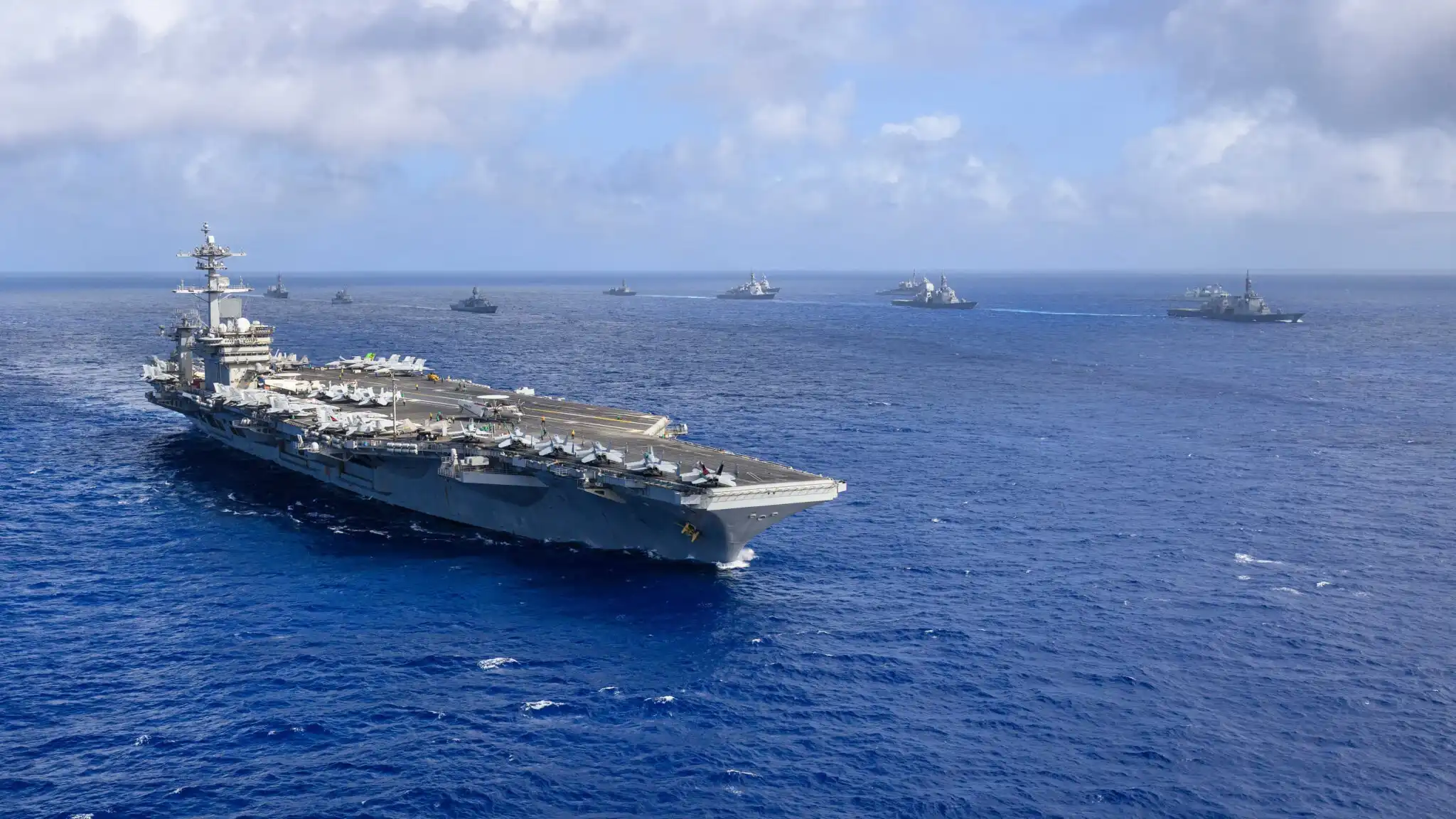
China’s Liaoning carrier strike group turned northeast on October 23, 2026, after reaching waters about 25 nautical miles (46 km) east-southeast of Balut Island, the southernmost point of the Philippines, according to Philippine news channel BNC, as reported by the South China Morning Post (SCMP). On that course, the People’s Liberation Army Navy (PLAN) formation could enter the Philippine Sea, where USS Theodore Roosevelt (CVN-71) is operating with allied warships during the US-Japan exercise Keen Sword 27.
The US 7th Fleet said on October 22 that the Nimitz-class carrier was sailing in the Philippine Sea alongside Japanese, Australian, Canadian and French ships. Keen Sword, a biennial exercise centered on the defense of Japan’s southwestern islands, runs through October 29 with about 45,000 Japanese personnel, about 11,000 US troops and seven partner nations. The Liaoning’s current cruise, which began on October 14, is its second Western Pacific deployment of 2026 after a 40-day voyage that ended on June 22. The PLAN said the training, part of its annual plan, targets no specific country.
Liaoning Carrier Group Track: From Miyako Strait to Balut Island
Japan’s Joint Staff first detected the formation on October 13, sailing south about 390 km southwest of the Danjo Islands: the Liaoning (hull 16), the Renhai-class (Type 055) large destroyers Anshan (103) and Wuxi (104), and the Luyang III-class (Type 052D) destroyer Huainan (123). On October 14, the four ships passed southeast between Okinawa’s main island and Miyako-jima into the Pacific, where the carrier conducted about 10 fighter and helicopter takeoffs and landings some 250 km south of Ishigaki-jima, prompting Japan Air Self-Defense Force scrambles. By October 15, the group was heading for the South China Sea.
It then worked down the western flank of the archipelago, transiting the Basilan Strait on October 22 under Philippine Navy surveillance before reaching Balut Island. As the SCMP noted, the track traces an anticlockwise loop around the Philippines and leaves the group beyond the first island chain, the arc running from Japan through Taiwan to the Philippines that frames US strategy in the region.
Japan’s defense ministry also detected a Y-9 electronic reconnaissance aircraft and a WZ-7 high-altitude drone between Okinawa and Miyako while the carrier operated there. Whether either supported the southern leg is unconfirmed. Publicly available specifications credit the WZ-7 with a ceiling near 18,000 meters, enough to push the group’s surveillance horizon well beyond shipborne sensors. Japanese releases list no replenishment ship, an open question for a cruise expected to last several weeks.
Beijing presents allied monitoring as harassment. Chinese state television said on October 24 that Japanese ships and aircraft repeatedly shadowed the Liaoning at close range in June, and that the Type 054B frigate Luohe and carrier-based J-15 fighters warned off Japanese vessels and P-3C patrol aircraft.
Ski Jump Versus Catapults: How Liaoning Compares to Theodore Roosevelt
The two carriers anchor very different force packages. The Liaoning, completed from the hull of the Soviet Kuznetsov-class Varyag and commissioned on September 25, 2012, displaces about 60,000 tonnes at full load, according to publicly available specifications. A conventional steam plant drives four shafts, and aircraft launch from a ski-jump bow under short takeoff but arrested recovery (STOBAR) procedures. Open-source estimates put its fixed-wing complement at about 24 Shenyang J-15 fighters, a Su-33 derivative, plus Z-18 and Z-9 helicopters. Without catapults, the J-15 trades fuel against ordnance at launch, and the ship cannot operate fixed-wing airborne early warning aircraft, leaving it dependent on helicopter radar and offboard sensors such as the WZ-7.
Theodore Roosevelt, which marked 40 years in commission on October 25, is a nuclear-powered carrier of roughly 100,000 tons with two A4W reactors and four steam catapults. Its air wing typically numbers 60 to 70 aircraft, including F/A-18E/F Super Hornets, EA-18G Growlers and E-2D Advanced Hawkeyes, giving it organic early warning and electronic attack.
The escort balance is closer. The Type 055, which the US Navy classifies as a cruiser, displaces about 13,000 tonnes and pairs 112 vertical launch system (VLS) cells with a dual-band active electronically scanned array radar, HHQ-9B long-range surface-to-air missiles and YJ-18 anti-ship cruise missiles. The Type 052D adds 64 cells. By publicly available counts, the three Chinese escorts field 288 cells, against about 398 across Carrier Strike Group 9’s cruiser USS Chosin (CG-65) and destroyers USS Decatur (DDG-73), USS Paul Hamilton (DDG-60) and USS Carl M. Levin (DDG-120). That magazine depth is what allows a 14-year-old STOBAR carrier to operate beyond land-based air cover.
Analysis: The Liaoning’s route turns Keen Sword into a collection opportunity. Operating within reach of an exercise the Philippines is joining as a full participant for the first time lets the PLAN rehearse far-seas carrier operations while observing how Tokyo, Manila and Washington integrate. It also exposes an asymmetry in presence: USS George Washington, the forward-deployed US carrier in Japan, has been in the Middle East since August, and Theodore Roosevelt is expected to relieve it, though the Navy has not announced a date, while the Liaoning is on its second Western Pacific cruise in five months.
Keen Sword ends on October 29. The near-term indicator is whether the Liaoning enters the Philippine Sea before then and how closely it approaches allied formations, which Japan’s Joint Staff tracks in near-daily releases. Still unresolved: whether a replenishment ship joins to sustain the cruise, and when Theodore Roosevelt departs for the Middle East, a move that would thin US carrier presence in the Western Pacific.